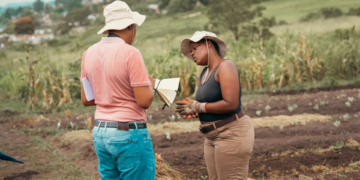
As South Africa works to strengthen its agricultural sector and support the growth of new-era farmers, one critical profession remains overlooked: agricultural extension. Despite its vital role in bridging the gap between scientific research and practical farming, extension services are often underfunded, undervalued, and misunderstood.
The government’s recent commitment to create 10 000 new extension officer positions highlights a renewed awareness of the crucial need for hands-on support in a farming sector grappling with deep inequalities, climate challenges, and rapid technological changes.
However, farmers today need extension officers who are better equipped to meet the demands of an evolving agricultural sector.
To unpack this, Food For Mzansi sat down with Ngoakoana Chokoe, senior lecturer and acting deputy head of agricultural management at Elsenburg Agricultural Training Institute in the Western Cape.
Related stories
- More resources, empowerment needed for extension officers
- Farm extension services key to inclusive agricultural success
- NW conference charts future of extension services
Patricia Tembo: Why are extension services still relevant in today’s agricultural landscape?
Ngoakoana Chokoe: Extension services remain incredibly important, especially considering the diversity of our farming systems. That’s why the national government has committed to creating around 10 000 extension jobs. It’s a clear indication that the need is still there.
With how much agriculture and technology have evolved, today’s extension officers must approach their work differently. Their mindset has to shift.
We’re in an era where farmers consult tools like ChatGPT and the internet for advice. So, extension officers need to be equipped to navigate and complement that digital landscape.
In terms of training agricultural extension professionals, what should be the focus?
We need more of a practical field component. I used to tell my students that I wish they could actually go into communities, not necessarily to give advice, but just to immerse themselves in the farming environment. See how things work, observe the social structures, and understand how people interact with each other. That way, when they do eventually go into communities or farms, they’re equipped with the skills to communicate with farmers and share information effectively.
Extension is a completely different story when you’ve had that kind of exposure. It would help so much if we could have a proper work-integrated learning component for extension. That’s something I’ve been advocating for, and I hope it’s something they plan to implement.
READ NEXT: How to compile a winning agribusiness plan
What do you think is necessary to make extension services more effective in today’s farming?
There is a need for more emphasis on the current challenges farmers are facing, such as climate change. Integrating emerging technologies into the training curricula is essential.
Equipping extension officers with the skills to design and deliver digital tools would greatly enhance their ability to support farmers effectively in today’s tech-driven agricultural environment. This kind of innovation could make a significant difference in how extension services are delivered and received.
Why do you think agricultural extension is often not seen as a priority profession within the sector?
Chokoe: Extension is very important. Unfortunately, I feel like it’s not well-marketed. People would rather go into production or something else, but not extension. Yet, it’s still such an important field, especially given the current situation in our country, where you have a massive divide between large commercial farms and many smallholder farms that still need support.
I think we just need to market it differently so that even with the 10 000 extension practitioners being brought in, we’re actually attracting the right people.
What went wrong with the implementation of the Assistant Agricultural Practitioners (AAP) programme?
The Assistant Agricultural Practitioners (AAP) process wasn’t managed properly. Initially, the idea was to bring people in on a three-month trial basis. But the issue was that these individuals weren’t hired as actual extension practitioners; they were meant to assist and support existing extension officers.
I think the problem started when the job descriptions weren’t clearly defined, which led to confusion about their roles. That’s ultimately where things began to fall apart. The budgetary constraints might have also contributed to it not being as effective. I am, however, happy to see it picking up currently.
READ NEXT: Foot-and-mouth disease: What farmers need to know