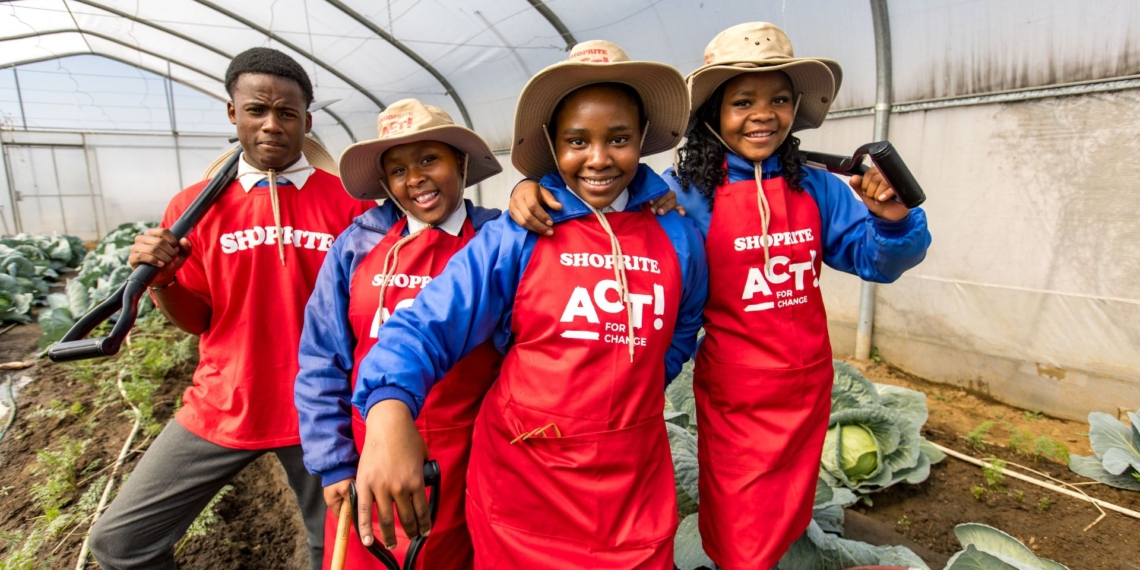
Inside two horticultural tunnels in the heart of Reiger Park, east of Johannesburg, rows of spinach, cabbage, tomatoes, green peppers, chillies and eggplant flourish at Oosrand Commerce and Entrepreneurship School.
But its greatest achievement is nurturing a generation of young farmers learning how to cultivate livelihoods, strengthen their communities by improving food security, and develop entrepreneurial skills through agricultural studies.
Before the tunnels were built, the school’s agricultural studies lessons were largely theoretical. The Shoprite Foundation stated that since it established the tunnels two years ago, learners have gained hands-on, practical experience and harvested approximately 5 000 units of crops.
Growing and inspiring the younger generation
Agricultural studies educator Joyce Ngcobo, said the school now harvests enough produce to supply the wider Reiger Park community and neighbouring Ramaphosa informal settlement, with spinach proving to be a best-seller.
The tunnels are large enough to accommodate her entire class of 42 learners for practical lessons, something the school’s previous, smaller tunnel could not do. Learners take these skills home, growing seedlings in their own yards, where space allows, and selling produce to neighbours.

Left to right: Dinakwe Tsholofelo, Joyce Ngcobo and Palesa Matshidiso. Photo: Shoprite
Sales from the produce support the programme with gardening resources such as compost and seedlings, while the harvest also supplements the school feeding scheme, with meals prepared by kitchen employees who provide lunch to about 90% of the school’s 2 200 learners.
Ngcobo said parents are learning from their children how to plant vegetables and to water gardens in the evening rather than during the heat of the day.
She said teaching agriculture has challenged her own perception that farming was only for men. She now hopes to inspire young women to believe they can own farms, pursue careers in agriculture, and contribute to food security, gender equality and job creation.
Looking ahead, Ngcobo hopes that in 10 years she will be recognised as an educator who has shown young people that.
“You can’t live on someone’s salary. You need to do something for yourself,” she said.
Related stories
- Small-scale food gardens win big in Shoprite’s Act For Change
- Food gardens feed learning and hope across Mzansi
- Record maize, soybean harvests reshape export outlook
- SA food inflation slows, but rising costs squeeze farmers
When agriculture was added to the school’s curriculum, former natural sciences and life sciences teacher Farida Beckweitz jumped at the opportunity to teach it. The mother of two is also an alumna of the school.
She beams with pride when speaking about the school’s achievements. Earlier this year, Beckweitz and Ngcobo qualified as occupational trainers – teachers who are trained to help learners gain practical skills that focus on workplace standards and technical expertise.
The next goal, Beckweitz noted, is for learners to leave school with more than a matric certificate. Learners can also obtain qualifications in plant production. In the programme’s first cohort, nine of the 10 learners graduated with level 1 and level 2 crop production certificates.
Empowering girls to break stereotypes
Since 2024, more than 1 700 learners have gone through practical agricultural training. Over the long term, the school hopes to extend this training to unemployed parents in the community.

Learner Sefaga Diketso watering the garden. Photo: Shoprite
“There’s nothing that can take away that feeling of having your hands inside the soil, getting them dirty. Seeing their (learners) pride when the vegetables are still small, and then next time we go they see the progress, how they’ve grown, and they know they had a part in that,” Beckweitz said.
Beckweitz added that the school deliberately recruited mostly girls into the programme. “We were biased, and we chose our learners mostly girls. Today, girls outnumber boys in the programme, helping to challenge long-held stereotypes and shape identity about who belongs in agriculture,” she said.
Maude Modise, director of the Shoprite Foundation, said what these horticultural tunnels have achieved in just two years shows the lasting impact of practical education.
“Beyond the harvests, we’ve seen learners gain confidence, while the school and surrounding communities have benefited from fresh produce. Educators like Joyce Ngcobo and Farida Beckweitz are at the heart of that success, inspiring more young people, especially girls, to see agriculture as a career with potential,” Modise said.
Former learner Sello Mokena, from the Ramaphosa informal settlement, says the agriculture programme nurtured his love for farming. He has transformed his small backyard into a thriving vegetable garden and donates the produce to a local school.
“I fell in love with agriculture, and it’s my passion to help people,” he said.
READ NEXT: SA food inflation slows, but rising costs squeeze farmers