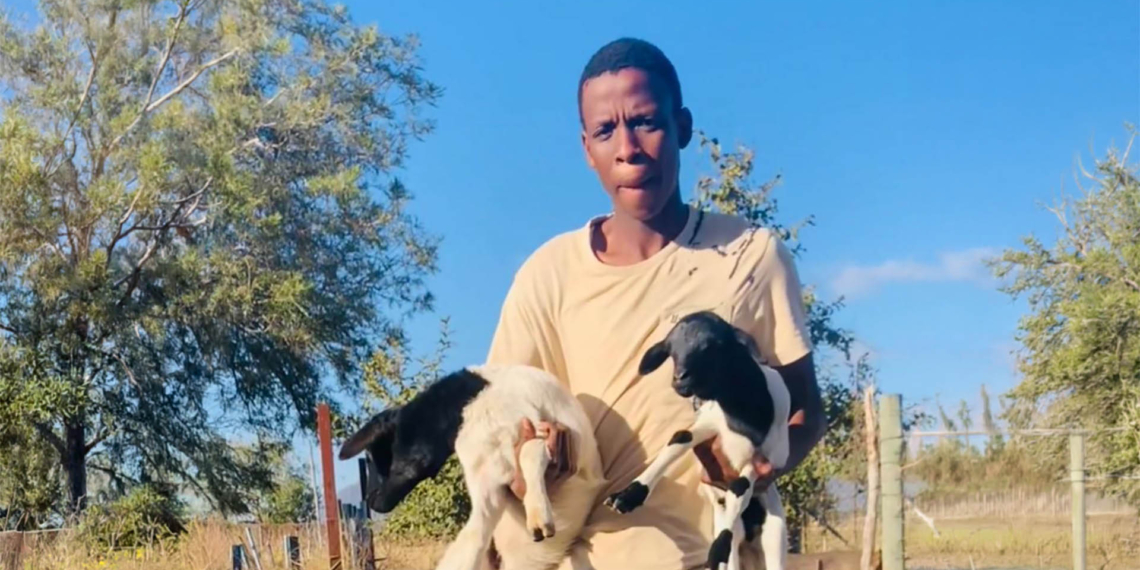
Driven by a fierce desire to secure his family’s economic future, Molatelo Morena, the founder of S.S Moepathutse, is completely redefining youth entrepreneurship from his home village of Sekiding in Bochum, Limpopo.
Through absolute financial discipline, this young farmer leveraged a saved social grant allowance to turn a two-year savings plan into a growing dual-production agribusiness specialising in livestock and traditional grain.
Morena’s agricultural roots run deep. His parents, Moses and Diana, ran a modest farming operation as the primary source of income to put bread on the table during his childhood.
Growing up alongside the family fields, Morena attended Mamopte Primary School and later Mahlase Secondary School, where he matriculated in 2022. It was during these final high school years, as he witnessed the escalating financial pressures at home, that a quiet ambition began to take shape.
Related stories
- Self-taught EC farmer builds 6-hectare agribusiness from scratch
- Ex-cop beats poisoning disaster to build growing livestock business
- ‘Cayenne Chilli Lady’ brings the heat with 8.5ha farming success
- Simemo Nkosi grows family farm into diversified enterprise
The power of a gap year
While many of his peers looked for immediate employment or faced uncertainty after matric, Morena began executing a meticulous savings strategy.
“The money I saved came from the social relief of distress (SRD) grant,” Morena recalls. “At R350 a month at the time, I managed two years of disciplined saving to accumulate R8 400 by 2023.”
Armed with his hard-earned savings, he made a bold, calculated decision to pause his academic journey and pour his energy into the soil.
“I decided to take a gap year after my matric, and that’s where I started,” he explains. “I utilised my father’s land, which was not being used because my parents lacked the financial resources and the physical energy to work it as they grew older. My family gave me their full support.”
With his parents’ enthusiastic approval, Morena stepped onto the four-hectare plot alone. Capitalising on local staple food trends, he focused his initial efforts on pearl millet, a highly popular crop across the community used to grind flour for traditional porridge. He sold the raw crop directly to villagers eager for fresh, local grain.
The market response was immediate. “My product was in such high demand that I quickly managed to secure customers who bought in bulk,” he says.

Diversification and balancing the books
The momentum gained from his early grain harvests allowed Morena to diversify his operations. In 2024, he bought two sheep and dedicated two more hectares of land to the livestock, strategically building a herd to buffer his seasonal crop income and drive production efficiency across the farm.
His flock management strategy is highly cyclical and self-sustaining.
“When my sheep produce young rams, I sell them so that I can buy more ewes to increase the breeding size of the business,” Morena says.
“Some of the livestock profits go toward buying necessary medication for the herd, while others are saved so I can hire a tractor to prepare and cultivate my millet crop properly.”
Remarkably, Morena is orchestrating this farm growth while simultaneously pursuing higher education. The same year he introduced livestock, he enrolled at Capricorn TVET College in Polokwane to study transport logistics.
Strict time management is the glue holding his demanding schedule together.
“Pearl is highly seasonal, so I only plant it between November and December. Because of this, I can focus entirely on my studies during the week and use my weekends to manage the intensive farm work.”
While some students view graduation as a stepping stone into corporate life, Morena’s corporate plans have a strict expiration date.
“After completing my studies, my long-term plan is to go straight back to farming full-time,” he says. “I won’t leave the land. My plan is to work in logistics for up to six years just to collect enough capital to make my family financially stable and then pour everything back into the business.”
Showing grit through village challenges
This forward-thinking mindset is exactly why Morena is already treating his village venture as a serious corporate entity rather than a casual side project. In September 2025, he officially registered his agribusiness under the name S.S Moepathutse.
While the newly registered business does not yet employ permanent workers, his family steps in to provide crucial hands-on support during peak labour periods and heavy harvests.
Yet, formalising the business is only half the battle, as navigating the realities of rural farming presents a continuous test of grit.
“This particular crop [pearl millet] is a favourite for birds, so if I’m not actively protecting it, they will destroy the harvest,” Morena admits. “I have to constantly invest in protective covering nets. Climate patterns are another hurdle, which is why I specifically plant in November when the chances of rainfall are highest.”
Despite these operational hurdles, his ultimate vision remains unshakeable. The young producer hopes to evolve from a raw grain supplier into a commercial agroprocessor, with plans to manufacture his own brand of instant pearl millet porridge.
His advice to the next generation?
“You have to be completely ready for the challenges because farming is truly not for the weak. It requires someone who pays absolute attention to detail, and above all, you must genuinely love the work you do.”
READ NEXT: Will new black warning labels on food save lives or hurt farming?