Southern Africa already has many of the tools and ideas needed to build a climate-resilient food system, writes Ivor Price. The real challenge is turning proven solutions into everyday practice by putting farmers first and aligning finance, technology, policy and markets around what works.
I left the High-Level SADC Food Systems Transformation Policy Dialogue in Durban with a familiar feeling, but also a renewed sense of urgency. Southern Africa knows more than we sometimes give ourselves credit for.
Across the region, farmers, researchers, financial institutions, development organisations and governments have already tested approaches that can make agriculture more resilient to climate shocks. We have data. We have technology. We have farmers innovating every day.
So the question is increasingly not whether we know what needs to be done.
It is whether we can organise ourselves well enough to do it at scale.
I had the privilege of moderating a panel on scaling proven climate-smart technologies for agricultural resilience, as part of the special session convened by Kagiso Trust during the dialogue. The session brought together perspectives from climate science, agriculture, finance, research and the farming community.
What struck me was not how different the perspectives were, but how much they converged.
Make resilience pay
The first principle is simple: climate-smart agriculture has to make economic sense. We cannot turn climate resilience into another development project with a short funding cycle and a clever acronym.
Farmers are not resistant to change. They are rational.
They will adopt practices that make their farms more productive, resilient and profitable. The challenge comes when the ecological benefits of a transition are clear, but the financial returns take longer to materialise. We cannot ask farmers to carry the cost of building resilience while the rest of the system continues to operate on short-term financial cycles.
If healthy soils, diversified production and resilient ecosystems are productive assets, then our financial systems need to treat them as such.
That means patient capital, better risk-sharing and financial products designed around agricultural realities. It also means recognising that responsible farming is not simply an environmental virtue. Increasingly, it is a question of financial risk.
Put farmers before technology
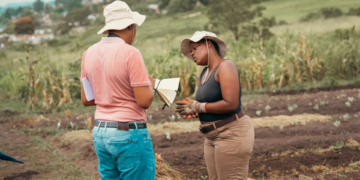
The second principle is that technology must serve the farmer, not the other way around.
We need to be careful not to confuse technological sophistication with progress.
For a large commercial farm, precision machinery and advanced digital systems may be transformational. For a smallholder farmer, a very different intervention may deliver far greater value.
The starting point should therefore be the farmer’s problem, not the technology provider’s product.
Understand the problem. Co-design the solution. Test it in real conditions. Build the financial model around it. Then scale what works.
The same applies to data.
Southern Africa does not necessarily suffer from a lack of climate and agricultural information. In many cases, we have more data than we know what to do with.
The challenge is connecting it to decisions.
Farmers need information they can understand and act on. Early-warning systems must become early-action systems. Climate intelligence must reach the people deciding when to plant, what to plant, how to manage livestock, where to invest and how to respond to risk.
Digital technology has an enormous role to play, but the technology is not the point.
The outcome is. Better decisions. Earlier decisions. Lower risk.
Stop working in silos
The third principle is perhaps the most difficult: we cannot scale climate-smart agriculture while continuing to work in silos.
Government cannot do it alone. Banks cannot do it alone. Researchers cannot do it alone. Farmers cannot do it alone. Neither can development partners or the private sector.
The pieces have to connect.
Policy must support innovation. Finance must support transition. Research must respond to farmers. Extension must carry knowledge into communities. Infrastructure must make adoption possible. Data must inform decisions. Markets must reward responsible production.
This is where SADC has a particularly important opportunity.
Climate does not respect borders. Neither do food markets, agricultural value chains or many of the risks facing farmers.
Regional cooperation can help us share what works, align policy, transfer knowledge and technology, and unlock investment at a scale individual countries may struggle to achieve.
But there is an even bigger opportunity here.
We often talk about African agriculture as a problem to be solved. I think we need to become much more confident about talking about agriculture as an opportunity to be unlocked.
An opportunity to feed a growing population. Create jobs. Build rural economies. Restore degraded land. Develop new businesses around climate resilience. And make farming more attractive to a new generation.
One phrase from the discussion captured that shift in thinking for me:
Don’t sell agriculture. Sell the opportunities within agriculture.
That is also why resilience should not be understood simply as surviving the next climate shock.
Resilience is an investment in the future of the food system.
It is built in the soil. Through diversification. Through better information. Through responsible farming. Through patient investment. And through stronger relationships between farmers and the institutions that are supposed to serve them.
The real test of this dialogue will not be what was said in the room. It will be what happens when we leave the room.
Can we take what we already know works and make it easier, cheaper and less risky for farmers to adopt? Can we put farmers at the centre rather than at the end of the innovation chain?
Can we align policy, finance, science, technology and markets behind the same objective? And can we stop celebrating pilots and start celebrating scale?
For me, that is the work ahead. Because the future of Southern African agriculture will not be determined by how many good ideas we generate.
It will be determined by how effectively we turn the good ideas we already have into everyday practice.
- Ivor Price is co-founder and managing director of Food For Mzansi Group.
READ NEXT: SADC experts urge smarter, more inclusive climate-smart tech