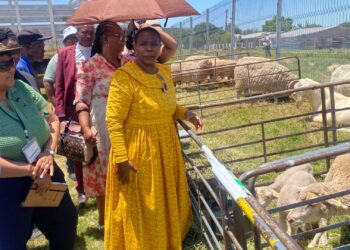
Deputy minister of trade, industry, and competition, Zuko Godlimpi, along with deputy minister of agriculture, Nokuzola Capa, led an executive oversight meeting on the Poultry Sector Master Plan. The discussion focused on assessing the progress of the plan’s first phase and exploring ways in which the government can provide further support.
Delivering the progress report, the chief director of agro-processing and forestry-based industries at the department of trade, industry and competition, Ncumisa Mcata-Mhlauli, confirmed that since the inception of phase one, the poultry industry has retained 52 930 direct jobs.
Mcata-Mhauli said it shows the industry’s critical role in bolstering employment and contributing to South Africa’s economic growth.
Investing in the poultry industry
“These are the stakeholders that have been involved in terms of the formulation of the master plan. That includes government departments, development finance institutions (DFIs), farmers’ associations, feed manufacturers, labour, and private sector partners,” she said.
The meeting highlighted the investments directed towards infrastructure development and industry support, exceeding initial targets.
“There was a case made by the South African Poultry Association (Sapa) for R1.5 billion to support their processing facilities and infrastructure. That target has been exceeded, with almost R2.02 billion allocated by major players in the industry,” she said.
Related stories
- Funding boost propels Tzaneen poultry farmer to new heights
- Poultry farming: Essential insights to boost your production
Further demonstrating the government’s commitment to industry growth, Mcata-Mhlauli detailed financial interventions supporting emerging poultry businesses.
“Through the Industrial Development Corporation and the department of agriculture, land reform and rural development Agri-Industrial Fund, a total of R1.2 billion has been invested in 14 poultry projects.
“The Land Bank has also approved two projects valued at R31 million, while the Comprehensive Agricultural Support Program (Casp) has backed 42 initiatives aimed at empowering small-scale farmers,” she said.
According to the department, discussions also focused on expanding exports, improving affordability, and strengthening biosecurity measures to mitigate disease outbreaks affecting the industry.
Reaching poultry farmers across SA
“As phase 2 progresses, stakeholders remain committed to supporting black-owned enterprises, increasing local production, and sustaining employment.
“With a total investment commitment of R635 million the poultry master plan continues to be a flagship initiative driving transformation and growth in the agricultural sector,” Mcata-Mhlauli said.
Meanwhile, Lesego Mopuetso, a poultry farmer from Welkom in the Free State, said it is important government information filters through to as many farmers as possible.
“What is important for us in rural provinces is that decisions and initiatives that government takes need to come to us as farmers. Some of us are fortunate to have an understanding of what the master plan is but others do not. The government needs to come to the ground and inform us of what is happening in different commodities.
“It is a good thing that the master plan has saved jobs, that is important and can never be underestimated, however, the industry is operating under extremely difficult conditions. We are forever working in fear; if it is not excessive heat or rainy conditions it is load shedding which has just made a comeback,” he said.
READ NEXT: SA farmers navigate global supply chain disruptions
Sign up for Mzansi Today: Your daily take on the news and happenings from the agriculture value chain.