Saturday, February 21, 2026
SUBSCRIBE
21 GLOBAL MEDIA AWARDS
Food For Mzansi
  • News
  • Changemakers
  • Lifestyle
  • Farmer’s Inside Track
  • Food for Thought
No Result
View All Result
  • News
  • Changemakers
  • Lifestyle
  • Farmer’s Inside Track
  • Food for Thought
No Result
View All Result
Food For Mzansi
No Result
View All Result
in News

China tariff cuts to boost SA apple and pear exports

With apple and pear exports to China up 35% year-on-year, Tru-Cape says the new CAEPA agreement marks a turning point for the fruit industry. The deal will phase out China’s 10% import tariff on local apples and pears, levelling the playing field for South African producers

by Staff Reporter
21st February 2026
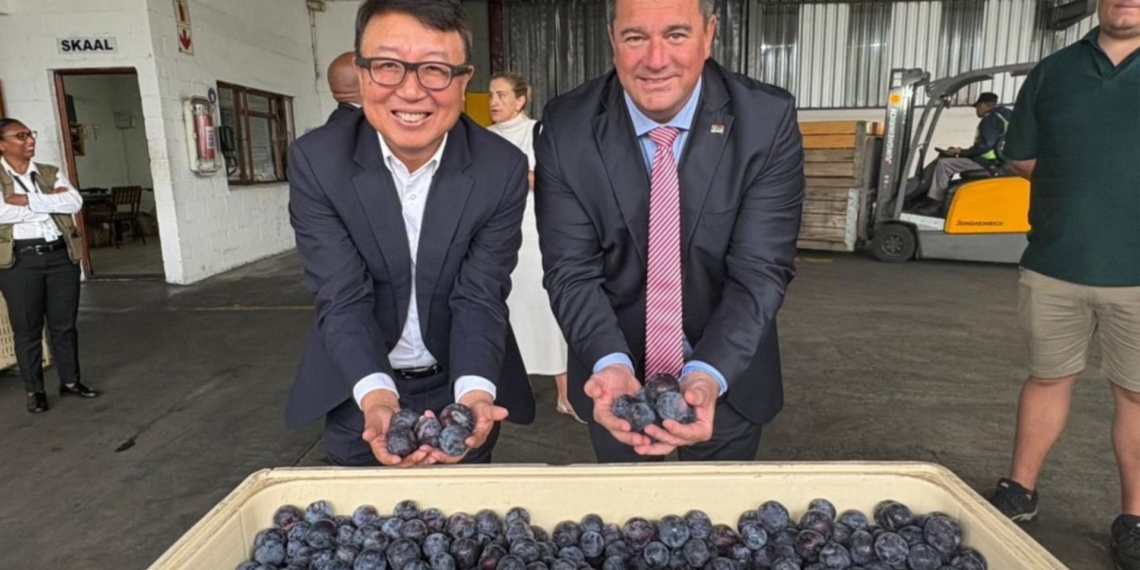
Minister of agriculture, John Steenhuisen, accompanied by ambassador Wu Peng of the People’s Republic of China, at the Freshness First Pack-house in Franschhoek. Photo: Tru-Cape

Minister of agriculture, John Steenhuisen, accompanied by ambassador Wu Peng of the People’s Republic of China, at the Freshness First Pack-house in Franschhoek. Photo: Tru-Cape

Share on FacebookShare on TwitterShare on WhatsApp

Tru-Cape has welcomed the recent signing of the CAEPA agreement between the department of trade, industry and competition and China, describing it as a significant and encouraging step toward strengthening bilateral trade and expanding opportunities for South African agricultural exports.

The deal saw a historic milestone as the first stone fruit shipment departed for China.

The Chinese market opened to South African apples in 2015 and to pears in late 2021. Although initial export volumes were modest, shipments have grown exponentially as relationships have developed and market understanding has deepened.

“Between 2024 and 2025, Tru-Cape’s volumes to China increased by 35%. While China still represents a relatively small share of our total apple and pear exports, it is extremely encouraging to see this consistent upward trajectory as we gain a better understanding of the Chinese retail environment, supply chain requirements, cold chain management, and client expectations.

“This positions us well for further expansion, particularly in the event of more favourable market access conditions,” said Roelf Pienaar, Managing Director of Tru-Cape.

Levelling the playing field for SA fruit

South African apple and pear exports to China are currently subject to a 10% import tariff. Under the new comprehensive economic partnership agreement (CAEPA), this will progressively be reduced to zero, with full duty-free treatment scheduled for implementation on 1 May 2026.

“If we can compete on an equal trade footing with key competitors in the East, such as New Zealand, it will create a level playing field and significantly enhance our competitiveness,” Pienaar said.

He said there was a strong potential in the Chinese market for Gala apples, including Flash Gala and Royal Beaut, as well as Envy, Fuji and Forelle pears, among other premium varieties.


Related stories
  • Landmark season as Flash Gala apples break records
  • SA’s Flash Gala apples take a bite out of Indian market
  • Pork prices rise as disease outbreaks tighten supply
  • South Africa eyes bumper grain and soybean crops

High import duties weaken position in global markets

While celebrating this progress, Pienaar emphasised that further trade agreements and tariff reforms are essential to ensure broader market access diversification. He highlighted India as a priority market with substantial potential, where South African apples currently face a 50% import tariff and pears are subject to duties of between 30% and 35%.

He also pointed out that South African apples and pears are subject to higher tariff barriers in the United Kingdom and across European Union markets compared to major Southern Hemisphere competitors.

“The fact that South Africa is subjected to significantly higher tariffs than our biggest Southern Hemisphere competitors makes a material difference to our global competitiveness. More favourable tariff agreements would not only strengthen our position in international markets but would also place more funds in producers’ hands for on-farm investment and, ultimately, job creation.

“Tariffs directly affect the final sales price of our products. We must manage both prices and costs extremely carefully to remain competitive in leading export markets, and in many cases, this pressure stems purely from duties, not from any value addition. High tariffs can even influence planting decisions, with producers potentially favouring varieties destined for lower-tariff markets instead of those in highest global demand,” he said.

New markets are crucial

Pienaar further stressed the importance of diversifying access to markets not yet open to South African apples and pears. More than a decade ago, Tru-Cape’s Far East programme was largely concentrated in Malaysia and Singapore. Today, expanded access to China, Indonesia, Thailand, Vietnam, Sri Lanka and Bangladesh has significantly reshaped the export landscape.

“It is vital that we are able to market the entire apple and pear bin. Access to multiple markets creates alternatives for placing different varieties, sizes and grades. Over-reliance on a single market is never advisable; diversification allows us to spread risk, manage debtor exposure and build a more resilient industry,” he said.

The industry is hopeful of gaining access to the Philippines in the near future, while Pienaar added that Taiwan should be reopened to South African apples. 

READ NEXT: Expert urges farmers to leverage ‘good debt’ for growth

Sign-up for the latest agricultural news delivered straight to your inbox every day with Mzansi Today!

Staff Reporter

Researched and written by our team of writers and editors.

Tags: Agricultural exportsChinaFuture-focused farmerInform meTru-Cape

Related Posts

High-tech DNA instrument  strengthens SA’s livestock industry

High-tech DNA instrument strengthens SA’s livestock industry

21st February 2026
Agri jobs rise, yet small-scale farmers still struggle

Agri jobs rise, yet small-scale farmers still struggle

20th February 2026

Rooibos industry holds its ground amid climate uncertainty

Beyond sugar: How SA’s farmers are crushing it with diversification

South Africa eyes bumper grain and soybean crops

Meat is safe to eat despite FMD outbreak, assure experts

Expert urges farmers to leverage ‘good debt’ for growth
Pork prices rise as disease outbreaks tighten supply

Choosing the right maize variety for South African conditions is key to boosting yield, resilience, and profitability.
News

South Africa eyes bumper grain and soybean crops

by Staff Reporter
19th February 2026

Favourable weather and robust yields could see South Africa’s maize production nearing 17 million tons and soybeans reaching 3 million...

Read moreDetails

Traditional medicinal plants offer hope for men’s health

18th February 2026
Pomegranate pioneer: Debbie Theunissen’s rise in fruit farming

Pomegranate pioneer: Debbie Theunissen’s rise in fruit farming

18th February 2026
Red Meat Industry Services (RMIS) advocates for methods that can revolutionise red meat production, ensuring sustainable resource use and nourishing nations. Photo: Supplied/Food For Mzansi

Meat is safe to eat despite FMD outbreak, assure experts

18th February 2026
Financial literacy: A gateway for farmers who dream big

Expert urges farmers to leverage ‘good debt’ for growth

18th February 2026

Agri jobs rise, yet small-scale farmers still struggle

Beyond sugar: How SA’s farmers are crushing it with diversification

Meat is safe to eat despite FMD outbreak, assure experts

Cane to craft: Brad O’Neil blends legacy and innovation in sugar

South Africa eyes bumper grain and soybean crops

Join Food For Mzansi's WhatsApp channel for the latest updates!

JOIN NOW!
Next Post
High-tech DNA instrument  strengthens SA’s livestock industry

High-tech DNA instrument strengthens SA’s livestock industry

THE NEW FACE OF SOUTH AFRICAN AGRICULTURE

With 21 global awards in the first six years of its existence, Food For Mzansi is much more than an agriculture publication. It is a movement, unashamedly saluting the unsung heroes of South African agriculture. We believe in the power of agriculture to promote nation building and social cohesion by telling stories that are often overlooked by broader society.

High-tech DNA instrument strengthens SA’s livestock industry

China tariff cuts to boost SA apple and pear exports

High seas to harvest: Nonjabulo navigates new path in Ndwedwe

Agri jobs rise, yet small-scale farmers still struggle

Rooibos industry holds its ground amid climate uncertainty

How Dr Sokombela grew from top learner to agricultural scientist

  • Awards & Global Impact
  • Our Story
  • Contact Us
  • Cookie Policy
  • Privacy Policy
  • Copyright

Contact us
Office: +27 21 879 1824
News: info@foodformzansi.co.za
Advertising: sales@foodformzansi.co.za

Contact us
Office: +27 21 879 1824
News: info@foodformzansi.co.za
Advertising: sales@foodformzansi.co.za

  • Awards & Global Impact
  • Our Story
  • Contact Us
  • Cookie Policy
  • Privacy Policy
  • Copyright
No Result
View All Result
  • News
  • Changemakers
  • Lifestyle
  • Farmer’s Inside Track
  • Food for Thought

Copyright © 2024 Food for Mzansi

This website uses cookies. By continuing to use this website you are giving consent to cookies being used. Visit our Privacy and Cookie Policy.