Tuesday, December 9, 2025
SUBSCRIBE
21 GLOBAL MEDIA AWARDS
Food For Mzansi
  • News
  • Changemakers
  • Lifestyle
  • Farmer’s Inside Track
  • Food for Thought
No Result
View All Result
  • News
  • Changemakers
  • Lifestyle
  • Farmer’s Inside Track
  • Food for Thought
No Result
View All Result
Food For Mzansi
No Result
View All Result
in News

Doyer warns: SA’s farmers face regulatory overload

Dr Tobias Doyer, the CEO of Grain SA, says South Africa’s outdated regulations are crippling farmers and entrepreneurs. He urges government to stop treating them as risks and start enabling growth

by Ivor Price
23rd July 2025
South Africa’s outdated regulations are stifling growth for farmers and entrepreneurs. Government must shift from seeing them as risks to recognising their role in driving the economy, warns Grain SA CEO Dr Tobias Doyer. Photo: Supplied/Food For Mzansi

South Africa’s outdated regulations are stifling growth for farmers and entrepreneurs. Government must shift from seeing them as risks to recognising their role in driving the economy, warns Grain SA CEO Dr Tobias Doyer. Photo: Supplied/Food For Mzansi

Share on FacebookShare on TwitterShare on WhatsApp

South African farmers and small business owners are being pushed to the brink by an outdated and burdensome regulatory system, warns Dr Tobias Doyer, CEO of the Grain SA Group. In a hard-hitting opinion piece shared on LinkedIn, he calls for urgent regulatory reform to safeguard the very enterprises driving South Africa’s economy.

Doyer expressed measured optimism about a possible shift in government’s regulatory stance, following minister of agriculture John Steenhuisen’s decision to revoke the designation of Leaf Services – an unpopular and costly grain testing contractor.

“I was very encouraged by an apparent change in approach towards regulations by government when minister John Steenhuisen revoked the designation of Leaf Services,” said Doyer.

However, that optimism is tempered by continued frustration over what he describes as a regulatory environment that is stifling growth and exhausting entrepreneurs and farmers alike. “I know I shouldn’t write when I’m frustrated. But sometimes things simply need to be said,” he wrote.

Dr Tobias Doyer, CEO of Grain SA. Photo: Supplied/Grain SA/X

Farmers are also SMEs

Drawing from personal experience, Doyer reflects on his early years on the family farm, where he had to juggle both agricultural duties and administrative red tape. “The regulatory burden seems to be increasing exponentially. It’s not just farming. It’s full-spectrum entrepreneurship,” he said.

Today, he argues, farmers wear multiple hats – as employers, mechanics, risk managers, and financiers – but without the institutional support enjoyed by corporates.

“Every one of those tasks had a team behind it… But the farmer? Or any SME owner? They carry all of that alone – or subcontract every sliver of it, at a cost they can barely afford.”


Related stories
  • Grain SA appoints Mabuza to lead farmer development
  • Grain SA CEO calls for overhaul in agricultural education

Real-world consequences

Doyer paints a vivid picture of the daily pressures faced by South African producers: delayed VAT refunds, audited diesel rebates, and the constant pull between compliance and critical operations. 

“This isn’t just a farming issue. It’s an SME crisis. And it’s happening everywhere,” he warned.

These challenges have direct economic consequences. Citing data from SEDA, the World Bank, and the ILO, Doyer notes that SMEs account for nearly 40% of South Africa’s GDP and 60% of private sector employment. 

While large companies can absorb the cost of compliance via in-house teams and legal experts, the same rules overwhelm smaller enterprises, Doyer argues. “The same regulatory rules are ‘copy-pasted’ for small and medium businesses, small farms, and township start-ups. And it breaks them.”

According to Doyer, it’s not a question of willingness to comply – but a mismatch between design and reality. 

“The system was built for companies with back offices, not back roads,” he said. “If you need to pay someone to manage your diesel claims, VAT, UIF, skills plans, HR, tax, BEE, and labour compliance… you’re not building a business anymore. You’re just paying to feed the bureaucracy.”

A smarter path forward

Doyer is not asking for special treatment, but for smart, scalable and inclusive regulation. He cites New Zealand as an example of a country that has successfully introduced dedicated policies to reduce red tape for small businesses.

He proposes practical reforms, including:

  • Scaled compliance and simplified processes tailored to small enterprises;
  • Faster VAT and diesel refunds for low-risk, compliant taxpayers;
  • Risk-based audit frameworks to avoid blanket penalties;
  • Access to digital tools that streamline rather than complicate compliance;
  • Real involvement of SME voices in the co-design – not just consultation – of regulations.

At the heart of his message is a call to reframe how government and society view SMEs and farmers “We must start treating SMEs – especially our farmers – not as outliers or tax risks, but as the engine of economic recovery.”

He concluded with a stark warning: if South Africa is serious about transformation, job creation, and rural development, then fixing the regulatory system must be a top priority. He urged policymakers to rethink how SMEs are regulated and taxed, especially in agriculture, warning that the current system is pushing entrepreneurs out of business.

“Let’s build a system that recognises the reality of a single entrepreneur doing the work of ten people. Because that’s who’s holding up the economy.”

READ NEXT: Proposed Transformation Fund needs clarity to drive real change

Sign-up for the latest agricultural news delivered straight to your inbox every day with Mzansi Today!

Ivor Price

Ivor Price is a multi-award-winning journalist and co-founder of Food For Mzansi.

Tags: black farmer developmentCommercialised farmerGrain SAInform me

Related Posts

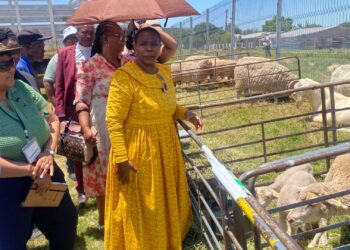
From dairy to wool and fruit to meat, the Chris Hani District Agricultural Show celebrated the power of local production. Photo: Supplied/Food For Mzansi

Farmers and financiers unite to grow EC agribusiness

9th December 2025
Jean Vincent Ridon and his son, William, co-founded the Beer Trophy Awards in 2015, at the dawn of the craft beer era. Photo: Danie Nel and Gareth Davies

How beer powers SA’s economy from farm to pint

8th December 2025

This week’s agri events: 08 – 12 December

New Plant Improvement Act to boost SA crop quality

Joburg Market shines with three consecutive clean audits

New RMIS research targets FMD, stock theft & market growth

World Soil Day shines light on degraded farmland

Fraud exposed at Fort Hare’s Honeydale Research Farm

From Kenya to South Sudan, pastoralists are using digital tools, traditional knowledge and local cooperation to manage scarce resources and strengthen resilience. Photo: Ansar Photography/Pexels
Climate Change

How pastoralists are redefining survival in Africa’s drylands

by Claire Bedelian and Guy Jobbins
7th December 2025

About 60% of Africa is dryland, home to half a billion people. However, pastoralists and farmers are using innovation, mobility,...

Read moreDetails
Dr Ndeke Musee

Farming with nature: The hidden power behind food security

6th December 2025
Screenshot

After the field: Safe practices when the day is done

6th December 2025
The new Plant Improvement Act mandates stricter quality standards and a national listing for plant varieties. This protects farmers by ensuring the seeds and propagating material they buy are up to scratch. Photo: Supplied/Food For Mzansi

New Plant Improvement Act to boost SA crop quality

6th December 2025
Nkosinathi Baloyi, chartered cccountant and chief financial officer of Joburg Market, Africa’s largest fresh produce hub. Photo: Supplied/Food For Mzansi

Joburg Market shines with three consecutive clean audits

5th December 2025

Drone spraying cuts costs, boosts yields for KZN sugarcane co-op

Millions missing from Fort Hare’s Nguni cattle programme

Joburg Market shines with three consecutive clean audits

New RMIS research targets FMD, stock theft & market growth

KwaNdaba farmer transforms food waste into farm wealth

Join Food For Mzansi's WhatsApp channel for the latest updates!

JOIN NOW!
Next Post
Government and communities need greater institutional support to make land reform succeed, believes Peter Setou, the CEO of the Vumelana Advisory Fund. Photo: Supplied/Food For Mzansi

Land reform failure: Ideas not the issue, delivery is

THE NEW FACE OF SOUTH AFRICAN AGRICULTURE

With 21 global awards in the first six years of its existence, Food For Mzansi is much more than an agriculture publication. It is a movement, unashamedly saluting the unsung heroes of South African agriculture. We believe in the power of agriculture to promote nation building and social cohesion by telling stories that are often overlooked by broader society.

Seed technology: How innovation drives higher yields & success

Ethical partnerships drive change in South Africa’s wine industry

KwaNdaba farmer transforms food waste into farm wealth

Farmers and financiers unite to grow EC agribusiness

Drone spraying cuts costs, boosts yields for KZN sugarcane co-op

Trash to triumph: Sukazi transforms wasteland into farmland

  • Awards & Global Impact
  • Our Story
  • Contact Us
  • Cookie Policy
  • Privacy Policy
  • Copyright

Contact us
Office: +27 21 879 1824
News: info@foodformzansi.co.za
Advertising: sales@foodformzansi.co.za

Contact us
Office: +27 21 879 1824
News: info@foodformzansi.co.za
Advertising: sales@foodformzansi.co.za

  • Awards & Global Impact
  • Our Story
  • Contact Us
  • Cookie Policy
  • Privacy Policy
  • Copyright
No Result
View All Result
  • News
  • Changemakers
  • Lifestyle
  • Farmer’s Inside Track
  • Food for Thought

Copyright © 2024 Food for Mzansi

This website uses cookies. By continuing to use this website you are giving consent to cookies being used. Visit our Privacy and Cookie Policy.