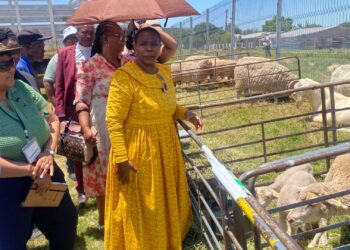
Delegates from across the globe have agreed that adopting conservation farming practices can improve the economic viability of farms. The sentiments where shared during the 9th World Congress on Conservation Agriculture in the Western Cape.
Farmers have given conservation farming the nod as it plays a crucial role in reducing input costs such as water, fertilisers, and pesticides, helping farmers to achieve higher profitability in the long run.
Danie Bester, a conservation farmer who farms livestock and crops in Mpumalanga, said he has tried to adapt to different types of farming from day one because he saw it as a long-term solution.
‘I needed to change’
“What really prompted me to change how we run our farms is increasing input costs, cost of machinery, [and] the ever-changing weather patterns which is a make-or-break dealer in farming.
“Importantly, looking at the potential of higher yield and sustainability which is key for having the farm intact for my children in the future,” he said.
Bester said he would not trade conservation farming for anything else as it has worked for him for many years despite facing challenges like weeds, compaction, fertility issues, and soil not aligning with the crops.
“However, even though I encountered such challenges, I decided to get in touch with like-minded farmers, gather information from credible sources, and I used the Nike motto ‘just do it’ mentality to those technical challenges.
“I believed that mistakes only show you have to try another way,” he said.
Bester explained that with the reality of climate change, he had to use a lot of technology-driven methods to ensure he increased his yields while also taking care of the land.
Related stories
- Climate change: Sub-Saharan Africa needs to up adaptation game
- Climate change: ‘Smart farming is the only way to go’ – farmers
Sustainability and raising awareness
Meanwhile, Cobus Bester, a crop farmer in Moorreesburg in the Western Cape, said the government needs to ensure conservation farming becomes sustainable. Awareness should also be raised because the the country’s growing population would need food while farmers face the effects of climate change, he added.
“My plea is that government should invest in agriculture with long-term choices that make financial sense. To those who want to get into conservation farming, my advice will be change your mindset. It is a mindset thing and everything will fall into place,” he said.
The acting chief director on natural resource management at the department of agriculture, Lydia Bosoga, said the government is prioritising farmer assistance with regard to climate change through different initiatives.
“We will continue to support farmers on climate change issues and ensure they work towards conservation agriculture to ensure a food-secure country,” she said.
A roadmap for climate resilience
Western Cape minister of agriculture, economic development and tourism Dr Ivan Meyer said his department will continue to play a pioneering and crucial role in promoting the adoption of conservation agriculture as best practice in its SmartAgri Plan.
“We want to mitigate and combat climate change in the province. We are proud of the department’s leadership in this area.
“The SmartAgri plan, the first provincial sector plan for agriculture in SA and the roadmap to climate change resilience was internationally and nationally acknowledged as a superb plan that was continuously and dynamically upgraded and implemented in our sector,” he said.
Meyer noted that long-term sustainable conservative agriculture is needed to deal with the climate change impact in the Western Cape. He said climate change is a permanent topic on the WC government’s agenda.
“To this congress, I can assure you that you will see the outcomes of this congress in our policies and goals of our departments,” Meyer vowed.
ALSO READ: Budget for a better climate response in agriculture, urge experts
Sign up for Mzansi Today: Your daily take on the news and happenings from the agriculture value chain.