Communities can thrive where they have access to their land, writes Peter Setou, chief executive of the Vumelana Advisory Fund. But access to land alone is not enough. In this piece he unpacks:
- Land restitution struggles for the Khomani San Communal Property Association.
- How access to land has created job opportunities for small rural communities.
- Why it is important communities are adequately supported on finalisation of their land claims.
Successful land reform can contribute towards boosting tourism in South Africa, argues the Vumelana Advisory Fund, a non-profit organisation that works with land reform beneficiaries to make their land productive by facilitating partnerships between communities and investors.
The Khomani San Communal Property Association (CPA), located in the Kgalakgadi Transfrontier Park and surrounds, is among one of the land reform beneficiary communities that Vumelana has supported. The community has evolved and grown to become an enterprise with the potential to become a renowned Heritage Site.
The community owns 25 000 ha of land within the Kgalagadi Transfrontier Park, and six farms south of the park totaling about 370 000 ha.
Land restitution struggles for the Khomani San community with respect to their rights inside as well as outside the Kgalagadi Transfrontier National Park, started when the Kalahari Gemsbok Park was proclaimed in the 1930s thus dispossessing the community of their land.
The eight Khomani San clans were scattered. Some settled in Namibia and Botswana, while others moved to nearby farms, and farms further afield in the Northern Cape.
Successful land redistribution story
According to Dirk Pienaar, the tourism and conservation officer of the Khomani San CPA, in 1995 the community lodged a land claim for the restitution of 45 000 ha in the Kalahari Gemsbok Park.
Pienaar says after years of negotiation and verification, the claim was finally settled on Human Rights Day, 21 March 1999. The settlement agreement paved the way for the transferring of the title deeds of six Kalahari farms (approximately 36 0000 ha) to the Khomani San CPA.
The six farms allocated and managed by the CPA committee include Miershoopan, Uitkoms, Andriesvale, Scotty’s Fort, Witdraai and Erin. The restitution process impacted primarily people of the San origin, according to Pienaar.
The CPA membership is now at 1 090 San descendants. Of them, about 600 live on the land while other members live elsewhere within the region as well as further afield in the Northern Cape, Pienaar said.
Today, the community has been able to derive several benefits from the restitution process, including gaining access to their land and job creation through tourism and hunting operations.
On the tourism front, successful ventures include the Erin Game Farm operation. The main source of income is derived from sustainable consumption and eco-tourism projects taking place on the property.
Leveraging opportunities
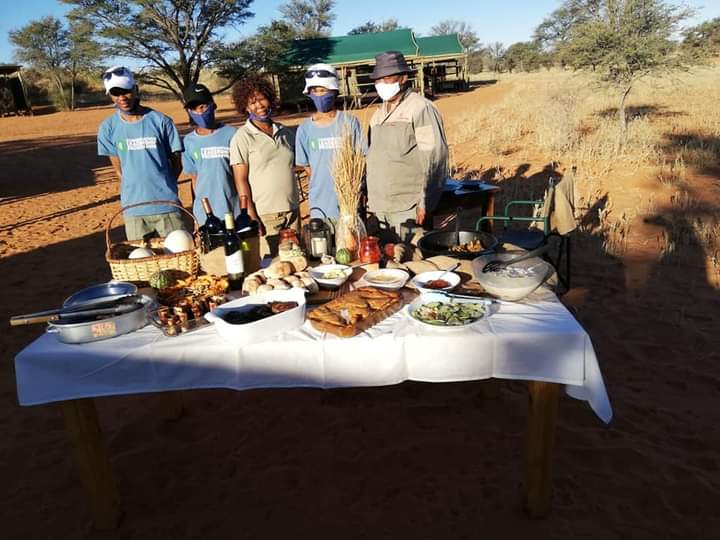
The community has been able to leverage other tourism opportunities on their land, including the creation of jobs through tracking guided walks and drives, hunting guides, skinners and meat processors, storytelling, craft making and sales as well as accommodation in the Erin Tented Camp.
Three female entrepreneurs also operate successful tourism businesses: Vinkie’s Kalahari Tours; Koera’s Farm Kitchen and Boesmanrust. Furthermore, the community has launched skills enhancement programmes for community members and these have helped enhance the livelihoods of community members.
Pienaar said working in collaboration with various stakeholders, donors and government departments, a number of programmes have been implemented.
Post-land claims support paramount
Over the past 10 years working with land reform communities, we have observed that communities can thrive where they have access to their land, and the requisite support from stakeholders, including government and the private sector.
Access to land alone is not enough, skills transfer, access to finance, access to markets and good governance are all important elements to enable the success of land reform.
To achieve this, partnerships with the private sector is crucial since they have access to capital, the skills and access to markets. These partnerships, however, do not happen naturally. Independent facilitation is required in order to ensure that the interests of the communities are safeguarded and the partnerships are sustainable.
Vumelana has been supporting communities in facilitating these partnerships and we believe that if more communities can be supported to mobilise private investments and secure partnerships, more restored land could be productive thus contribute to employment opportunities for the beneficiaries.
We are actively engaging with private sector players and other stakeholders who are willing to support our work to ensure sustainable land reform.
Where heritage land is involved in land restitution claims, it’s crucial that communities are adequately supported on finalisation of their land claims, provided with post-settlement support, as well as ensuring that existing jobs are saved and new ones are created – so that they too can benefit from the tourism proceeds from their land.
About 60% of the Khomani San people are semi-skilled. Communities have also engaged in acquiring basic filming, photography, skinning, game ranch assistant skills, guiding, tracking, and conflict management in order to take advantage of the opportunities that arise from the park activities.
The importance of protected land
With their land claim having been finalised, the community now have free access to the Kgalagaqdi Transfrontier Park. They are allowed to practice traditional hunting and gathering in the park, by arrangement between the community and the park offices.
The park is pegged as a World Heritage Site (WHS).
The community understands that this land is protected on a global level and that is very important for our future. We also understand that more benefits will accrue to the community, including job creation opportunities that will be derived from the WHS status, although that is still in process, Pienaar said.
The majority of the community understand that there can be limited use of the restored land inside the park due to it being a heritage site, Pienaar added. They accept that this protects their ancestral land for future generations, especially the sacred sites like the graves and heritage trees.
ALSO READ: Should vertical farming replace conventional farming?
Sign up for Mzansi Today: Your daily take on the news and happenings from the agriculture value chain.