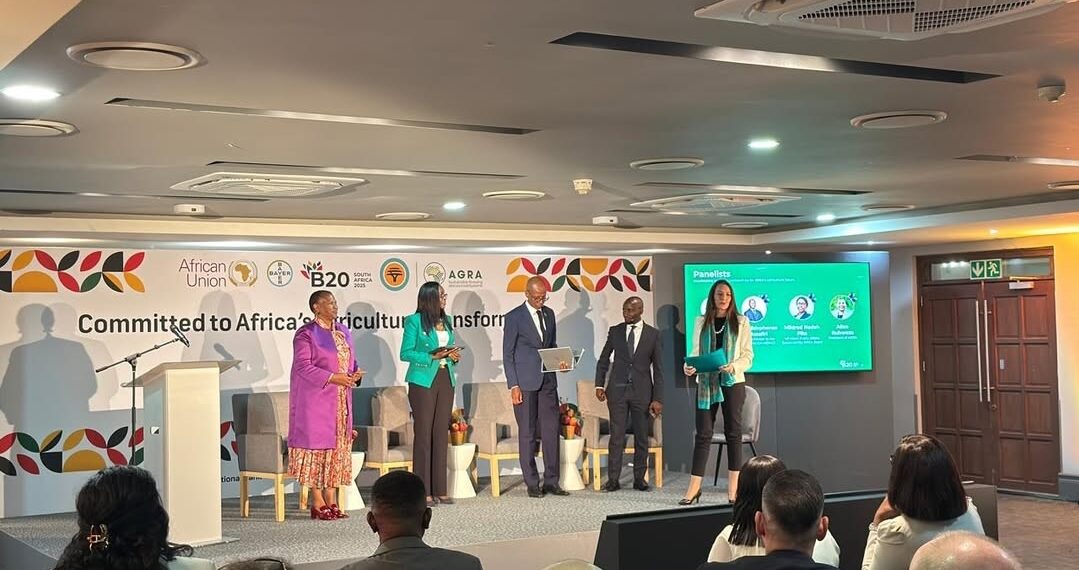
At the B20 Sustainable Food Systems Dialogue on Africa’s Agricultural Transformation, business leaders, policy officials and development partners delivered an unequivocal message: the continent has only “four harvests” left to secure its food future before 2030, and the window for bold action is rapidly closing.
Debrah Mallowah, the head of Africa for Bayer Crop Science, opened the dialogue with a stark question: “Are we acting boldly enough and fast enough to confront Africa’s food challenge by 2030?
“You see, 2030 is not far away. It is four harvests away. It is four opportunities for us to strengthen systems that feed an additional 200 million people who will get onto the continent by 2030,” she said.
Mallowah cautioned that inaction would expose the continent to severe risks, including more unstable food prices, deeper reliance on imports, heightened climate-related shocks and widespread setbacks for rural livelihoods.
“You truly did Africa proud. Now, this is therefore the time for this not just to be a symbolic gesture, but it is a moment that we move from ambition to high-impact action,” she said.
Related stories
- Exports up, jobs down: Why agri-trade leaves rural workers behind
- SA strikes major agri trade deal with Vietnam
- Smart insurance could shield Africa’s farmers from climate shocks
- African farms hold the key to global food security
Unlocking intra-African trade
To demonstrate the real-world implications of Africa’s food system challenges, Mallowah shared the story of a woman smallholder farmer in East Africa. Mallowah emphasised that this farmer never referenced “regulatory alignment” or “policy harmonisation”, only practical barriers such as impassable feeder roads, unpredictable buyers, delayed seed at border posts, limited storage, and lack of credit.
Mallowah outlined the task force’s core question: “What can Africa do between now and 2030 to enhance food security through trade, resilient supply chains and sustainable agriculture? Not theoretical ideas, not long lists. Practical, high-impact solutions rooted in Africa’s reality and ambitions.”
The first transformation lever is unlocking intra-African trade. She noted that the continent holds regions of surplus and shortage within the same borders, yet food cannot move efficiently between them.
“If we unlock trade, this would create an additional 180 billion in agricultural exports through intra-Africa trade, 10 million jobs and more sustainable food availability.”
She added that South Africa’s experience shows what can be achieved when infrastructure, logistics and finance operate effectively, while also reflecting the wider continental challenges that emerge when rural roads, ports, cold-chain systems and energy networks fail to keep pace.
Africa has the blueprint, but needs action
Delivering his keynote, Rwanda’s former minister of agriculture and animal resources, Dr Ildephonse Musafiri, noted the urgency of the moment, calling for swift implementation of the newly approved CAADP (Khartoum/Kampala) Declaration.
He highlighted that Africa holds 65% of the world’s remaining arable land, and that tripling intra-Africa agricultural trade could generate $180 billion and create 10 million jobs within a decade.
Musafiri argued that Africa must urgently reduce its dependency on imported inputs.
“We need to have a mindset shift to make sure we start producing our own inputs on the continent. That’s the most important priority, cutting the import of inputs. Make sure we use our local knowledge, our local scientists, our people, to make sure we make our own production level of seeds,” Musafiri said.
Mildred Nadah Pita, head of public affairs, science and sustainability for Bayer Africa, highlighted South Africa as a case study of how innovation can drive productivity, noting that the adoption of technology has enabled the country to become a net exporter of food and foodstuffs.
She emphasised Bayer’s commitment to making innovation, research, and development accessible to farmers across the continent. “We strongly believe in the power of science. We strongly believe in the power of innovation in solving the most critical challenges that we have.”
Nadah also noted Bayer Zambia’s progress in seed development as a practical example of risk-mitigating innovation reaching local farmers.
READ NEXT: ‘Be counted’ campaign to reveal SA’s true agri heartbeat