Monday, August 31, 2026
SUBSCRIBE
22 GLOBAL MEDIA AWARDS
Food For Mzansi
  • News
  • Changemakers
  • Lifestyle
  • Farmer’s Inside Track
  • Food for Thought
No Result
View All Result
  • News
  • Changemakers
  • Lifestyle
  • Farmer’s Inside Track
  • Food for Thought
No Result
View All Result
Food For Mzansi
No Result
View All Result
in News

Africa has four harvests left to secure its food future

With Africa’s population set to grow by 200 million by 2030, leaders at the B20 Dialogue called for bold reforms to strengthen food systems. Key priorities include unlocking intra-African trade, reducing dependency on imported inputs, and expanding innovation to empower smallholder farmers

by Patricia Tembo
1st December 2025
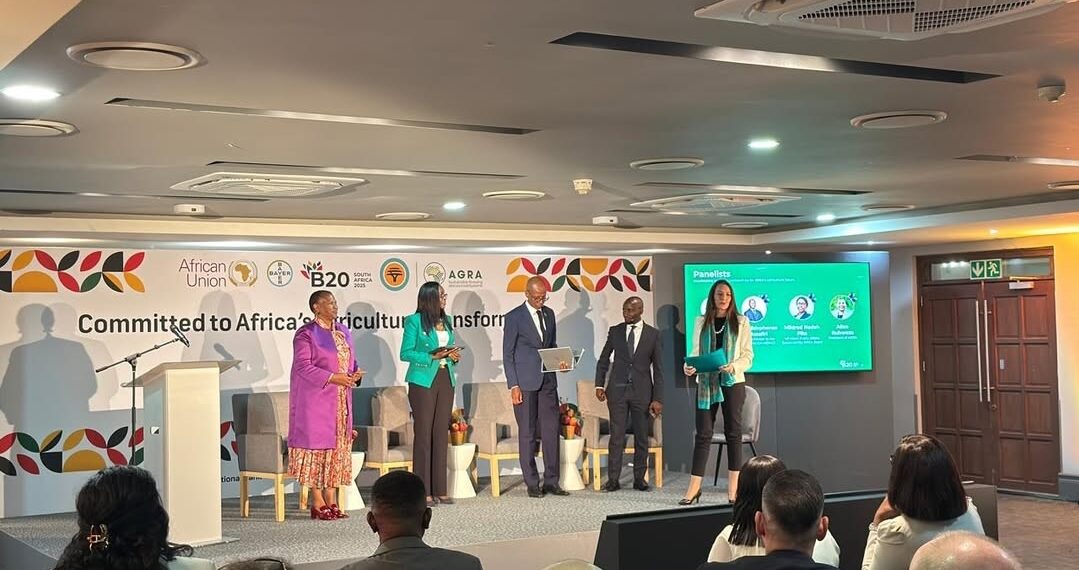
Pictured from left to right at the  B20 Sustainable Food Systems dialogue on Africa’s Agricultural Transformation to Advance Trade, Innovation and Resilience: Alice Ruhweza from AGRA; Mildred Nadah Pita from Bayer; Mooketsa Ramasodi, DG
of the department of agriculture; Dr Ildephonse Musafiri; and Chania Frost, associate partner. Photo: Supplied Food For Mzansi

Pictured from left to right at the B20 Sustainable Food Systems dialogue on Africa’s Agricultural Transformation to Advance Trade, Innovation and Resilience: Alice Ruhweza from AGRA; Mildred Nadah Pita from Bayer; Mooketsa Ramasodi, DG of the department of agriculture; Dr Ildephonse Musafiri; and Chania Frost, associate partner. Photo: Supplied Food For Mzansi

Share on FacebookShare on TwitterShare on WhatsApp

At the B20 Sustainable Food Systems Dialogue on Africa’s Agricultural Transformation, business leaders, policy officials and development partners delivered an unequivocal message: the continent has only “four harvests” left to secure its food future before 2030, and the window for bold action is rapidly closing.

Debrah Mallowah, the head of Africa for Bayer Crop Science, opened the dialogue with a stark question: “Are we acting boldly enough and fast enough to confront Africa’s food challenge by 2030?

“You see, 2030 is not far away. It is four harvests away. It is four opportunities for us to strengthen systems that feed an additional 200 million people who will get onto the continent by 2030,” she said.

Mallowah cautioned that inaction would expose the continent to severe risks, including more unstable food prices, deeper reliance on imports, heightened climate-related shocks and widespread setbacks for rural livelihoods.

“You truly did Africa proud. Now, this is therefore the time for this not just to be a symbolic gesture, but it is a moment that we move from ambition to high-impact action,” she said. 


Related stories
  • Exports up, jobs down: Why agri-trade leaves rural workers behind
  • SA strikes major agri trade deal with Vietnam
  • Smart insurance could shield Africa’s farmers from climate shocks
  • African farms hold the key to global food security

Unlocking intra-African trade

To demonstrate the real-world implications of Africa’s food system challenges, Mallowah shared the story of a woman smallholder farmer in East Africa. Mallowah emphasised that this farmer never referenced “regulatory alignment” or “policy harmonisation”, only practical barriers such as impassable feeder roads, unpredictable buyers, delayed seed at border posts, limited storage, and lack of credit. 

Mallowah outlined the task force’s core question: “What can Africa do between now and 2030 to enhance food security through trade, resilient supply chains and sustainable agriculture? Not theoretical ideas, not long lists. Practical, high-impact solutions rooted in Africa’s reality and ambitions.”

The first transformation lever is unlocking intra-African trade. She noted that the continent holds regions of surplus and shortage within the same borders, yet food cannot move efficiently between them.

“If we unlock trade, this would create an additional 180 billion in agricultural exports through intra-Africa trade, 10 million jobs and more sustainable food availability.”

She added that South Africa’s experience shows what can be achieved when infrastructure, logistics and finance operate effectively, while also reflecting the wider continental challenges that emerge when rural roads, ports, cold-chain systems and energy networks fail to keep pace. 

Africa has the blueprint, but needs action

Delivering his keynote, Rwanda’s former minister of agriculture and animal resources, Dr Ildephonse Musafiri, noted the urgency of the moment, calling for swift implementation of the newly approved CAADP (Khartoum/Kampala) Declaration.

He highlighted that Africa holds 65% of the world’s remaining arable land, and that tripling intra-Africa agricultural trade could generate $180 billion and create 10 million jobs within a decade.

Musafiri argued that Africa must urgently reduce its dependency on imported inputs.

“We need to have a mindset shift to make sure we start producing our own inputs on the continent. That’s the most important priority, cutting the import of inputs. Make sure we use our local knowledge, our local scientists, our people, to make sure we make our own production level of seeds,” Musafiri said.

Mildred Nadah Pita, head of public affairs, science and sustainability for Bayer Africa, highlighted South Africa as a case study of how innovation can drive productivity, noting that the adoption of technology has enabled the country to become a net exporter of food and foodstuffs.

She emphasised Bayer’s commitment to making innovation, research, and development accessible to farmers across the continent. “We strongly believe in the power of science. We strongly believe in the power of innovation in solving the most critical challenges that we have.”

Nadah also noted Bayer Zambia’s progress in seed development as a practical example of risk-mitigating innovation reaching local farmers.

READ NEXT: ‘Be counted’ campaign to reveal SA’s true agri heartbeat

Sign-up for the latest agricultural news delivered straight to your inbox every day with Mzansi Today!

Patricia Tembo

Patricia Tembo is motivated by her passion for sustainable agriculture. Registered with the South African Council for Natural Scientific Professions (SACNASP), she uses her academic background in agriculture to provide credibility and technical depth to her journalism. When not in immersed in the world of agriculture, she is engaged in outdoor activities and her creative pursuits.

Tags: AfricaAgricultural tradeBayer Crop ScienceInform me
QueenAgri’s reign: How Fellistus Sekgale scaled from scratch
Inspiration

QueenAgri’s reign: How Fellistus Sekgale scaled from scratch

by Vateka Halile
28th August 2026

A primary school field trip sparked Fellistus Sekgale’s love for farming. Today, the cum laude graduate manages 6 000 layer...

Read moreDetails
Land reform key to reviving rural economies and drive growth

Land reform: Why SA must shift from hectares to productive impact

28th August 2026

New agriculture chair vows strict public sector oversight

28th August 2026
EC entrepreneur turns ancestral wisdom into a wellness brand

EC entrepreneur turns ancestral wisdom into a wellness brand

27th August 2026
Netafim’s Dosing 5G range wins global precision fertilisation award

Netafim’s Dosing 5G range wins global precision fertilisation award

27th August 2026

QueenAgri’s reign: How Fellistus Sekgale scaled from scratch

EC entrepreneur turns ancestral wisdom into a wellness brand

Water rights alone won’t fix inequality in SA commercial farming

Soul to Soil: Women urged to claim every corner of agriculture

Stats SA: Food sector income rises 8.4% as takeaways surge

Join Food For Mzansi's WhatsApp channel for the latest updates!

JOIN NOW!
Next Post

Voermol Protein Block is NW Bonsmara farmer’s secret weapon

THE NEW FACE OF SOUTH AFRICAN AGRICULTURE

With 21 global awards in the first six years of its existence, Food For Mzansi is much more than an agriculture publication. It is a movement, unashamedly saluting the unsung heroes of South African agriculture. We believe in the power of agriculture to promote nation building and social cohesion by telling stories that are often overlooked by broader society.

Beyond finance: Making women-led farms bankable

Former electrical engineer builds farming powerhouse on tribal land

KZN farmer loses 90% of crop amid severe water shortages

This week’s agri events: 31 August – 03 September

Mamelodi farmers learn how to test soil with just a bottle and spade

Water rights alone won’t fix inequality in SA commercial farming

  • Awards & Global Impact
  • Our Story
  • Contact Us
  • Cookie Policy
  • Privacy Policy
  • Copyright

Contact us
Office: +27 21 879 1824
News: info@foodformzansi.co.za
Advertising: sales@foodformzansi.co.za

Contact us
Office: +27 21 879 1824
News: info@foodformzansi.co.za
Advertising: sales@foodformzansi.co.za

  • Awards & Global Impact
  • Our Story
  • Contact Us
  • Cookie Policy
  • Privacy Policy
  • Copyright
No Result
View All Result
  • News
  • Changemakers
  • Lifestyle
  • Farmer’s Inside Track
  • Food for Thought

Copyright © 2024 Food for Mzansi

This website uses cookies. By continuing to use this website you are giving consent to cookies being used. Visit our Privacy and Cookie Policy.