For Catherine Sepeng, agriculture is more than just a business, it’s a family legacy. As the founder of Cathys Farm Primary Cooperative, based in Fochville, Gauteng, she is not only building on what her father started, but also charting a sustainable and structured path in livestock and crop farming.
Cathys Farm Cooperative is a family-run operation led by Sepeng, her husband, Alex, and their three children, some of whom work elsewhere but remain involved on the farm.
Sepeng’s early exposure to farming was hands-on from the start. “I come from a farming background. My dad was a farmer. He used to breed pigs, goats, cattle, and it was in a communal farming [system]. At the same time, he was planting maize and sorghum,” she explains.
Her early years were deeply influenced by the responsibilities of communal farming, where she took on the task of herding goats while still in primary school. With no brothers in the household, much of the farming responsibility fell on Sepeng and her sister.
“Dad had a passion for farming. He was farming while he was working in Johannesburg. So he was only coming home every weekend. He employed other people to look after the cows, so I was looking after the pigs, the hens, and the goats.”
Although she didn’t always envision herself as a full-time farmer, the spark grew stronger when she and her husband purchased their first farm in 2009, coinciding with her father’s declining health.

Building a diverse business
Armed with diplomas in secretarial studies, business management, project management, and event management, Sepeng initially built a corporate career before transitioning into agriculture.
“Work was too much, and in 2009, I decided to leave work to focus on our business,” she says.
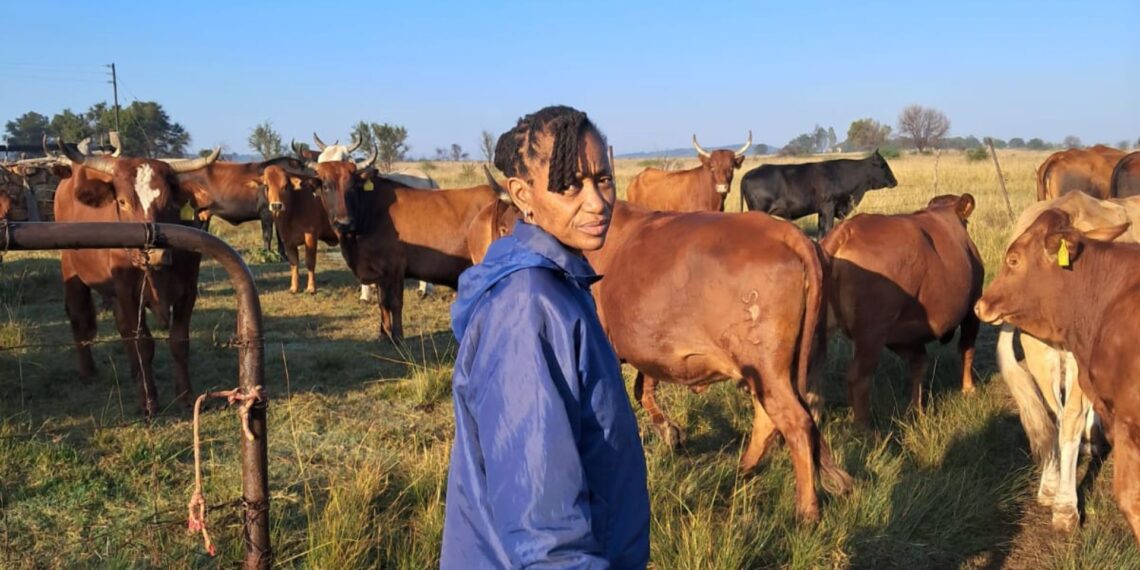
Today, the farm she runs with her husband is thriving, particularly in beef cattle production. What began with mixed breeds inherited from her father has now evolved into a focused and professional breeding operation.
“We’re into pure Bonsmara, 90% of our cattle are Bonsmara.”
Sepeng currently manages a herd of 92 breeding cows, aiming to grow that number to 120 next year and eventually to 150.
Related stories
- Farmer Mentor: Queen of Bonsmara defies odds to rule cattle kingdom
- Farming is not for chancers, says Limpopo Bonsmara farmer
Her deepening knowledge of livestock breeding comes from working with partners such as the Agricultural Research Council (ARC), Sernick, Bonsmara breeders, and the department of agriculture.
These collaborations have helped formalise operations, introducing structured breeding systems, health plans, and efficient protocols. “After doing that, we saw a vast difference in how we run our business,” Sepeng shares.
Her calving schedule is strategically set for June and July. “During that time when they give birth, there is no disease. So most of the time, we don’t have a mortality.”
In addition to beef production, Sepeng also farms sheep, transitioning from mixed breeds to those suited for wool trading. Plans are in place to reintroduce goats, which had to be phased out due to recurring theft.
“Our aim is to beef up our security and then have cameras. Once we have our security intact, then we will begin breeding goats.”
Security for cattle and sheep has already been improved, though theft remains an ongoing concern. She also produces maize, which serves both as a cash crop and as feed for the livestock.
“We make sure that we send our yields or our produce to be sold, but we remain with a few maize in order to produce feed for our animals.”
Sepeng also cultivates herbs such wormwood and rie/wynryt, which she processes and sells.
Buzzing with new ideas
One of Sepeng’s most innovative ventures is beekeeping, sparked by an unusual number of bees on the farm. Initially, they began selling honey in 2017 for personal use. A 2024 veld fire destroyed her hives, but undeterred, she has already hand-built nearly 15 new ones.
While her long-term goal is to process honey-based products, her current focus remains on honey production.
Despite her expertise and regulatory compliance, Sepeng, like many South African farmers, struggles with funding.
She credits the ARC and Sernick for helping her meet requirements. Mechanisation is another challenge, with limited access to equipment hindering growth. To address this, she’s partnered with neighbouring farmers to share resources and responsibilities.
Natural disasters, including devastating wildfires, have also taken a toll. With support from the agriculture department and recovery loans, they limited their losses to just three cows.
Sepeng acknowledges the added challenges black farmers face, often starting without land or generational wealth. Still, she remains hopeful.
“If you want to farm, you should have patience. You must know that you shouldn’t think about making money or fortune overnight. You’ve got to have patience and you’ve got to have pressure,” she advises.


READ NEXT: RSVP now for Land Bank conversations at Nampo
Get Stories of Change: Inspirational stories from the people that feed Mzansi.