Tuesday, October 20, 2026
SUBSCRIBE
22 GLOBAL MEDIA AWARDS
Food For Mzansi
  • News
  • Changemakers
  • Lifestyle
  • Farmer’s Inside Track
  • Food for Thought
No Result
View All Result
  • News
  • Changemakers
  • Lifestyle
  • Farmer’s Inside Track
  • Food for Thought
No Result
View All Result
Food For Mzansi
No Result
View All Result
in Inspiration

Reluctant farmer scales EC cabbage enterprise to supply Spar

Eastern Cape grower Sibahle Sifo went from resisting family farm duties to running Imbewu YeThemba Agricultural Projects. Overcoming total flood loss in 2025, she scaled production to 5000 cabbages, supplying local vendors and formal retailers

by Lisakanya Venna
19th October 2026
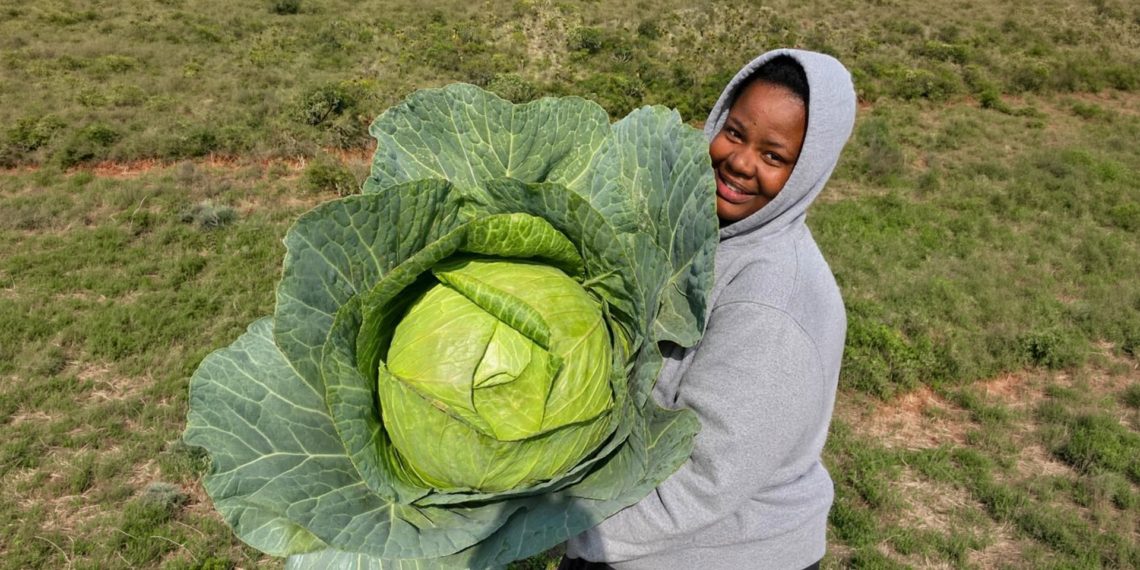
Sibahle Sifo, founder of Imbewu YeThemba Agricultural Projects in Mthatha, transformed an initial reluctance into a thriving cabbage enterprise supplying local vendors and retail stores. Photo: Supplied/Food For Mzansi

Sibahle Sifo, founder of Imbewu YeThemba Agricultural Projects in Mthatha, transformed an initial reluctance into a thriving cabbage enterprise supplying local vendors and retail stores. Photo: Supplied/Food For Mzansi

Share on FacebookShare on TwitterShare on WhatsApp

From resisting her father’s farm chores to supplying Spar, Sibahle Sifo overcame severe 2025 flood losses to build Imbewu YeThemba Agricultural Projects into a thriving 5 000-seedling cabbage business in the Eastern Cape.

Sifo spent her youth doing everything she could to escape the agricultural life her father envisioned for her.

Born in Lusikisiki and raised in Mthatha in the Eastern Cape, she grew up working on the family farm under the instruction of her father, Mtutuzeli Sifo, but actively resisted following in his footsteps.

“During school holidays we would go to the garden to cultivate and sometimes sell some of the vegetables we produced,” Sifo recalls. 

“Ironically, I absolutely hated going to the garden when I was younger. At the time, I never imagined that farming would one day become something I would love and build a business around.”

Her primary ambition was to build a corporate career far away from the land. After finishing at Zingisa Comprehensive High School, she pursued project management training, earning a level 4 certificate through Damelin/SETA in 2016.

By 2019, she had secured a role as a store manager at Vodacom, pursuing what she believed was her true calling.

“I have always wanted to be a corporate girly. Farming was honestly never part of the plan,” she explains.


Related stories
  • Palesa proves small-scale farming can feed communities, retailers
  • Rising from storm loss: Sinethemba Gebashe’s egg triumph
  • Pivot to poultry: Jennifer Gazide swaps boardroom for broiler house
  • Farming bootcamp propels Unicha Dladla’s path to growth

A change of heart

Following her tenure at Vodacom, Sifo spent a prolonged period at home looking for new employment opportunities. 

During these years of job hunting, family members repeatedly urged her to venture into business, an idea she initially resisted, insisting she lacked an entrepreneurial passion. However, her father remained steadfast in his belief that his children were meant to build their own enterprises rather than work for others. 

“Looking back now, almost every sibling in my family has a business of their own. So, in a way, my family had been waiting for this day, but I’m sure none of them ever saw the agricultural side coming,” she reflects.

During this period of job searching, Sifo finally decided to put her project management and leadership skills to the test in the soil. 

A lush row of fully matured Mega Star and Green Coronet cabbages ready for harvest on the family’s arable land in Mthatha. Photo: Supplied/ Food For Mzansi

In 2024, she embraced agriculture, starting small on a portion of her family’s 12-hectare arable holding. Without a large pool of capital, Sifo relied on her personal savings to gradually purchase seedlings and basic inputs.  

She also received crucial support with free seedlings from community members outside her immediate family, most notably Nomsa Mfiri and MJ Mfiri, veteran local producers who had worked on her father’s farm for 12 years before branching out to farm on their own.

Beginning with just 300 cabbage seedlings, she worked step by step to master essential agronomy, focusing on spacing, irrigation, fertilisation, and pest control.

Trial by flood and scaling production

On 10 June 2025, severe flooding devastated her initial crop and destroyed critical infrastructure, including farm fencing. Rather than abandoning the enterprise, Sifo chose to rebuild. 

“It was a difficult experience, but I decided to start again. When I returned to farming, something changed in me. I started appreciating the entire process: planting, caring for the crop, watching it grow, and eventually harvesting something that I could sell,” she says. 

“I lost a lot, but starting again taught me resilience and showed me that farming requires patience and the willingness to keep learning.” 

Freshly planted cabbage seedlings lined across Imbewu YeThemba’s fields, representing Sifo’s resilient rebuild after severe floods wiped out her initial crop in June 2025. Photo: Supplied/ Food For Mzansi

Following the flood, Sifo reinvested her available resources to scale production significantly, growing her output from 300 to 5 000 cabbage seedlings, focusing primarily on the Mega Star and Green Coronet varieties. 

She also enrolled in climate-smart agriculture studies through Unisa to build long-term resilience against volatile weather, soil degradation, and pest pressure.

In 2026, she formally registered her enterprise under the name Imbewu YeThemba Agricultural Projects, which translates to “seed of hope”.

Commercial reach and future outlook

To manage operational demand, Sifo works with one core team member, Musa, while Nomsa and MJ continue to provide hands-on assistance and guidance on the farm whenever needed. During peak periods, she employs up to five part-time workers.

Her commercial market spans both informal and formal trade. Imbewu YeThemba supplies cabbage to local street vendors and individual buyers, as well as formal retail buyers, including Spar.

“I particularly enjoy selling to street vendors because when I sell to them, I know that my produce can also help another person generate an income and support their family,” Sifo says.

A delivery vehicle loaded with freshly harvested cabbages prepared for transport to local street vendors and retail stores across the Eastern Cape. Photo: Supplied/ Food For Mzansi

As Sifo works toward cultivating larger portions of the family’s 12-hectare allocation, her immediate priorities involve securing capital for infrastructure, improving water management, and acquiring dedicated farm machinery.

Reflecting on her business slogan, “Every seed carries hope,” Sifo emphasises the importance of persistence for emerging producers.

“A seed looks small when you put it into the ground, but with the right conditions, care, and patience, it can grow into something much bigger.” 

READ NEXT: Agritourism experts urge fair distribution of SA’s tourism boom

Sign-up for the latest agricultural news delivered straight to your inbox every day with Mzansi Today!

Lisakanya Venna

Lisakanya Venna is a junior journalist and content coordinator with varied multimedia experience. As a CPUT journalism alumni, she finds fulfilment in sharing impactful stories and serving as a reliable source of information.

Tags: Crop farmingEastern CapeInspire meWomen in Agriculture
The panellists at FNB Business’s “Farming together” discussion at the Royal Show explored how market access, mentorship, financial discipline and strong commercial relationships can help farmers build sustainable businesses. Featured from the left are Bertram July (FNB’s distribution sales lead), commercial farmer Shakes Shabalala; Sandy Gumede (co-founder of Zulu Girl Wines), and Janis Robson (FNB’s head of development and SME business development). Photo: Food For Mzansi
News

FNB puts relationships at the heart of commercial farming

by Staff Reporter
17th October 2026

From buying a farm with cattle to building a wine brand from scratch, entrepreneurs shared how strong relationships, market access...

Read moreDetails
Agri Skills Transfer students gain hands-on experience at the institution’s Cullinan Farm Training Centre, where agricultural theory meets the realities of commercial production. Photo: Supplied/Food For Mzansi

Build your future in agriculture with Agri Skills Transfer

17th October 2026
Durbanville Hills tastes sweet success at Michelangelo Awards

Promising early conditions predicted for 2027 SA wine harvest

17th October 2026

Reclaiming the kraal: Cultural heritage sparks a farming dream

16th October 2026

How animal welfare and human rights shape food security

16th October 2026

Laastedrift Agri leads with BigBucks Gala success

What farmers should know about diarrhoea in lambs and kids

Reality check: What SA agri interns really experience on the farm

Ramaphosa: Title deeds and blended finance key to farming growth

Farmworkers rally against rising evictions and housing insecurity

Join Food For Mzansi's WhatsApp channel for the latest updates!

JOIN NOW!
Next Post
Agda conference to tackle finance, market access and agri growth

Agda conference to tackle finance, market access and agri growth

THE NEW FACE OF SOUTH AFRICAN AGRICULTURE

With 21 global awards in the first six years of its existence, Food For Mzansi is much more than an agriculture publication. It is a movement, unashamedly saluting the unsung heroes of South African agriculture. We believe in the power of agriculture to promote nation building and social cohesion by telling stories that are often overlooked by broader society.

Fixing SA’s agricultural visa system to protect seasonal harvests

SA and Namibia reevaluate livestock trade after FMD outbreak

Agda conference to tackle finance, market access and agri growth

Reluctant farmer scales EC cabbage enterprise to supply Spar

Reality check: What SA agri interns really experience on the farm

This week’s agri events: 19 – 23 October

  • Awards & Global Impact
  • Our Story
  • Contact Us
  • Cookie Policy
  • Privacy Policy
  • Copyright

Contact us
Office: +27 21 879 1824
News: info@foodformzansi.co.za
Advertising: sales@foodformzansi.co.za

Contact us
Office: +27 21 879 1824
News: info@foodformzansi.co.za
Advertising: sales@foodformzansi.co.za

  • Awards & Global Impact
  • Our Story
  • Contact Us
  • Cookie Policy
  • Privacy Policy
  • Copyright

Chat Options

About this assistant

This feature generates automated answers summarised from Food For Mzansi articles. By using it, you are interacting with an AI system (provided by Google), not a human. AI can make mistakes. Please refer to the source articles for verification and citation purposes.

Our staff do not check or moderate Lerato’s answers in advance, but may review some later. Our journalists continue to write and edit all the articles Lerato uses as sources.

To estimate unique and returning web users, we store a random browser ID in this browser. WhatsApp users are counted by phone number. The same person using both channels may be counted twice.

I'm Lerato, your AI assistant!
No Result
View All Result
  • News
  • Changemakers
  • Lifestyle
  • Farmer’s Inside Track
  • Food for Thought

Copyright © 2026 Food for Mzansi