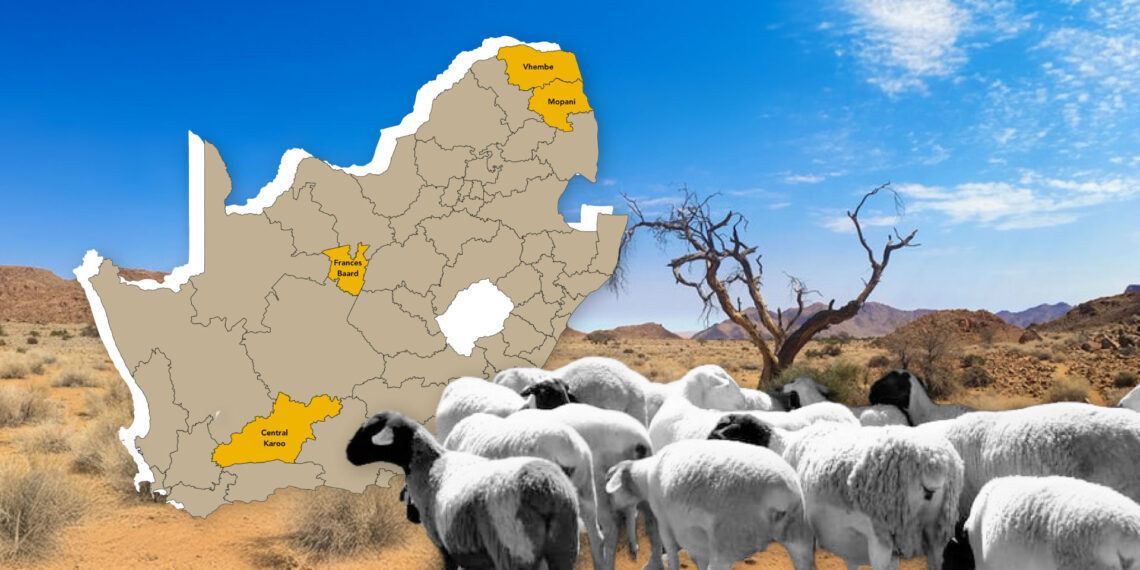

Across South Africa’s drought-prone regions, sheep farmers are forced to coexist with the unforgiving cycle of climate change. First, they fight to survive the drought, then they battle to survive the rain and the wave of animal diseases that come with it.
Emmanuel Mudau’s smallholding in Limpopo’s Vhembe district is no stranger to dry spells. Without timely intervention from him, his sheep and goats won’t meet the desired weight and condition standards, impacting their auction value.
“The [2024] drought affected us. Climate change, everything is affecting us,” Mudua says with frustration, his words reflecting the struggles of countless farmers across the province, all grappling with the same unforgiving conditions.

Data from Open Meteo and Nasa’s Worldview confirm Mudua’s frustrations. Plotting monthly rainfall (mm) and P-ET (mm) for the Vhembe District shows the severe drought conditions experienced during 2024.
What is P-ET?
P-ET is a way of measuring how much rainwater is left after nature uses some of it. When it rains (that’s the “P” for precipitation), some of that water evaporates into the air, or is used by plants (that’s the “ET” for evapotranspiration).

Satellite Image A — Enhanced Vegetation Index (EVI) over Vhembe District (Limpopo), Dec 2023. Photo: Carl Jacobs
Satellite Image B — Enhanced Vegetation Index (EVI) over Vhembe District (Limpopo), Oct 2024. Photo: Carl Jacobs

During the peak drought period of October 2024, the premier of Limpopo, Dr Phophi Ramathuba, met with drought-stricken farmers following a government assessment of the severe dry spells in the Vhembe and Mopani Districts of Limpopo, which left some land barren and grazing fields depleted (Satellite Image B, above).
Mudau’s livestock also suffered and grew weak. Then, just as farmers struggled to adapt to the dry conditions, the weather took another unexpected turn.
In previous years, rain typically arrived in the region during October or November, giving livestock time to adjust. However, this time, there was no rain until December 2024, followed by heavy rainfall in January 2025 (231.1mm), causing widespread damage.
“After the drought – a long drought – animals are so stressed. Now it is wet, and then it rains for two months, a lot of diseases emerge,” Mudau explains.
“When there is no rain, there is no food. The animals are exposed to any disease, and even those that normally wouldn’t be fatal become deadly. The immune system is struggling,” Mudau explains.
He adds that some of these diseases do not show up when animals eat well because their immune systems can fight them off. However, when they are not getting enough food, worms attack more easily because their bodies are too weak to protect themselves.
Livestock numbers drop
Over the past decade, South Africa has seen a decline in cattle and sheep numbers, with Northern Cape, the country’s largest province and a key player in livestock farming, being particularly affected. This decline is a result of various factors, including drought
According to a study titled: The Impact of Agricultural Drought on Smallholder Livestock Farmers: Empirical Evidence Insights from Northern Cape, South Africa, agricultural drought has continually impacted the Northern Cape for over a century, causing significant livestock losses.
Yonas Bahta and Vuyiseka Myeki, the authors of the study, reported that, at the time of their research, agricultural droughts in the province resulted in a more than 45% loss of cattle, sheep, and goats; a more than 27% deterioration in animal health; and a more than 19% decline in livestock prices.
The report states, these losses leave farmers economically vulnerable, as the lack of adaptation strategies leads to reduced income.
A more recent report published by the Red Meat Industry Services in December 2024 reveals that South African sheep meat production declined from 2017 to 2022, with a slight increase in 2019.
“Sheep meat production felt the same pressures as beef – droughts, persistently high feed costs, vaccine shortages at OBP, and FMD outbreaks – also negatively impacting live sheep and wool exports,” the report states.
Related stories
- Karoo lamb GI registration sparks hope for market growth
- Winter forecast: Drought for some, floods for others
Agricultural economist Wandile Sihlobo also reported that the number of sheep slaughtered dropped between 2020 and 2022 due to the devastating drought in the Karoo region and the impact of Covid-19. This dropped from 5,431 million in 2015/16 to 4,361 million in 2020/21.
These sheep numbers include ewes, rams, and lambs, with lambs usually around 80% of the total. However, in the Karoo region, the share of lamb slaughtering dropped to 65% of all slaughtered sheep towards the end of 2022.
As highlighted earlier, drought-stressed livestock have weaker immune systems and are more prone to diseases brought about by sudden, heavy rainfalls (such as those experienced in Vhembe and Mopani Districts in Limpopo).
The result is a drop in livestock production, which affects meat pricing – for example, one can see in the chart below how a drop in the number of sheep slaughtered leads to an increase in the price per kg, across all classes of sheep meat.
Herd recovery after La Niña and pricing
The effects of climate conditions on sheep farming are evident in the fluctuating market prices. Dr Johnny van der Merwe, an agricultural economist, explains that the severe droughts in late 2019 caused a significant depletion of livestock numbers, which directly impacted sheep production.
In 2020, the onset of good rains, brought on by La Niña conditions, allowed farmers to begin rebuilding their herds. This recovery period saw lamb prices soar, reaching a record R154 per kilogram in June. However, with the herd rebuilding, supply was limited, and demand remained strong, which kept prices high.
By 2023, as the herd size grew, prices started to stabilise. The El Niño conditions in 2024 brought drier weather again, leading to increased livestock sales and reduced investment in sheep farming. High interest rates, lower consumer spending, and weak demand contributed to lower prices last year.
While tentative global forecasts see little chance of El Niño forming this year, it is too early to tell at this stage.
In the meantime, Van der Merwe urges farmers not to overlook assessing a farm’s natural resources, climate suitability, and location, as the success of sheep farming depends heavily on these factors. He warns that high input costs can easily outweigh profits if they are ignored.
“You must, especially with the high input cost for producers, do a natural resource assessment. [Also] make sure that your area can accommodate that without running the risk of increasing your input cost,” Van der Merwe explains.
This article is a collaboration between Food For Mzansi and OpenUp, supported by Africa Data Hub.
READ NEXT: Trees: More than shade – a climate change ally
Sign up for Mzansi Today: Your daily take on the news and happenings from the agriculture value chain.