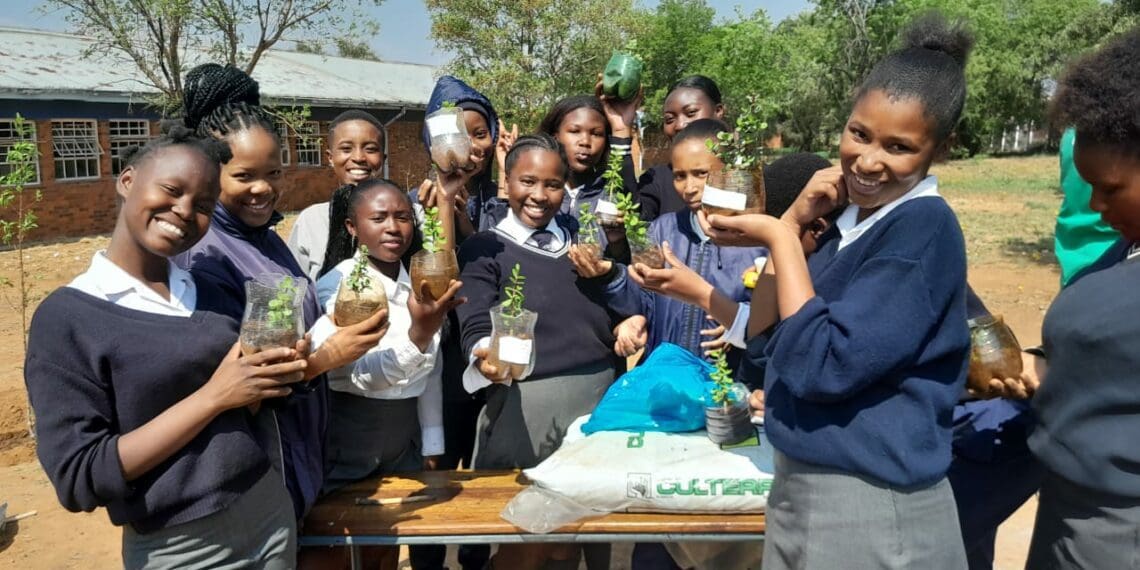
Creating awareness of the environment will go a long way in building a sustainable future for young people in Mzansi. That is why the Wildlife and Environment Society of South Africa (Wessa) and Sun International have partnered in a two-year climate crisis campaign involving 18 schools across the country.
The aim of the project is to create eco-classrooms to build environmental resilience in schools and their communities.
Sun International invested just over a million rand to support the programme in schools in areas surrounding their properties. The programme, which kicked off in August, will run until the end of July 2023 involving over 450 learners ranging from grade 6 to 10.
Wessa senior project manager Nomfundo Ndlovu says, “Learners that understand the science, impacts, and solutions, are better prepared to deal with the climate crisis and advocate for mitigation and adaptation policies at a local and national level.”
Education remains crucial
She adds that through education, people are better equipped to prepare and recover from natural hazards, such as those caused by climate change.
“With knowledge and skills, they can adapt more flexibly. With our educational programmes, Wessa hopes to inspire the next generation to advocate and act for a healthy planet they are proud of,” Ndlovu says.

Wessa, formed in 1926, is one of South Africa’s oldest and largest independent non-profit environmental organisations. The organisation was started when a group of passionate individuals got together to campaign for the creation a National Parks Board – now known as SANParks – to ensure the proclamation of the Kruger National Park and other national parks.
According to Sun International’s SED Manager Heidi Edson, the project will assist schools and educate learners on different levels.
Abundance of skills
“The learners will gain much from participating in the programme, from science learnings to values, knowledge about plants and animals, human and environmental health, to practical skills such as learning how to separate recycling and how to plant indigenous plants,” says Edson.
Soft skills include self-confidence, leadership abilities, critical thinking and the will to act and advocate.
Some of cross-cutting challenges that will be addressed are poor waste management, substance abuse and poor sanitation.
“Sun International’s Eco-Schools project will support schools with the creation of eco-classrooms where learners, teachers and school leadership will use the eco-schools seven steps framework to chart a way to building resilience in their schools and communities,” Edson explains.
The steps are: Write an eco-code, form an eco-committee, do an environmental review, develop an action plan, monitor and evaluate, link to the curriculum, and inform and involve others.

Schools will also select specific themes that will give them specific focus areas for their projects. “This is vital in the sustainability of projects because teachers and learners are trained to do this themselves, and thus can continue maintaining their projects and start new ones.”
The schools involved are: Bellville South Secondary, Riverton Primary, Ekukhanyisweni Primary, Tembisa Secondary, Moduopo Primary School, Ipontshe Primary School, Lereko Secondary, Buhlebemfundo Secondary, Tsimong Primary, Mamelodi Pre-Vocational, Soshanguve Secondary, Sterngrove Primary, Glenhaven Secondary, Waterloo Secondary, Phoenix Secondary, Palmview Secondary, Bo-Doorn Rivier Primary, and Plangeni Junior school.
Marking important days
An environmental campaign is also run at the schools, aligned with calendar dates such as World Food Day, Arbour Day, World Environmental Health Day and World Water Week.
To ensure long-term sustainability in light of the climate crisis, teachers will be supported to establish teacher hubs which will grow to become a “community of practice”, where teachers come together to share expertise, work collaboratively and use this space for professional dialogue.
ALSO READ: Youth-led poultry farm gets solar power boost
Get Stories of Change: Inspirational stories from the people that feed Mzansi.