Agricultural journalists play a critical role in connecting farmers with reliable information, strengthening the agricultural value chain and countering misinformation, agriculture minister Willie Aucamp said at the Agricultural Writers SA 2026 awards ceremony held in Muldersdrift, Gauteng.
Addressing agricultural communicators, industry representatives and stakeholders, Aucamp emphasised the importance of credible agricultural journalism in helping farmers make informed decisions and protecting the integrity of information circulating within the sector.
“Credible information has become as important as the green seed. We cannot farm without credible information,” he said.
The minister highlighted the growing challenge of misinformation and sensationalism on social media, particularly as traditional print media continues to decline and more people rely on digital platforms for information.
He called on agricultural journalists, farmers and industry stakeholders to work together to counter fake news and support professional journalism that provides accurate, accountable reporting.
“You are the storytellers, you are the educators, but you’re also the connectors of important partners,” Aucamp said, adding that agricultural journalists serve as a bridge between farmers, service providers, manufacturers and other participants across the value chain.
Related stories
- Agricultural Writers SA North honours top farmers, stakeholders
- From five fish to a commercial farm: Meet the AWSA !Xhariep winners
- Khula! wins eight Pixels at the 2026 IAB Bookmark Awards
- SA Olive Awards celebrate world-class quality and industry heroes
He also stressed that agriculture extends beyond primary production, encompassing the livelihoods of farming communities, food security and the country’s economic future. Journalists therefore have an important responsibility to communicate the sector’s developments, challenges and opportunities accurately.
Aucamp further encouraged journalists to build and maintain trust with farmers, noting that once trust is broken, it can take considerable time to restore.
Collaboration key to agricultural progress
The minister also used the occasion to share an update on the country’s efforts to vaccinate its national cattle herd against foot-and-mouth disease (FMD).
He announced that South Africa had surpassed its initial target of vaccinating 80% of the national herd by the end of 2026, with at least 90% reportedly already vaccinated.
Aucamp attributed the progress to collaboration between government, agricultural organisations and other industry stakeholders.
Acknowledging ongoing challenges around vaccine availability and production capacity, he highlighted the need for greater collaboration to strengthen local vaccine manufacturing.
He also spoke about efforts to involve the private sector in vaccine production by making vaccine antigens available to additional manufacturing partners.
The minister thanked organised agriculture for its contribution to the sector, emphasising that collaboration between agricultural organisations and the media would be important in addressing the industry’s challenges.
Building opportunities for the next generation
Nedbank’s head of agriculture, John Hudson, emphasised the importance of supporting new entrants to commercial agriculture and building sustainable farming businesses.
His presentation showcased farming enterprises that have developed from modest beginnings into more structured commercial operations through practical experience, technical knowledge, diversification and industry partnerships.
One of the enterprises highlighted was a commercial poultry business with a capacity of 7 500 birds, employing 11 people and generating an annual turnover of approximately R5 million. Its production model combines livestock and crop farming, supported by structured feeding programmes, quality genetics and strict biosecurity practices.
Another example demonstrated the value of integrated farming, with vegetable production complemented by pigs and poultry. The operation uses crop residues and animal waste to support compost production, creating a more circular production system.
The presentation also highlighted the importance of mentorship, skills development and market access in helping emerging farmers build sustainable enterprises.

Recognising agricultural excellence
Agricultural Writers SA 2026 also celebrated individuals making significant contributions to South African agriculture.
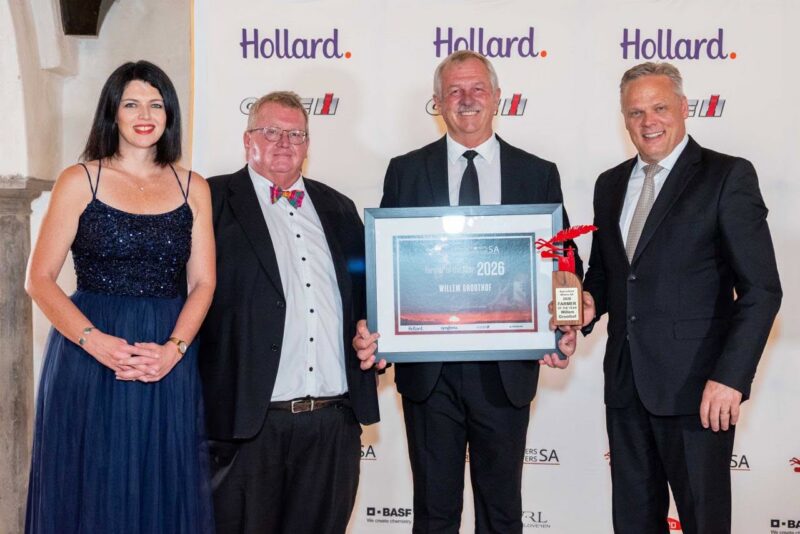
Willem Groothof, a third-generation grain, cattle and game farmer from the Springbokvlakte in Limpopo, received the 2026 Farmer of the Year award.
Angelo Maarman, owner of Abits Farming, an organic farming enterprise in Chatsworth, Western Cape, was recognised as the 2026 New Entrant to Commercial Agriculture.
Jade Smith, an agricultural economist at Absa Agribusiness, received the Agriculturalist of the Year award.
The event also provided an opportunity for agricultural writers, producers, agribusinesses and industry leaders to strengthen relationships across the value chain.
Meanwhile, agricultural journalist Lindi Botha encouraged attendees to use the gathering to build new relationships and engage with people beyond their immediate professional circles.
She noted that bringing together agricultural expertise, industry leaders and communicators created valuable opportunities for collaboration.
“You never know where a conversation might lead, what you might do, or what new opportunities for friendship might arise,” Botha said.
The awards ultimately celebrated not only professional achievements but also the people and relationships that contribute to the growth and sustainability of South African agriculture.
READ NEXT: Have your say: New animal identification rules open for comment