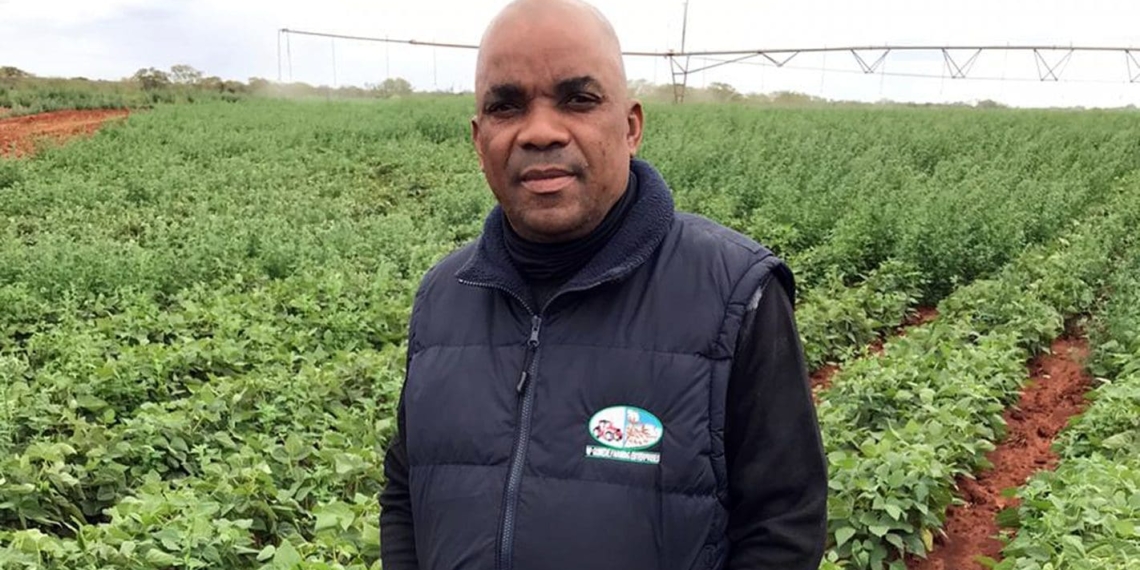

Noluthando Ngcakani speaks to veteran farmer and agricultural leader Phenias Gumede, who firmly believes that the notion of ‘being spread too thinly’ does not exist. During his 30 years of farming experience he has taken up many leadership roles in the sector, recently adding the title of vice-chair of the Southern African Confederation of Agricultural Unions (SACAU).
Gumede serves as the deputy president of Agri SA and is the president of the KwaZulu-Natal Agricultural Union (Kwanalu). In addition to these, he also serves as the deputy president of Cotton SA and is the longest running chairperson of the KwaZulu-Natal Cotton Growers Association.

Born in the north KZN farming community of Makhatini Flats near the borders with Swaziland and Mozambique, Gumede has been farming since he was a young boy working as a herder on his father’s one-hectare smallholding.
Today he runs a total of three large farms in the province, farming cotton, vegetable crops and livestock. He is also the managing director of a cotton processing facility, Makhatini cotton gin, where commercial cotton farmers have access to offtake markets for their produce.
We catch up with Gumede over his new appointment with SACAU, the voice of farmers on regional and global matters.
Noluthando Ngcakani: As a man who has taken up so many leadership roles in the sector, did this appointment come as a surprise at all, Mr Gumede?
Phenias Gumede: Farming flows through my blood, I love agriculture, I love working with people. I want to farm. My aligning myself with various agricultural organisations is me wanting to learn more about the sector each and every day.
NN: Where do your passions stem from?
PG: I grew up as a herd boy, so for me farming has been a lifestyle and a way of life. I think I was about 14 or 15 when I worked for my father. He was just an ordinary small-holder farmer who used oxen to plough his one-hectare piece of land producing crops like beans, potato, and maize.
Around the 1990’s he passed away and I decided to proceed with my farming and decided to expand my land. To date I have 200 hectares under irrigation and another 150 hectares of drylands.
NN: The issue of land reform has been at the centre of hot debate for years now. What is your take on the big land question?
PG: As much as I would like to see land reform happen, the biggest concern remains the redistribution thereof.
New landowners need to be trained and before that they need to be encouraged to want to farm. There should be proper selection criteria for those set to receive land.

These criteria must align with an undying passion for agriculture and a love for farming. It is not about receiving land or becoming a landowner overnight, you need to know what to do with it. We need people who are passionate.
Limitations and exclusion hinder growth in the sector, including lack of knowledge, skills development, experience and mostly access to funding.
Everybody wants to own a motor vehicle, but if you do not have the necessary implements to maintain it, then what is the point?
Just because you have the car does not mean you are successful. It is the same with land. You cannot proceed with land reform without having a proper plan and method. This will bring disaster to the sector.
NN: How do you juggle all your responsibilities?
PG: I have three farms in total and take care of all them. While I have three sons, the youngest is the one who alleviates some of my pressure, from land preparation to harvesting crops. On the cotton plant I have a full team of staff who make sure operations run smoothly, from finance to logistics and overall management. I am actively involved in the marketing of all the cotton produced by the thousands of farmers I work with.
With all these organisations that I have aligned myself with they understand that I am human and make sure to facilitate my movements and availability for urgent matters.
Two or three days a week are dedicated to family and I usually split my day between the office and the farm.
NN: Being black in the sector comes with challenges. What has been some stumbling blocks for you in gaining access to markets?
PG: The sector is not yet properly transformed. If you don’t fight to gain access you will end up with nothing.
In 2020 language is still a problem – that alone excludes you from access to opportunities, proper financial information and education.
Note that finance will always hold us back, and you need funding to produce but with this you need all the relevant information that shows how you are going to produce. Banks sometimes just take one look at your documentation and notice one small miscalculation and will discredit you.

NN: There has been an upsurge in farm violence throughout the country. Do you believe we are seeing a change in political will regarding rural safety and farm attacks that will result in effective action by government?
PG: Farm attacks, farm murders, safety and rural security in the sector needs urgent intervention. This is a national disaster and we are in a crisis. It is not racial at all; we are all targets in the sector. With gender-based violence and femicide added this crisis needs immediate attention.
One commercial farmer in South Africa produces enough food to feed thousands, that is why there is an outcry when a farmer is killed in this country. It is problematic and hinders production in the consumer value chain. By committing these crimes, criminals are taking food away from people’s tables.
Government must take decisive action in order to stop the scourge, there are measures and protocols, but it is now a matter of implementation.
NN: You speak of the urgent need to implement strategies. In all your years of experience, has government in any ways made progress in improving the sector?
PG: For the longest time, government approached the sector as if it was a social development initiative. The way the distribution of funding and agricultural inputs is done likens to a grant system. According to me government should lend a helping hand regardless of historical background or political alignment. They must work according to a commodity baselines of agriculture. And there are many, red meat, poultry, forestry, sugar, cotton the list goes on.
Within in these structures there is expertise and knowledge that government must work with. The future of the sector lies in the transference of knowledge, the transference of skills and training.
Instead they go directly into communities where some farmers that have been given inputs will sell that feed or manure directly back to another farmer.
NN: Do you have any advice for young farmers looking to penetrate the market?
PG: There is a gap in the sector that only young women can close. Looking at most organized agriculture you would find old people and rarely find a woman or man under the age of 50.
What the youth lacks is patience. When you decide to make your mark, be dedicated. You cannot get frustrated after one failure and want to give up, you need resilience and an open mind.
Be open to learning, always improve on your management skills, expose yourself to new technology. Start small, but at the end of the day remember it is a marathon and not a race. You cannot start today and wake up rich the next, hard work is needed.