The odds have always been stacked against Jolian du Preez, a farmworker turned farm owner. As the son of a farmworker and a general worker at a primary school, du Preez’s options were limited. While he has always been aware of his limitations, they have never stopped him from dreaming big.
In 2016, Du Preez’ biggest dream came true when he bought a farm. The purchase signalled a new chapter for this laaitie from Haarlem, a small village in Langkloof, Western Cape. To him, it was proof that decades of hard work and failures were not in vain.
Growing up in Haarlem, Du Preez dreamt of becoming a farmer with his seven siblings.
“My father was a general worker at our local school in Haarlem. Those days in Haarlem, there were no townships. Everyone had a piece of land where they could plant fruit trees, vegetables and also keep a few animals, mostly pigs.”
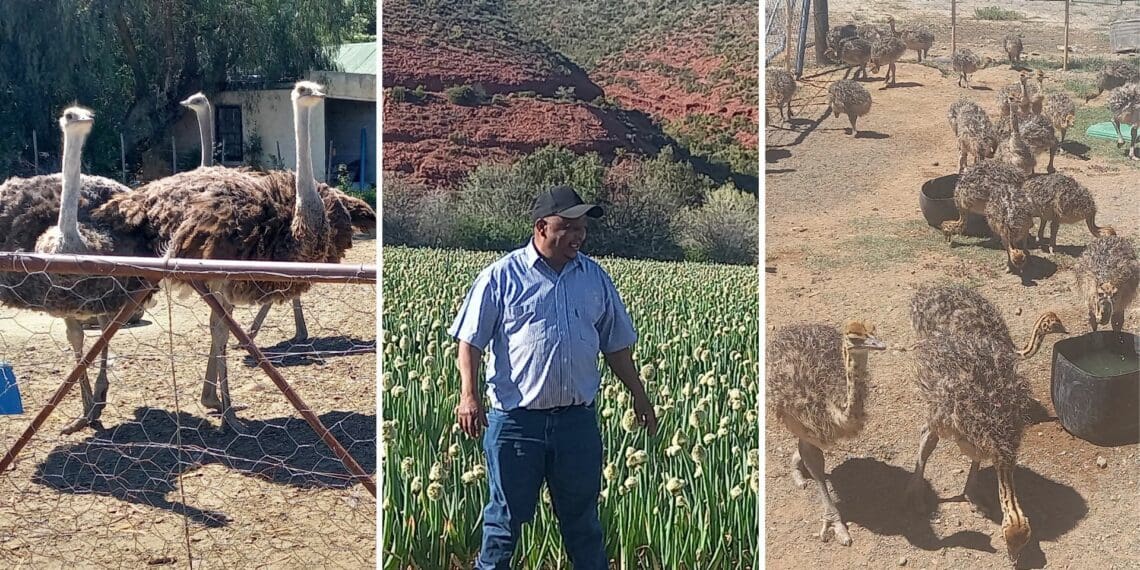
Inspired by this way of life, Du Preez set out a course to carve his own path in agriculture. And today, he’s the proud owner of Boetie Hutties, a 51-hectare farm. The farm located near Dysselsdorp, is where Du Preez farms on an intensive scale with vegetable seeds, fresh vegetables, lucerne and ostriches.
To top things off, he’s the only black commercial farm owner in this area.
Hard road to success
Du Preez pursued his dream of becoming a farmer in 1990 when he moved to Stellenbosch to study at the Kromme Rhee Agricultural College. He, however, failed his first year of studies and could unfortunately not return to continue. Du Preez then found himself working as a general worker on a state-owned farm called Anhalt Boerdery.

“I applied in 1992 for re-admission and my mother’s boss, Nelis Johnson, owner of Haarlem Vrugteplase, believed in me and paid for my studies. In my second year, I secured a bursary from the government to complete my studies.”
He finally graduated in 1993 and joined Waaikraal farm managed by the Cape Agency for Sustainable Intergrated Development in Rural Areas (Casidra), where he worked as a trainee manager for five years. Thereafter, he took on the role of farm manager for about 15 years.
During this time, he applied to study at Elsenburg Agricultural College and from there on, only the sky was the limit for this farmer.
“I bought [my] farm in 2016, but it was registered in my company’s name in March 2017. It was always my dream to become an independent farmer,” he says.
Du Preez has also managed to accomplish some impressive milestones in the Klein Karoo region. In 2018, his farm was announced as the Klein Karoo Seed Production Emerging Agribuisness of the Year. He was also announced as the overall Spring Onion Seed Winner.
Highs and lows of being the boss
He admits that the title of black commercial farm owner has earned him a lot of street cred as well. But owning land in the Klein Karoo as a black farmer comes with its highs, but it also comes with a lot of lows.
“To have your own land means you must pay a bond. Now in a drought, that’s merely impossible. My money comes from the production of goods on the farm. If you don’t have water, you can’t farm properly. But the main thing is just to survive during tough times.”
The region recently experienced its most devastating drought in history. Du Preez says his farm only had enough water to irrigate two hectares of land.
“In a normal season, I can irrigate my whole farm. I’ve learned a lot during the past years. Things are a little bit better than in previous years, but our main irrigation dam is still below 5% which means there is no irrigation water for us.
“|Luckily, we are entering the summer months, so now we are waiting for the thunderstorms in the catchment areas to fill our dams.”
While farming can be challenging, Du Preez will always fight another day to experience the tranquillity of the life he dreamed of building. It is a great joy for him to witness his crops grow.
“When you are on a farm, you are between your crops daily. You see what is happening to them on a daily basis. You see them grow, not in length but in maturity.”
Land distribution and women in farming
When it comes to issues around land distribution and women empowerment in the agricultural sector, Du Preez has a lot to say.
For starters, he views it as crucial that government buys land for redistribution to educate black farmers. There is enough land in the government’s hands to place successful black farmers on these farms, he states.
“But you can’t buy a farm and give it to someone who doesn’t have the skills and educational background. And if they gave a farm to a beneficiary, they normally give it without implements and tractors. [Farmers are likely to fail].”
He also believes that there are way too few women in the agricultural sector and he encourages them to come to the fore. “Women don’t need men to be successful as farmers. Listen, learn, adopt and ask questions. There are enough advisors who are willing to help,” Du Preez advises.
His love for development also extends to young farmers. Nurturing young people is important for the next generation of commercial farmers, he says.
His advice for young farmers is to, “get a mentor, somebody who is willing to take your hand for the next 3-5 years and attend farmer days and workshops too”.
ALSO READ: Sobuza transforms hobby into booming business
Get Stories of Change: Inspirational stories from the people that feed Mzansi.