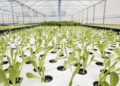
Distell has taken the farm-to-table concept to heart creating an eco-friendly, water-recyclable aquaponics project to grow a variety of vegetables and farm fish at its Nederburg Winery in Paarl.
Through its Agri+Gator empowerment arm, the alcohol company teamed up with majority black-owned Mi-Crop Group Holdings to produce pesticide-free rainbow trout, herbs, and specialty salad crops all-year round.
Distell started working on the project more than a year ago, says Eric Leong Son, Distell’s acting director of corporate affairs.
“These types of transformational partnerships, involving multiple stakeholders in our value chain, truly deliver tangible value for the community at large,” he says.
Farm to table
Currently, the project involves a 500 sq. m trout and packaging facility, established alongside a 1 000 sq. m hydroponic greenhouse that cultivates miniature leafy greens and herbs like thyme, mint, basil, coriander, baby spinach, rocket and exotic lettuces all year round.
Alternative energy sources have been established as a back-up, so no disruptions result from central or local authority power outages, says Distell’s Charles Wyeth, acting head of the company’s sustainability operations.
Wyeth adds that the intention is to scale up the venture to three times its current size.
“Staff are being trained in this extremely detailed and sensitive type of work. In addition to the full-time employment opportunities created in running the aquaponics facility, skills will also be developed in packaging, marketing, sales, and cold-chain distribution.”
Plans to expand
Marius Conradie, the chief executive of Mi-Corp, explains that the plan is to identify more local wine farms and small-scale BEE partners in the greater Drakenstein area to co-fund, co-own and operate multiple sites with the venture in its expanded phases, and will also include the involvement of local black farmers.
“As the project grows, more employees will be upskilled to participate. We envisage that once fully up and running, around 10 additional work opportunities will have been created at the Nederburg hub alone. With its multiplier effect, this will provide a much-needed injection into the local economy.”
He says this latest venture at Nederburg is becoming an extension of the winery’s long-standing social and eco-sustainability focus. Steps already undertaken at the farm include regenerative viticultural practices conducted that range from increasing biodiversity through cover cropping, clearing of alien riparian vegetation, and creating biochar from biomass on the farm to add to the microbial life, structure, water-holding, and carbon sequestration of the soil.


ALSO READ: In pictures: Farmers dazzle at AWSA awards
Sign up for Mzansi Today: Your daily take on the news and happenings from the agriculture value chain.