Wednesday, October 21, 2026
SUBSCRIBE
22 GLOBAL MEDIA AWARDS
Food For Mzansi
  • News
  • Changemakers
  • Lifestyle
  • Farmer’s Inside Track
  • Food for Thought
No Result
View All Result
  • News
  • Changemakers
  • Lifestyle
  • Farmer’s Inside Track
  • Food for Thought
No Result
View All Result
Food For Mzansi
No Result
View All Result
in News

Maritime nonprofit gets young people into aqua farming

The eThekwini Maritime Cluster (EMC) has been championing the maritime industry in and around Durban since 2009 and now takes selected young people through three years of aquaculture and aquaponics training and assistance

by Nicole Ludolph
28th February 2022
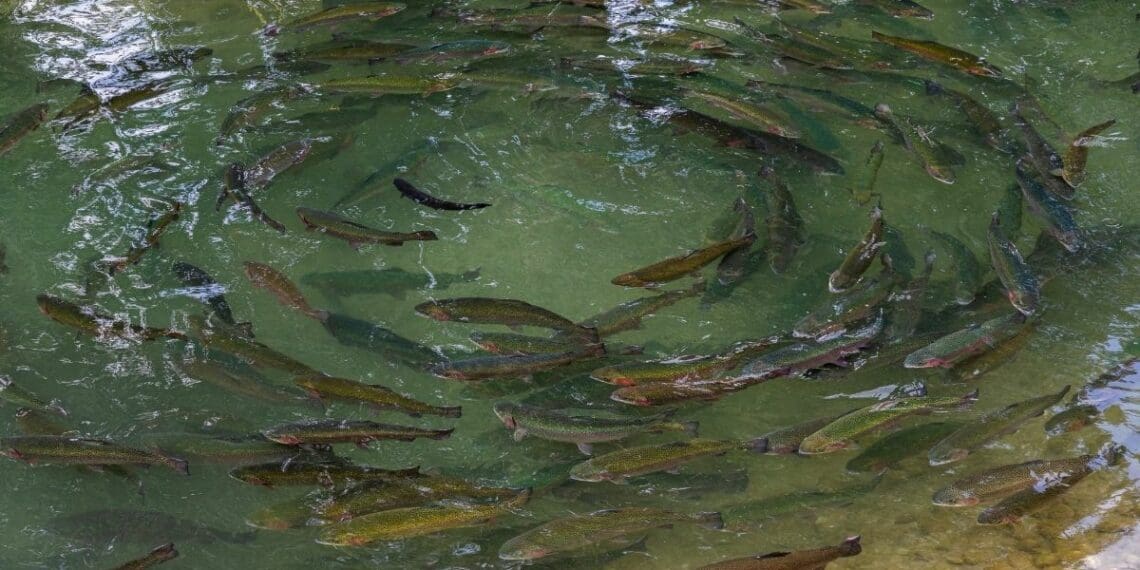
The eThekwini Maritime Cluster helps young people gain skills in the freshwater aquaculture and aquaponics industry. Photo: Supplied/Food For Mzansi

The eThekwini Maritime Cluster assists young people with learning skills within the freshwater aquaculture industry. Photo: Supplied/Food for Mzansi

Share on FacebookShare on TwitterShare on WhatsApp

With well over a decade of experience in the maritime business sector behind it, a nonprofit in KwaZulu-Natal is now helping unemployed youth set up their own aquaculture and aquaponics farms.

The eThekwini Maritime Cluster (EMC) has been championing the maritime industry in and around Durban since 2009 and focuses mainly on bridging the gap between industrial policy and business.

Ayanda Sikobi, programmes manager for enterprise development and marine manufacturing at EMC. Photo: Supplied/Food For Mzansi

“We get businesses that are trying to venture into the maritime industry, but they can’t do that without sufficient knowledge and sufficient information. That is our goal as the EMC,” says Ayanda Sikobi, programmes manager for enterprise development and marine manufacturing at EMC.

Through five different divisions, the organisation does small business incubation, graduate placement, assistance with commodities like logistics and stevedoring, work readiness, and water sports engagements. They even create innovation challenges where young people try to resolve problems within the maritime space.

The Youth Aquaculture Project

One of the enterprise development division’s tasks is to upskill unemployed young people in aquaculture and aquaponics. The organisation selects participants from five municipalities in the eThekwini region, helping them form co-operatives and then piloting the projects once they are grouped.

Inside the municipal Northdene Agroecology Research & Development Centre in Queensburgh, where EMC takes programme beneficiaries for site visits and training. Photo: Supplied/Food For Mzansi

Sikobi says that about 20 participants are currently undergoing training at the Northdene municipal facility.

A field trip is an important part of their training. “We take them to Bloemfontein [to the] China-South Africa Agricultural Technology Demonstration Centre (ATDC). It’s owned by the government, so the training there is free if people are interested in learning more about aquaculture.”

The field training takes place over seven days, with EMC subsidising much of the transport, accommodation and meals. “Bloemfontein is far!” Sikobi laughs.

Participants in the programme receive three rather thorough training sessions at the facility and learn as much as they can about freshwater aquaculture and aquaponics. “You learn everything from sampling your water to how to take care of your stock, feeding them, spawning, the whole reproduction process, how to clear your tanks, how to take care of your fish… It’s a long process.”

Building businesses

Once participants have decided on the aspects of aquaculture on which they will focus, EMC supports them through the piloting process, including trying to secure funding.

The entire programme, built around a recirculating aquaculture system (RAS) where participants use tanks that recirculate the farm’s water, spans three years. Teaching a skill as big as aquaculture requires a lot of capital and cannot take place in a short time, says Sikobi, and this is why the training takes so long.

“You can’t capacitate and teach people something in a year. You need time. You need to help them with some business planning, how to construct proposals… You have to assist them with acquiring funding for getting the tankers, the net, to get the greenhouses and, if they want to take things further by venturing into aquaponics as well, then you need to teach them that aspect also. So one year is not enough, but three years are sufficient.”

The challenge of bureaucracy

Through their incubation process, EMC had already helped establish an aquaculture company in Umbumbulu in the eThekwini municipality. The project, run by Themba Mgwaba, entails both aquaculture and aquaponics, and will be the first fully operational aquaculture project the nonprofit has piloted once the compliance process is completed.

Programme participants during a visit to the Northdene facility. Photo: Supplied/Food For Mzansi

Sikobi says that the compliance process for aquaculture projects can be difficult. Parts of the process are unclear, and applicants end up having to communicate with government constantly without really getting anywhere.

“If government could work with small businesses [and] help them with the compliance issues, this can be a very lucrative project.”

Aquaculture is holistic development

For Sikobi, helping people sustain themselves is central to the aims of the aquaculture programmes. Studies done by the United Nations and other aid organisations have shown that fish is the easiest form of protein to obtain.

“By piloting and establishing this project, [we] are essentially assisting people with their own nutrition. And with the population that is forever increasing, [we are] assisting people with manufacturing their own food in the comfort of their own space, instead of having to purchase everything. And they are also creating revenue. [With this project], people are sustaining themselves and contributing towards a healthier lifestyle.”

ALSO READ: Aquaculture: Five tips to get started

Sign up for Mzansi Today: Your daily take on the news and happenings from the agriculture value chain.
Nicole Ludolph

Born and bred in Cape Town, Nicole Ludolph is always telling a story. After a few years doing this and that, she decided that she might as well get paid for her stories. Nicole began her journalism career writing science articles for learner magazine Science Stars and interning at Getaway Magazine.

Tags: Aquaculturetilapia aquaculture
Inspiration

Reluctant farmer scales EC cabbage enterprise to supply Spar

by Lisakanya Venna
19th October 2026

Eastern Cape grower Sibahle Sifo went from resisting family farm duties to running Imbewu YeThemba Agricultural Projects. Overcoming total flood...

Read moreDetails
Reality check: What SA agri interns really experience on the farm

Reality check: What SA agri interns really experience on the farm

19th October 2026
This week’s agri events: 19 – 23 October

This week’s agri events: 19 – 23 October

19th October 2026

Stop the rot: Four steps to slash post-harvest losses

18th October 2026
A standing ovation for agriculture’s incredible talent! The Agri’s Got Talent 2026 top three celebrate their achievements: winner Honey Katoo of Endulini Fruit in Patensie, alongside runner-up Clareece Vlotman of Wolfpack in Wolseley and finalist Lwandile Nantsi of Laastedrift in Ceres. Photo: Supplied/Food For Mzansi

Patensie claims Agri’s Got Talent crown for second year running

17th October 2026

Farmworkers rally against rising evictions and housing insecurity

AgriSETA sets the stage for the SAAA’s big night

Stop the rot: Four steps to slash post-harvest losses

Fixing SA’s agricultural visa system to protect seasonal harvests

FNB puts relationships at the heart of commercial farming

Join Food For Mzansi's WhatsApp channel for the latest updates!

JOIN NOW!
Next Post
Graduating from Elsenburg in the Western Cape were (front, from left to right) Engela Uithaler, Nominqwene Nonjola, Cameron Moodie, Karli du Toit and Britteney Havenga. At the back are Darrel Jacobs (deputy director for general agricultural development support services), Dr Mogale Sebopetsa (head of Western Cape Agriculture), Mooketsi Ramasodi (director-general of the department of agriculture, land reform and rural development), Dr Ivan Meyer (Western Cape MEC for ariculture) and Dr Harry Malila (director-general of the Western Cape government). Photo: Supplied/Food For Mzansi

ICYMI: Western Cape celebrates top agri graduates

THE NEW FACE OF SOUTH AFRICAN AGRICULTURE

With 21 global awards in the first six years of its existence, Food For Mzansi is much more than an agriculture publication. It is a movement, unashamedly saluting the unsung heroes of South African agriculture. We believe in the power of agriculture to promote nation building and social cohesion by telling stories that are often overlooked by broader society.

Smart irrigation: Precision tools boost crop yields while cutting costs

By-laws vs. livelihoods: Barriers facing WC smallholder farmers

CPAs urged to register for free governance support toolkits

Potatoes and tomatoes plunge while avocado prices soar

Becoming bankable: How to get your farm ready for finance

Fixing SA’s agricultural visa system to protect seasonal harvests

  • Awards & Global Impact
  • Our Story
  • Contact Us
  • Cookie Policy
  • Privacy Policy
  • Copyright

Contact us
Office: +27 21 879 1824
News: info@foodformzansi.co.za
Advertising: sales@foodformzansi.co.za

Contact us
Office: +27 21 879 1824
News: info@foodformzansi.co.za
Advertising: sales@foodformzansi.co.za

  • Awards & Global Impact
  • Our Story
  • Contact Us
  • Cookie Policy
  • Privacy Policy
  • Copyright

Chat Options

About this assistant

This feature generates automated answers summarised from Food For Mzansi articles. By using it, you are interacting with an AI system (provided by Google), not a human. AI can make mistakes. Please refer to the source articles for verification and citation purposes.

Our staff do not check or moderate Lerato’s answers in advance, but may review some later. Our journalists continue to write and edit all the articles Lerato uses as sources.

To estimate unique and returning web users, we store a random browser ID in this browser. WhatsApp users are counted by phone number. The same person using both channels may be counted twice.

I'm Lerato, your AI assistant!
No Result
View All Result
  • News
  • Changemakers
  • Lifestyle
  • Farmer’s Inside Track
  • Food for Thought

Copyright © 2026 Food for Mzansi