There’s a supply imbalance in Mzansi’s pork industry: consumers prefer the more expensive ribs and have little appetite for cheaper cuts. Thabile Nkunjana, agricultural economist at the National Agricultural Marketing Council, unpacks how the balance can be restored, along with an overview of the industry’s current state.
Projections point to a moderate rise in meat production, including pork, in the next few years in South Africa. Of all meat types, pork production has increased the most over the past decade, and the growth includes an estimated 10% by smallholder producers.
The rise in pork production is influenced by the meat’s affordability compared to other red-meat types and a rising demand from the local middle class.

Outbreaks of diseases such as African swine fever (ASF) remains, however, one of the challenges to the pork industry. Countries such as Germany have suffered the consequences of ASF, most notably a ban on its meat products in the global market.
Countries across Asia have also been affected by the disease, namely China, the Philippines and others.
As a result, the global pork market has seen sporadic demand or supply trends, along with unpredictable prices, especially in the European Union and China during 2021.
Presented in slaughtered numbers, the figure below shows commercial pork production through abattoirs in South Africa, from the 2009-10 season up to 2020-21.
In 2009-10, about 2.35 million pigs were slaughtered across the country compared to 3.49 million in the last year measured, based on Red Meat Abattoir Association (RMAA) data.
This represented a growth rate of 49%.
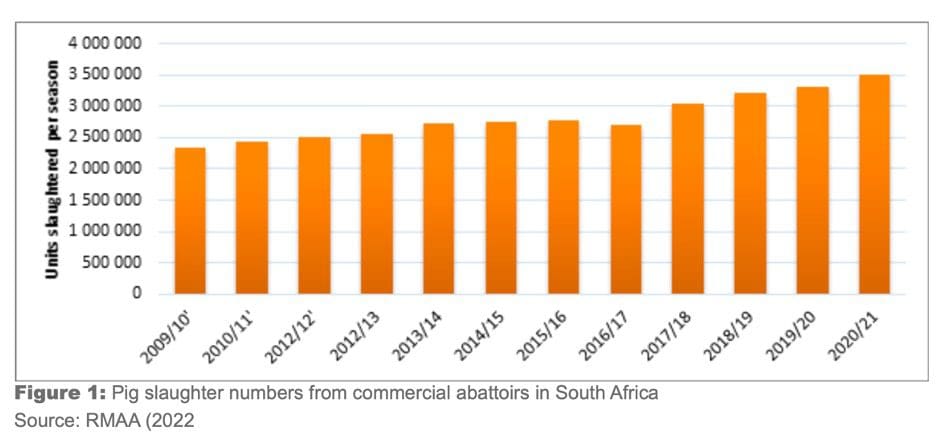
At the same time, the volume of pork products imported into South Africa declined by 10%, which can be linked to the consistent growth in the number of pigs slaughtered domestically, as shown above.
Figure 2 below depicts South Africa’s pork trade in value terms for the marketing seasons 2011 to 2021. While import quantities declined, the value of pork imports into the country increased by 149%.
In 2011, pork imports were valued at R429.8 million. This increased to a record high of R1.070 billion in the autumn of 2021. Similarly, pork export earnings increased by 152%, from R157.4 million in 2011 to a record high of R396.4 million in 2021.
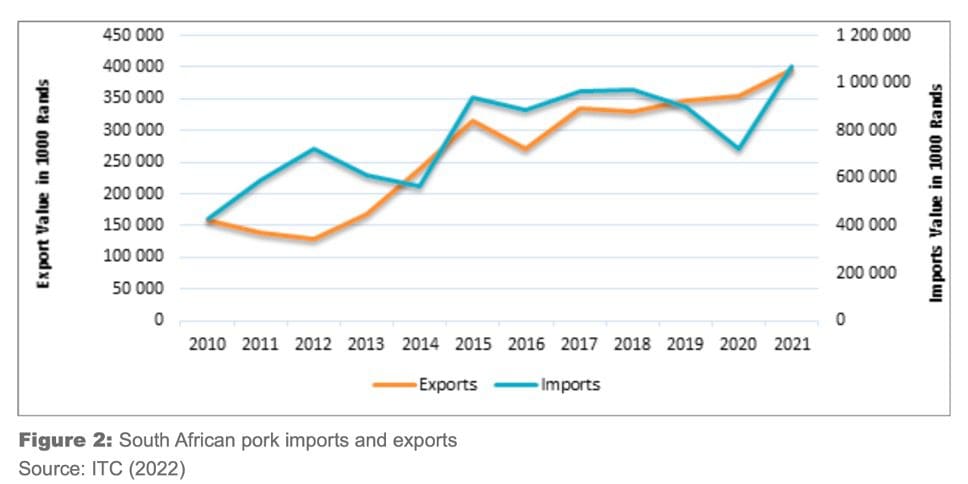
South Africa’s increase in pork export earnings is mainly supported by the Southern African region, followed by the Asia-Pacific Economic Cooperation (Apec) and the Middle East. In 2021, about 95% of South Africa’s pork export earnings originated from Africa, an increase of 6% when compared to the 89% of 2020. Apec purchased 4% of our pork exports and the Middle East 1%, which declined compared to the previous year.
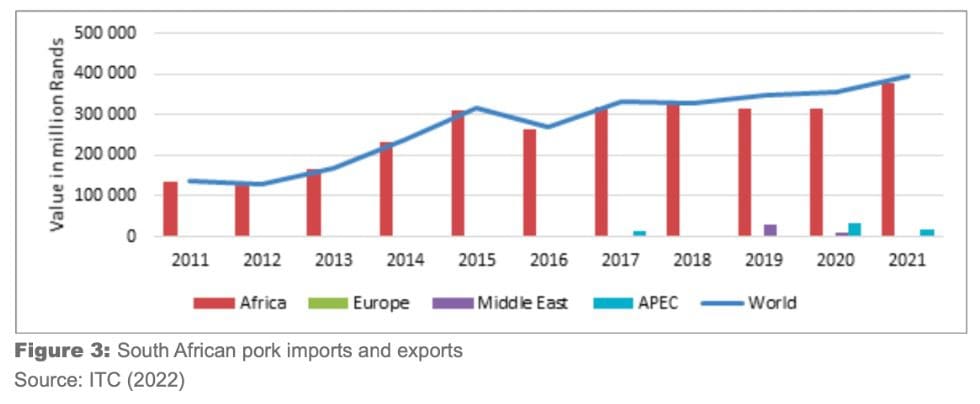
Gaining new markets
2021 was a mixed bag for South Africa’s pork export earnings. Major markets like Mozambique saw a decline, while others recorded increases.
But the general view is that Africa will remain South Africa’s main pork export market. Africa’s increases also offset the declines recorded in other regions. Namibia, Mozambique, Zimbabwe, Lesotho, Botswana and the Democratic Republic of Congo (DRC) are the top buyers of South African pork.
In 2021, export earnings from Zimbabwe increased by 1 981% year on year, followed by Zambia (558%), Eswatini (201%) and Nigeria (115%).
South Africa’s pork imports have drastically increased in value terms despite only a 49% increase in production volumes during the past decade.
Generally, South African consumers prefer the high-value ribs of the pork carcass, fuelling an exponential rise in pork spending in the country. Also, at least 75% of the total pork imports are ribs, resulting in a local supply imbalance for other carcass parts.
New markets are therefore crucial, given the rate of production growth.
As disease outbreaks remain a fundamental challenge for the industry, especially for markets outside of Africa, the country’s ability to manage the problem will determine its success in gaining markets such as the EU, to which South Africa did not export in the last two financial years.
ALSO READ: ICYMI: Many small-scale pig farmers expected to quit in 2022
Sign up for Mzansi Today: Your daily take on the news and happenings from the agriculture value chain.