Thursday, September 3, 2026
SUBSCRIBE
22 GLOBAL MEDIA AWARDS
Food For Mzansi
  • News
  • Changemakers
  • Lifestyle
  • Farmer’s Inside Track
  • Food for Thought
No Result
View All Result
  • News
  • Changemakers
  • Lifestyle
  • Farmer’s Inside Track
  • Food for Thought
No Result
View All Result
Food For Mzansi
No Result
View All Result
in News

Dragon fruit thrives in KZN valley despite tough national season

South Africa’s dragon fruit industry faces a tough season due to severe weather, but the Maqogo community project in the Tugela Valley, KwaZulu-Natal, is harvesting high yields despite national headwinds

by Gerda Potgieter
3rd September 2026
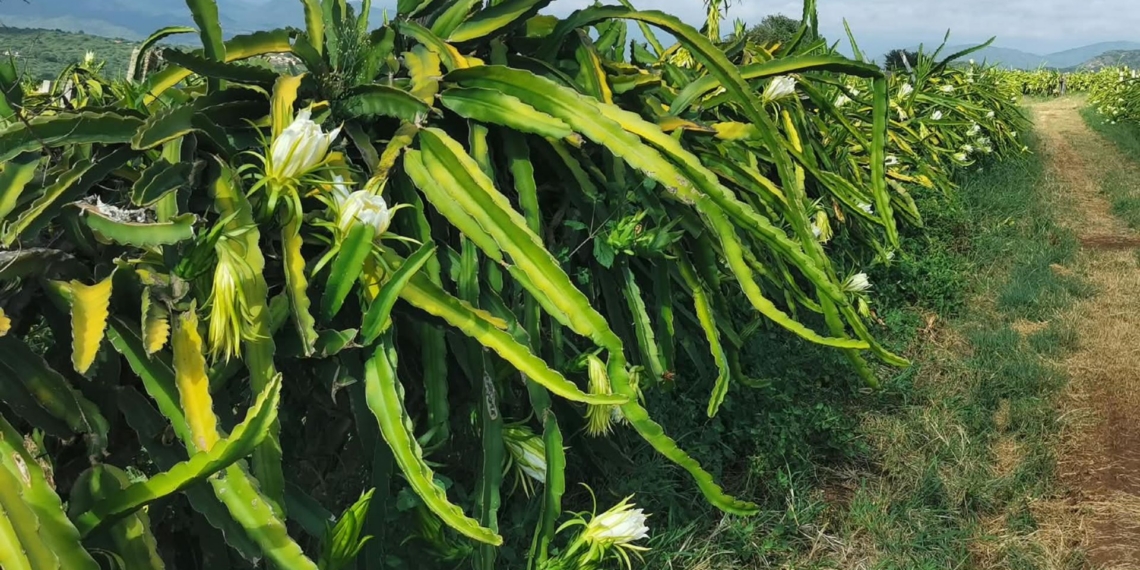
According to the writer Dragon fruit remains a high-value niche crop in South Africa mainly in warmer parts of the country. Photo:Supplied/Food For Mzansi

According to the writer Dragon fruit remains a high-value niche crop in South Africa mainly in warmer parts of the country. Photo:Supplied/Food For Mzansi

Share on FacebookShare on TwitterShare on WhatsApp

South Africa’s dragon fruit industry has had a challenging season, prompting many farmers to leave the sector after unfavourable weather hit production in several regions.

Yet at Maqogo in KwaZulu-Natal’s Tugela Valley, this exotic fruit is bucking the national slump. Situated alongside the Tugela River, the Maqogo community-driven farming project’s dragon fruit is thriving in the area’s hot climate and fertile soil.

Growers in Mpumalanga and the Western Cape have grappled with wet weather, while those in the Eastern Cape have faced overly dry, warm conditions. Maqogo, however, has continued to perform strongly.

Beating the climate odds in KwaZulu-Natal

Ralph Witthoff, one of the farm managers at Maqogo, is positive about the crop’s future. “Our seven hectares of dragon fruit at Maqogo are thriving, but our sister farm, Claridge, outside Pietermaritzburg, is doing even better, and we are looking at a good future for this fruit.”

Dragon Fruit
South African dragon fruit growers are feeling the heat from erratic weather, but KZN’s Tugela Valley is thriving. Emseni Farming’s Maqogo project has turned degraded land into a Global GAP-certified success, boosting local jobs and food security. Photo: Gerda Potgieter

The first plants were planted at Claridge in 2020, with Maqogo following soon after. Dragon fruit needs warm, frost-free conditions, well-drained soil, reliable rainfall or irrigation, and sturdy trellising, as its stems can grow rapidly. The climate and soil at both Maqogo and Claridge suit these requirements well.

Dragon fruit remains a high-value niche crop in South Africa, grown mainly in warmer regions such as Limpopo, Mpumalanga, KwaZulu-Natal, the Eastern Cape and the Western Cape. Harvesting generally runs from November to April.


Related stories
  • Grow dragon fruit: More than just a pretty face
  • Citrus industry confirms no new greening disease threat in SA
  • A look into Mzansi’s dragon fruit industry
  • KZN farmer loses 90% of crop amid severe water shortages

From degraded soil to a commercial success story

Maqogo began in 2009 as a community upliftment project initiated by the late Reverend Erlo Stegen, founder of the KwaSizabantu Mission in rural Kranskop. At the time, communal livestock had overgrazed the area, thorn shrubs dominated the landscape, and erosion was stripping away the soil.

Stegen recognised the land’s potential and, under his supervision, transformed the fertile soils into community vegetable gardens that provided healthy food and a small income for locals.

Experimental trials followed to determine which fruit crops suited the farm’s unique climate. These included dates, pomegranates, papaya, lemons, grenadillas, grapefruit, mangoes, litchis, and yellow dragon fruit. Over time, Maqogo moved beyond experimentation, and its parent company, Emseni Farming, obtained Global GAP certification for commercial dragon fruit production.

Today, the Dragon Fruit Project remains part of Emseni Farming’s broader community upliftment programme in greater KwaZulu-Natal. It created jobs, contributed to the local value chain, and provided Emseni with an additional income stream. Profits help sustain the outreach activities at the heart of the project, while surrounding communities benefit through agricultural development and skills transfer.

The project has also strengthened food security, promoted agricultural training, and supported rural livelihoods by helping community members participate in sustainable farming. Environmentally, it has turned degraded, overgrazed and thornbush-covered land into productive fields while encouraging responsible farming practices and improved soil management.

While many dragon fruit growers elsewhere in South Africa are under pressure, Maqogo and Claridge show how the right climate, careful management and a clear social purpose can turn a niche crop into a sustainable enterprise.

READ NEXT: Strategic support sparks record-breaking growth at WC grape farm

Sign-up for the latest agricultural news delivered straight to your inbox every day with Mzansi Today!

Gerda Potgieter

Tags: community projectsDragon fruitInform mejob creationKwaZulu-Natal
Food for Thought

How to align your farming cycles with long-term financial success

by Eric Enslin
1st September 2026

Farming cycles are unpredictable, but financial deadlines wait for no one. A productive farm can still face severe strain if...

Read moreDetails
Strategic support sparks record-breaking growth at WC grape farm
Strategic support sparks record-breaking growth at WC grape farm

1st September 2026
Beyond finance: Making women-led farms bankable

Beyond finance: Making women-led farms bankable

31st August 2026
Former electrical engineer builds farming powerhouse on tribal land

Former electrical engineer builds farming powerhouse on tribal land

31st August 2026
KZN farmer loses 90% of crop amid severe water shortages

KZN farmer loses 90% of crop amid severe water shortages

31st August 2026

How Tebogo beat post-harvest losses with smart agro-processing

Potato turning point ahead as onions double in price year-on-year

Beyond finance: Making women-led farms bankable

Chicken is booming, but the real money is in the supply chain

KZN farmer loses 90% of crop amid severe water shortages

Join Food For Mzansi's WhatsApp channel for the latest updates!

JOIN NOW!

THE NEW FACE OF SOUTH AFRICAN AGRICULTURE

With 21 global awards in the first six years of its existence, Food For Mzansi is much more than an agriculture publication. It is a movement, unashamedly saluting the unsung heroes of South African agriculture. We believe in the power of agriculture to promote nation building and social cohesion by telling stories that are often overlooked by broader society.

Dragon fruit thrives in KZN valley despite tough national season

Government hikes sugar import price, but industry warns of gap

Chicken is booming, but the real money is in the supply chain

How Tebogo beat post-harvest losses with smart agro-processing

Aucamp outlines strategy for biosecurity, trade, and infrastructure

Rising costs, climate risk push Swartland wheat farmers to the brink

  • Awards & Global Impact
  • Our Story
  • Contact Us
  • Cookie Policy
  • Privacy Policy
  • Copyright

Contact us
Office: +27 21 879 1824
News: info@foodformzansi.co.za
Advertising: sales@foodformzansi.co.za

Contact us
Office: +27 21 879 1824
News: info@foodformzansi.co.za
Advertising: sales@foodformzansi.co.za

  • Awards & Global Impact
  • Our Story
  • Contact Us
  • Cookie Policy
  • Privacy Policy
  • Copyright

Chat Options

I'm Lerato, your AI assistant!
No Result
View All Result
  • News
  • Changemakers
  • Lifestyle
  • Farmer’s Inside Track
  • Food for Thought

Copyright © 2024 Food for Mzansi

This website uses cookies. By continuing to use this website you are giving consent to cookies being used. Visit our Privacy and Cookie Policy.