Farming in South Africa has become increasingly challenging, particularly for black farmers seeking access to agricultural finance. However, the time has come to rethink the approach and recognise the pivotal role of institutional intelligence in empowering them.
This was a key point emphasised by renowned political analyst Dr Piet Croucamp during Food For Mzansi and Land Bank’s lunchtime conversation series at Grain SA’s Nampo Harvest Day. Just more than 100 farmers from across the country attended the event in Bothaville in the Free State.
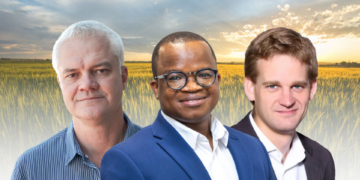
The session, which delved into the R650-million blended finance fund, saw farmers engaging with Croucamp, Free State farmer Happy Letsitsa, and Brenden Baatjies, a commercial banker at Land Bank. The conversation was led by Food For Mzansi co-founder and editor-in-chief Ivor Price.
While Croucamp advocated for blended financing to be given more attention on the agricultural agenda, he challenged the notion of simply replicating historical best practices that may not be suitable for the advancement of new-era farmers.
He suggested exploring other areas within the value chain where farmers can occupy space, capital is more accessible, and dependence on political interests is reduced. By tapping into “institutional intelligence”, farmers can leverage the expertise and guidance available, enabling them to make informed financial decisions that safeguard producers.
“Maybe we should look at where else in the value chain one could occupy space, where capital is more accessible but also where [you are] less reliant on the political interest of whoever may be part of this equation,” Croucamp said.
“If there is a type of institutional intelligence around your business and you are humble enough to ask someone to help you make financial decisions, it will help you in the end. This protects us from our own human weaknesses.”.

Providing exceptional support
Despite its shortcoming, Land Bank does go the extra mile in offering institutional intelligence to its clients, said Baatjies. He said that the bank’s blended finance model provides pre- and post-business support to farmers.
Baatjies added, “Our clients who come from a previously disadvantage background does have a lack of experience in terms of the foundational, technical, and financial [know-how]. We have support services, including, as an example, [and assist with] access to markets.”
While Land Bank cannot become overly involved in the development of applicants’ business plans, the bank does assist in drafting it. It also facilitates connections between farmers and experienced mentors who can provide valuable guidance and expertise.
Letsitsa, who has been farming in Welkom in the Free State for over nine years, expressed the importance of agricultural finance for farmers, drawing from his own experience as a former banker. He acknowledged the challenges faced by farmers when seeking financing without adequate security, emphasising the need for more accessible options.
“When you get the land without any financing or form of security, when you get to the bank the first thing they ask you is what do you have. The title deed is in Pretoria and you don’t have anything to offer,” he said.
ALSO READ: From financial advisor to farming on 600 hectares!
Baatjies, however, assured Letsitsa and others with similar concerns that land ownership was not a pre-requisite for blended finance. Instead, applicants must meet government’s economic benefits criteria scorecard criteria for a grant, and also meet the bank’s credit criteria for the debt portion of the loan.
Meanwhile, Ramodisa Monaisa, a North West farmer expressed frustration with delayed blended finance fund disbursements, resulting in missed planting seasons and compromised yields. This sentiment resonated with others who shared similar concerns about perceptions that undermine the capabilities of black farmers.
“It is hurting us because out there people will [remark] that Land bank is helping them. They’ll say, ‘That’s how black people are. You give them millions, but they cannot produce.’ Why are you doing this to us?”
Streamlining applications
Baatjies responded by acknowledging the valuable lessons the bank has learned in the realm of blended finance over the past decade, particularly since relaunching the programme in October last year. He emphasised that numerous application processes have since been streamlined, assuring farmers that those who have all the required documentation should expect a significantly shorter waiting period of no more than one month in the future.
He also advised farmers who are seeking finance to set realistic goals, highlighting the need for incremental progress and emphasising that in agriculture, taking baby steps is crucial.
“You must crawl before you can walk,” Baatjies said. “It’s important to come into the bank and advise us on what your needs are. Let us do a proper needs analysis and advise you. Spend money on things that [generates] money for you.”
Brian Disipi, a farmer from the Free State, expressed his positive sentiment towards Land Bank, stating, “Land Bank is doing a good job. I personally know three individuals who have already received blended finance. I am encouraged by their initiatives. Initially, I was hesitant to apply, but Land Bank has provided me with financing, even though I operate in a rural area”
- Join Food For Mzansi at Land Bank on Wednesday, 17 May for a lunchtime talk in which the new Land Bank chief executive, Themba Rikhotso, will share his vision for the bank. Joining him on the panel are Agri SA executive director Christo van der Rheede, and Leona Archary, chief executive of Agda. The panel discussion will be held at Food For Mzansi’s tent at gate 2 of Nampo Park.
WANT TO ATTEND? Click here to reserve your seat


Sign up for Mzansi Today: Your daily take on the news and happenings from the agriculture value chain.