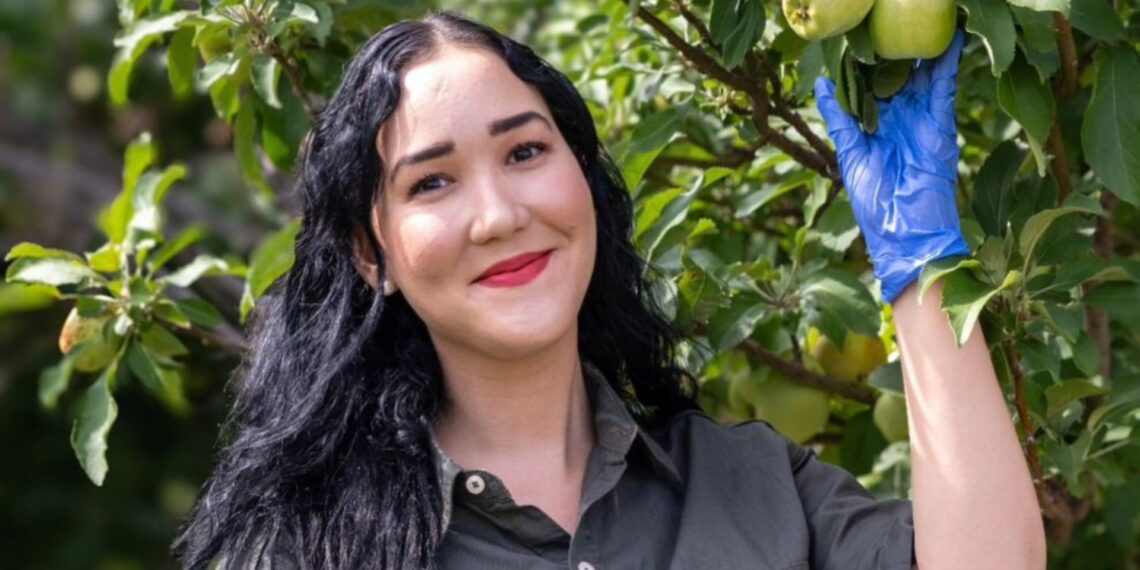
In a sector where women own only about 20% of farming units, Elize Gerda Beukes is forging a path of excellence and empowerment. Since founding G&E Beukes Boerdery in the Northern Cape, she has built a diverse, sustainable farm operation while inspiring women and youth to claim their space in agriculture.
Beukes grew up in a small farming community 15 kilometres outside Keimoes in the Skaap-Eiland area, where early lessons about nature and hard work shaped her. Although she later earned a degree in psychology, her true passion was always farming.
When Covid-19 struck just after she graduated, lockdown restrictions brought her home, and with little else to do, she returned to her first love, farming. Since then, she has committed to professionalising her skills, earning nine farming qualifications and completing extensive training in farm management and related fields.
Drawing on two worlds of knowledge, Beukes explains, “Studying agriculture and psychology has given me a unique perspective in my work. Agriculture taught me the science and strategy behind sustainable production, while psychology helped me understand human behaviour.’’
This knowledge has been vital for leading teams, managing stress, and building strong relationships in the farming world. Together, these fields have taught her that success in agriculture depends not only on the health of the soil but also on the well-being and mindset of the people who work it.
Related stories
- Ngwenya’s sweet potato surprise: Turning harvest into innovation
- Women in agriculture: Gender gap persists in commercial farming
- Women farmers demand fair shot at success
Diverse farming and community roots
Established in 2019, G&E Beukes Boerdery sits on seven hectares of semi-arid land in the Northern Cape. Here, Beukes has built a diversified mixed farming operation that balances sustainability, innovation and efficiency in a challenging environment marked by low rainfall and sandy soils.
The farm is carefully divided to optimise production and soil health. Two hectares are devoted to vineyards growing Thompson Seedless, Merbein, and Sultana raisin varieties, utilising flood irrigation suited to local conditions.
Another hectare grows peanuts, rotated to enrich the soil, while a further hectare produces lucerne, a high-protein forage that also improves soil nitrogen.
For livestock grazing, 30 goats and 25 sheep rotate on a hectare of pasture, alongside a hectare set aside as a resting dry land track. An additional hectare will soon be developed into intensive vegetable production, broadening the farm’s scope.
“From a young age, I learnt the value of hard work, patience, and respect for nature – lessons that continue to guide me every day in my farming journey. The close-knit community I was raised in taught me the importance of collaboration, resilience, and caring for both people and the environment,” she says.
Representing women in agriculture
Her hard work and dedication have earned her prestigious recognition, including the Top Achiever Award from Kal Group and coverage in prominent platforms such as Markto magazine, Woman in Business Radio Riverside and, most recently, the Agricultural Writers Award for New Entrant to Commercial Farming.
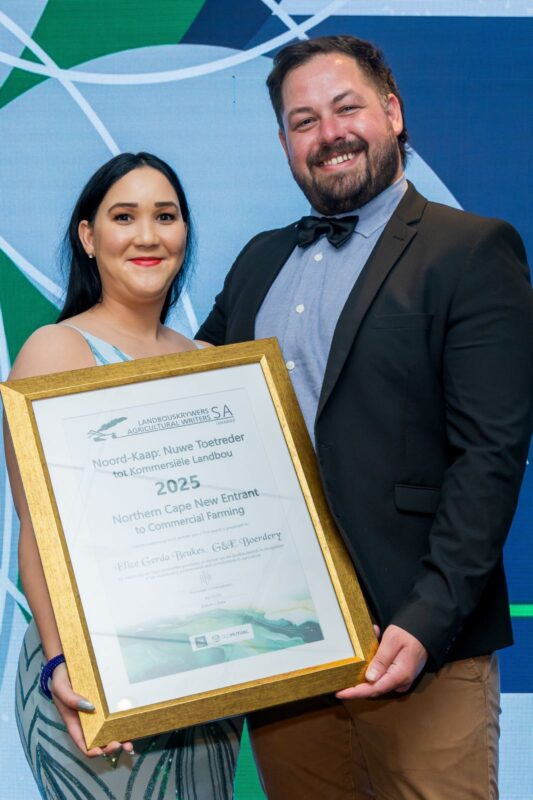
“As a woman in farming, this award represents empowerment. It shows there is space for women in agriculture, a place where we can feel safe, express ourselves, and celebrate our uniqueness. This win is more than just recognition; it’s about embracing who you are and discovering your true purpose in agriculture,” Beukes adds.
Inspired by her parents’ farming legacy and determined to tackle gender disparities, she actively mentors women and youth in agriculture. She champions a new narrative that farming can embrace femininity and individuality, inviting newcomers to challenge stereotypes and confidently seize opportunities in the sector.
“I saw a gap in agriculture; a lot of women are not in agriculture, and I wanted to fill that gap, to show youth and to show women that agriculture is a sector where we as women can actually be ourselves. You can have your lipstick on, you can have your make-up on and still be able to farm.
“To me, it was about changing the narrative, changing the dynamic and showing that there is more to agriculture.”
However, there is still a long road ahead to carve out meaningful space for women and newcomers in the agricultural sector; Beukes encourages those stepping into farming to embrace opportunities boldly.
“My advice is simple: take the opportunity and take the risk; just go for it. I believe knowledge is power, so start with a short course; there are plenty available nowadays. Find a mentor, apply yourself, and most importantly, show up.”
READ NEXT: Grain SA celebrates developing farmers at Ukukhula Conference