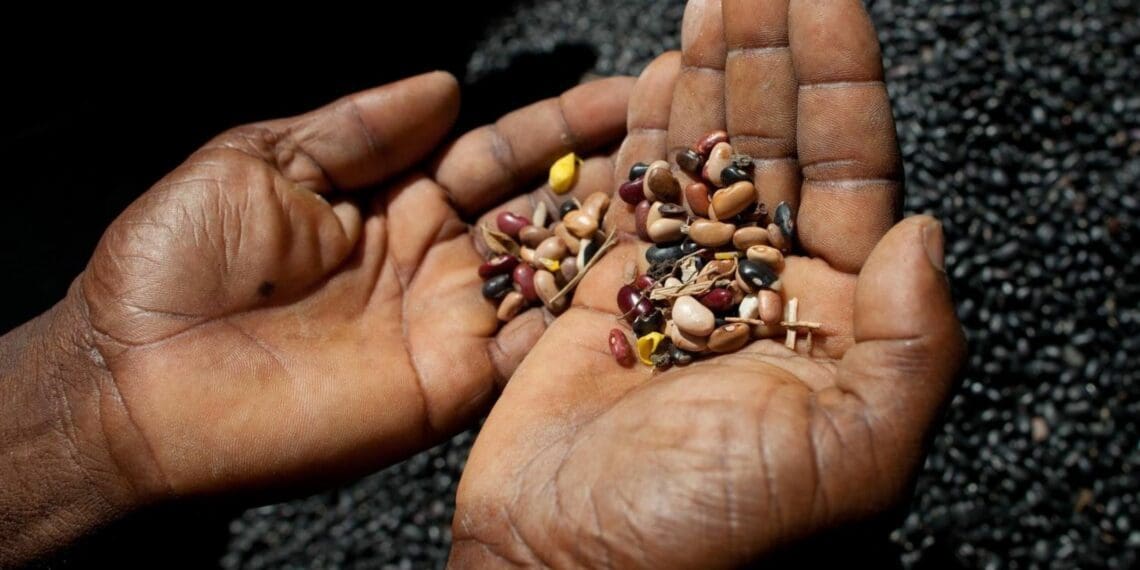
In most African countries, farmers continue to access seeds through a combination of formal, semi-formal, informal, and emergency-based seed systems.
Experts believe that the commercial sector has no real challenges in accessing quality seeds. However, in the subsistence sector, there are quite a bit of challenges. So the big question is, how do we enhance access to quality seed in Africa for these farmers?
In this article Julian Jaftha, chief director for plant production and health at the department of agriculture, land reform and rural development, and Chris Ojiewo, strategic partnerships and seed systems lead for the Consultative Group on International Agricultural Research (CGIAR), share their thoughts.
Breeding programmes lack investment
According to Jaftha, the commercial sector has no real challenges in accessing quality seed. These players, he said, are the main actors and good collaboration between the government, regulatory authorities and the commercial sector exists.
“However, in the subsistence sector, there are a few challenges. They are often dependent on government support programs where [seed] inputs are made available.
“Although from our point of view, we’ve always tried to advise what the input ought to be. There is really a challenge often as to what seed is ultimately made available to that particular farmer,” he said.
Access complications
South Africa has a public sector breeding programme associated with the Agricultural Research Council (ARC). However, Jaftha points to challenges around the investment that goes into breeding. This, he added, is also a challenge for the ARC. “Remember, you can’t just have a once-off investment. Breeding programmes do take time,” he cautioned.
He thinks that because there is a lack of investment, some of these research institutions, whether it’s state-owned or universities, become entangled in the prediction of their varieties.
This then leads them to enter into licensing agreements which, Jaftha added, then complicates access to the improved varieties.
Bridging the gap between science and farming
Part of the issue with seed varieties that are released into the market, Ojiewo believes, is that they are not sufficiently differentiated in terms of market segments. This, he said, is an issue that the public sector is currently looking at.
“This is for the farmers to be able to get the right access not just to quality seed, but quality seed of right varieties is also of the interest.”
Another problem, Ojiewo pointed to, is data. “I know most of our research institutions talk so much about data, but at a level that is not necessarily relevant to the various stakeholders to understand and to make commercialisation decisions.”
Ojiewo said current conversations around data do not look at the value proposition about a particular seed variety that will enable the farmer to make better seed decisions.
“[The question then becomes] do we have that displayed in a way that a farmer would understand from a scientist level to a farmer level?
“Can we climb down to the level of the farmers and enable the farmer to be able to make such kind of commercialisation decisions?” Ojiewo questioned.
Breed seeds for local context
According to Jaftha, the market failure is a result of breeding that is happening, but without due consideration being given to the local context.
“Unfortunately, multinational seed companies have a particular interest and they don’t necessarily release or develop what we could consider orphan crops which have a local relevance.
“So I think there is the opportunity really for us to invest more in terms of public sector breeding.”
Jaftha also believes that there is an opportunity for collaboration between breeding companies and public sector institutions. This is especially in terms of sharing the appropriate technologies.
Overall, experts said there is quite a bit of work that still needs to happen in order to ensure that some varieties are developing, which are not mainstream varieties.
READ NEXT: Women’s Day: Join us at our Soul To Soil brunch
Sign up for Mzansi Today: Your daily take on the news and happenings from the agriculture value chain.