 As a child, Rejoice Ncwane was already well versed in the skills of sugarcane farming. While she may have once entertained the idea of becoming a lawyer, her love for the land and her people has remained the true passion of her life.
Ncwane lives in the verdant valley of Qoloqolo Ezitholeni in southern KwaZulu-Natal, and is one of South Africa’s most prominent small-scale sugarcane farmers. She breaks down barriers for women in the industry too, urging all women in rural areas to unearth opportunities in their communities.

Do not to be afraid of becoming leaders, she often says, and specifically don’t “run away” from learning new skills because there is still “a lot to be done”.
Ncwane’s dream is to grow her 8ha under sugarcane to 25ha or 50ha because then she says she could do “something different”.
“Then I could help our children. It is not a good thing that our young people want to go to the cities. The cities first destroy your mind, then they destroy you and then they destroy your life. When our children go to the city, they forget who they are and where they come from.”
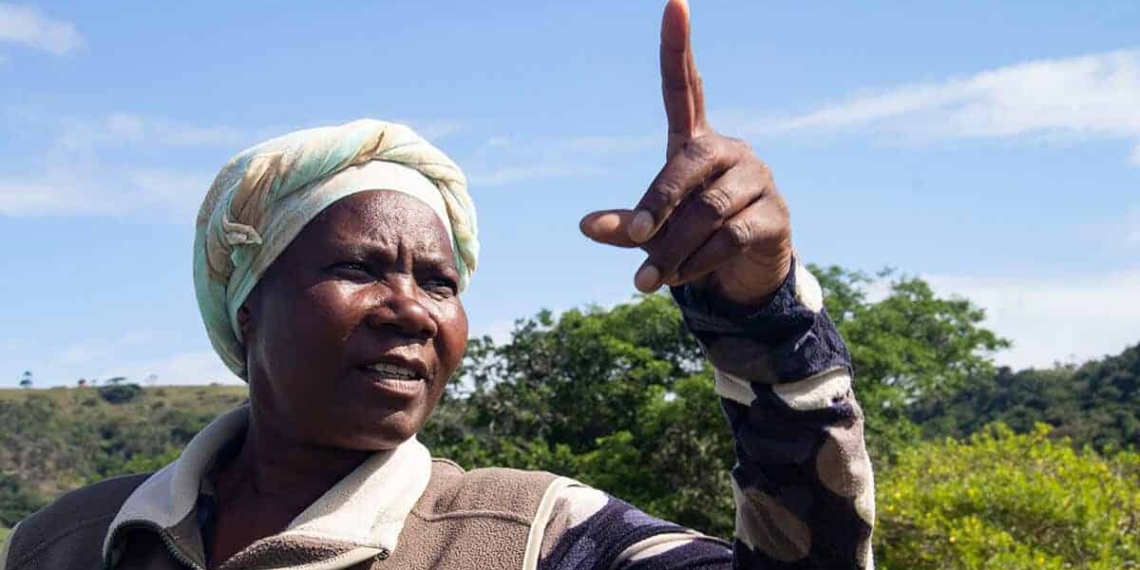
Ncwane uses her hands to paint eloquent pictures in the air of her simple, but extraordinary life.
“When I was a little girl, I would have to care for the animals and work in the fields before going to school. We have always grown maize, beans and vegetables. We used to have cows, but not anymore as I need at least one hectare for one cow. I would rather use that land for crops such as bananas. I now have about 30 goats. For as long as I can remember we have always grown sugarcane here,” she says.
Born in a world of sugarcane farming

When the mother of two was a 12 year-old girl she already knew everything there was to know about growing and taking care of her family’s crop.
“I used to help my parents weed the fields and when we harvested, I would lift the bundles onto my shoulders and carry them to the loading zone. That’s how we did it back then. There were no tractors or big trucks that came here to haul our crop to the sugar mill.”
In fact, when Ncwane was growing up, the family’s cane harvest was loaded on to a one-ton truck before being transported to a nearby commercial grower’s farm.
There the stalks were bundled onto railway carriages before being hauled to the Sezela mill under the power of a steam engine on narrow-gauge railway tracks.
Today, contractors who are all members of the community have their own haulage and cane- cutting companies. There is a loading zone at the bottom of the road leading up to Ncwane’s farmstead and the land she has under cane has grown from just one hectare to eight, which yield about 60 tonnes a hectare.
“Life has changed a lot here since I was a child. There have been many big projects where we have seen proper sanitation installed in our community. We have running water now and we got our electricity in 2015 and 2016.”

As a leader in the valley, Ncwane has been involved in driving each and every improvement project that has come their way, including the construction of a pedestrian bridge across the nearby and mighty Mtwalume River which, she says, can be treacherous in the rainy season.
“We are now working towards having a proper bridge built for vehicles and another pedestrian bridge higher up for the school children. I was also on the school governing body, but I told them I wanted to rest. I want to focus on my sugarcane,” she said.
Ncwane was educated at the local primary school before she headed off to the Mtwalume High School. Her desire to get out and work in the fields meant she decided to leave school in grade 11 to start her training in sugarcane management. In time, she completed her grade 12 through distance learning.
“I started as a loading zone clerk in 1978. I loved working in agriculture and I was really good at my work,” she said.

Nearby contractor and commercial sugarcane farmer Dono Bohlela, who came to the Qoloqolo valley to assist the small-scale growers with their harvesting and hauling, put Ncwane in charge of his crew – both in the fields and at the loading zone to oversee his operation.
“I wanted to do more. I went on sugar industry training courses at the South African Research Institute (SASRI) at Mount Edgecombe. I completed as many of those courses as I could – business administration, junior and senior courses in land and crop management. I wanted to know everything about becoming a better sugarcane grower.”
Prominent voice in sugarcane industry
Ncwane was soon elected chairperson of the local farmers’ association. In 1996 she was also elected vice-chairperson of the small-scale growers’ Sezela mill committee.
In 2006, when Errol Koekemoer, with support of the leadership of the time, made a decision to unify the commercial, small-scale and Indian grower associations in the area under the Sezela Cane Growers’ Association, Ncwane was immediately elected as vice-chairperson. This position was soon followed by her nomination as chairperson.
Once her term at the top of the table expired, Ncwane was again elected vice-chairman. And while she agrees there were many challenges along the way, with a light brush of her left hand across her right shoulder, this woman who loves to sing and says she was once bestowed with above average skills on the football field, demonstrates how she deftly brushed them away.
“A woman is the backbone of the world. Without women nothing can happen. I realised, as a woman on my own, that I had to stand up for myself and for others. We have done a lot here, we have a lovely new road, water, sanitation and electricity, but there is still a lot more to be done,” she says.
“Our small-scale growers still face challenges, but we have lots of support from SA Canegrowers, the South African Sugar Research Institute, the department of agriculture, land reform and rural development, and the Sezela Canegrowers’ Association. These organisations have people who are all helping us, supporting us and that is what is making us strong and that is how we will always succeed.”
-
This article was originally published by Shukela Plus, a quarterly magazine focusing on South Africa’s evolving sugar industry.