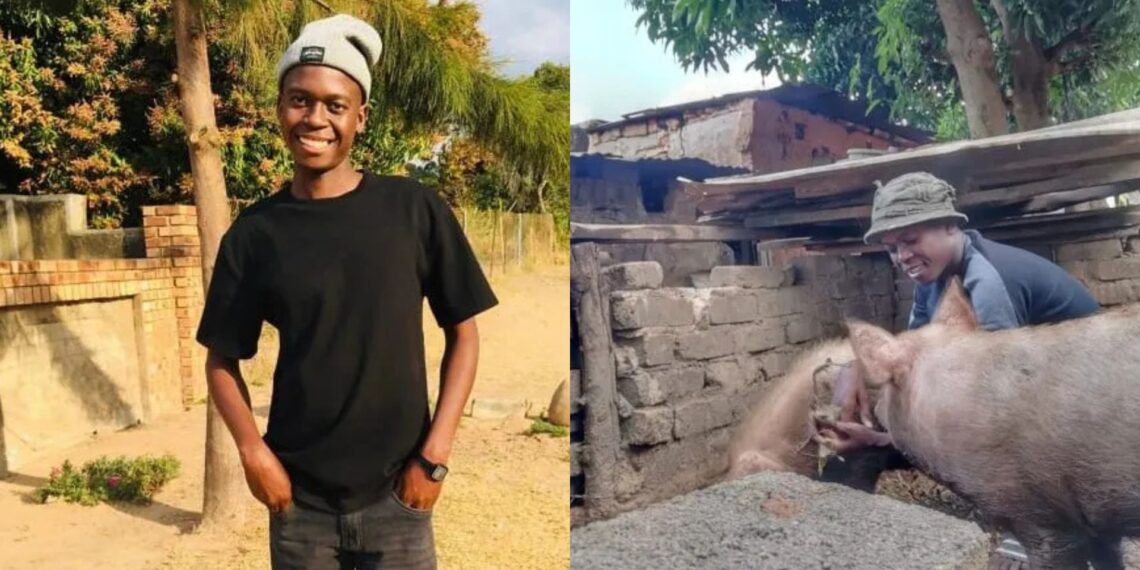
While most students use their NSFAS allowance to cover textbooks and groceries, 23-year-old Innocent Segodi invested his allowance in something less conventional. Segodi is bringing home the bacon by starting a piggery, with just R1 000 he saved from his NSFAS allowance.
Originally from the rural village of Casteel in Bushbuckridge, Mpumalanga, Segodi is studying towards a bachelor of education at the University of Venda. Like many students, he dreams of graduating on time. But beyond the classroom, he also wants to be a full-time livestock farmer.
“I’ve always wanted more than just a job,” he says. “I want to build something of my own.”
The struggles of his upbringing inspired his desire to become a farmer. Growing up in a household where money was tight lit the fire under him to want to transform his family’s situation.
“Saving capital to start a business was not easy for me, but I kept moving with my dream of being a livestock farmer, which somehow motivated me,” he says.
“Back then, it was tough for me to raise funds to purchase the pigs. I started raising funds and drafting my plan when I was still in school in Grade 11. I tried to save my lunch money at school, but it was not easy to raise even a minimum of R1000 since I was given R10 per day, sometimes nothing.”
Side hustles fund main hustle
To make ends meet, Segodi helped his grandmother sell vegetables to local street vendors. “Still, the money I made was not enough to start my business,” he recalls. His grandmother, who earns a pension, also struggled to keep her vegetable business afloat, as it took about eight months for the crops to mature.
So when his NSFAS allowances came through at university, Segodi didn’t rush to buy gadgets or luxuries. Instead, he put aside some money to buy two piglets for R500 each and built a kraal using bricks and poles on his family’s plot.
Related stories
- Engineering graduate takes shot left to farming in North West
- Limpopo farmer finds peace, purpose in the harvest
- Siyakhula Crop Farm: Ennerdale co-op battles odds to build legacy
- Next-gen farmer blends business savvy with soil wisdom
“I used my first book allowance to buy two pigs. And continued to use my allowance from university to buy medication, mixing feeds for my pigs and currently I am working on expanding and buying chicken layers and goats,” he says.
“I knew I had to be smart with the little I received from NSFAS. I didn’t wait for the ‘right time’, I used what I had to start the farm,” he explains. Some of his allowance also went towards commercial feed and vet visits, ensuring the pigs were vaccinated. It wasn’t much, but it was all he needed to get started. And great things do have small beginnings.
Today, Segodi runs his small operation under the name Casteel People’s Piggery, in recognition of the community where his suppliers and support system are based.
He currently manages eight pigs: two fully grown breeders and six piglets. With limited land, he caps his herd at 20. His sales are mostly local. Boar pigs go to nearby butcheries and individuals, while sows are kept for breeding. His pigs are now a cash cow with a good season bringing in around R9 000 into the business.
Family affair
Sometimes it takes a whole family to run a business. Innocent’s grandmother, Cecilia Magagula, helps collect kitchen waste from nearby homes and schools when he’s away to supplement the pigs’ feed. On tough days, she even buys maize meal to cook for the pigs.
“She’s the backbone of the farm when I’m not home,” Segodi says. When he is not home, he is away chasing assignment submission deadlines at the university.

Running a farm while studying full-time is a tough task. Classes sometimes clash with urgent farm duties. It gets so intense that during mating season, time and again, he has to spend hours standing near the kraal, watching the pigs and stopping them from hurting one another, and such farm duties have cost him a few tutorials. However, according to the young entrepreneur, these hard choices are the make-or-break of his business.
His classmates didn’t always understand. “Some laughed at me. They couldn’t see why someone at university, on track to graduate, would want to deal with pigs. But that didn’t stop me. I know why I’m doing this.”
What Segodi also knows is that the health of his pigs is of utmost importance if his business is to continue. He vaccinates them at the local vet clinic, but also uses traditional practices learned from his first supplier. One method involves applying ash from burnt wood to wounds, which prevents infection and keeps flies away.
Segodi combines the knowledge he absorbs from people already experienced in pig farming in his local area, as well as the knowledge he gains from reading. This helps him keep his pigs in sound health at all times.
SA’s pork industry
According to the National Agricultural Marketing Council, the pork industry is one of South Africa’s fastest-growing agricultural sectors, contributing about 2.15% to the primary agricultural sector. The industry plays an important role in the production of pork and the creation of job opportunities.
The South African Pork Producers’ Organisation (Sappo) says pig farming is suitable for young entrepreneurs because it requires relatively low startup capital, offers quick turnover, and benefits from strong demand. The organisation also mentors farmers, helping them navigate both the farming and business sides of pig farming.
The Department of Agriculture’s Young Producers and Entrepreneurs Strategy (YPES) is among the initiatives aimed at supporting young farmers like Segodi, offering mentorship and funding opportunities to scale small operations into sustainable businesses.
“My hope is not to lose focus,” says Segodi. “Sometimes it’s hard to deal with the mentality that pig farming isn’t for students… because it’s dirty work, you’re always in the mud. But I remind myself that both my education and the farm are part of my journey.”
He advises his peers to start small and start now.“You don’t need to wait for a perfect moment or big money. Start with what you have. Even if it’s small, even if it’s muddy, just start. That’s how you grow.”
Segodi’s story is a story of what conviction in your own dreams can achieve; the smallest seized opportunity can make all the difference. As South African youth continue to battle joblessness, it is seemingly small decisions, as in Segodi’s case, that might just turn things around.
- This article was first published by Khulani!
READ NEXT: Goats, gumboots & grit: Zanele grows hope in Hammanskraal