Saturday, April 18, 2026
SUBSCRIBE
21 GLOBAL MEDIA AWARDS
Food For Mzansi
  • News
  • Changemakers
  • Lifestyle
  • Farmer’s Inside Track
  • Food for Thought
No Result
View All Result
  • News
  • Changemakers
  • Lifestyle
  • Farmer’s Inside Track
  • Food for Thought
No Result
View All Result
Food For Mzansi
No Result
View All Result
in Inspiration

Next-gen farmer blends business savvy with soil wisdom

Kyle-Jones Middleton left a corporate career to lead African Joy Farm, blending business acumen with a 20-year legacy. He's redefined modern agriculture, cultivating not just maize and pecans, but a vision of black excellence in farming

by Lisakanya Venna
17th November 2025
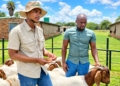
Kyle-Jones Middleton stepped into the family legacy at African Joy Farm, redefining black excellence in farming after 20 years in the Free State. Photo: Supplied/ Food For Mzansi

Kyle-Jones Middleton stepped into the family legacy at African Joy Farm, redefining black excellence in farming after 20 years in the Free State. Photo: Supplied/ Food For Mzansi

Share on FacebookShare on TwitterShare on WhatsApp

Taking over a family legacy can be daunting, with big shoes to fill. But Kyle-Jones Middleton stepped into those big shoes to redefine black excellence in farming, building on 20 years of history at African Joy Farm in the Free State. 

Middleton’s farming journey began far from the fields; his path at first led him through corporate corridors. Armed with an honours degree in management accounting, he understood early on that modern farming was as much about sharp business sense as it was about the land. 

“I hold an honours degree in management accounting, which has been invaluable in shaping my decision-making, as it equips me with a strong business-oriented perspective,” he says. 

Corporate to kraal

After completing his studies at Stellenbosch University in 2017, Middleton joined the corporate world the following year. He started as a category and channel development assistant for haircare, then moved to a category and channel assistant for deodorants and skin cleansing products. 

Eventually, he became a brand manager at Unilever until 2020, when he transitioned straight to farming to join his family business.


Related stories
  • Tipsy Twenties founder grows wine dreams far from the Cape
  • Finance meets farming: How Hlalele built a 300-hectare legacy
  • New generation, new struggles: Young farmers fight on

“My three years of corporate experience at Unilever South Africa provided me with key knowledge and skills that I regularly apply on the farm. These include managing and balancing finances, building business cases, forecasting, strategic financial planning, and, importantly, data-driven decision-making.”

A proud legacy

Today, Middleton and his family run a diverse and thriving farming enterprise near Jacobsdal in the Free State, situated on 300 hectares irrigated under the Orange-Riet Water Scheme. 

As a second-generation farm owner, he works closely with his mom, Jacqui, who manages administration and human resources (HR), and his dad, Keith, who supports him with various projects and advice. 

Their farm, African Joy, has been in the family for 20 years. They cultivate maize, wheat, lucerne, potatoes, and pecan nuts, alongside a newly built feedlot dedicated to finishing Bonsmara cattle, a breed he carefully raises with plans to establish a Bonsmara stud within the next three years. 

“I’ve been a full-time farmer for the last six years. I always wanted to farm from birth; some would say I was destined for it. Both my grandfathers were involved in farming, so it’s in my blood. My mom grew up on a farm in Ixopo, KwaZulu-Natal, so farming was always part of the family.

“I enjoyed gardening with my granny and was always fascinated by how you could put something in the ground and it would grow. I’ve always had a strong interest in animal production, and even as a three-year-old, I would often talk about my cows – even though they didn’t exist yet.”

📢 Stand Up, Be Seen, Be Counted

We want to provide you with the most valuable, relevant information possible. Please take a few minutes to complete this short, confidential survey about your farming practices and challenges. Your feedback helps us tailor our coverage to better support the future of agriculture across Mzansi.

What is your main commodity farmed?
CAPTCHA image

This helps us prevent spam, thank you.

Overcoming adversity, growing resilience

However, their journey hasn’t been without obstacles. When they first started farming, integrating into the local community proved challenging, as they were among the very few black commercial farmers in the area. Over time, perseverance and consistent relationship-building helped them carve out a respected place in the industry. 

“The fact that our family can officially say we are commercial farmers is a big achievement,” Middleton reflects. “I’m proud of the work done over the last six years to elevate the foundation I was given. We’ve grown every business unit exponentially and added new ones.”

His motivation is clear: “I want to provide for my wife and parents and be one of the best young black farmers in the country. We’re not here to take up space; we’re here to take over – a beacon of black excellence in farming.”

Leading with heart

Currently, Middleton employs 10 permanent staff, including three family members. His approach balances high standards with inclusivity. “I expect excellence and attention to detail, but I try to create a happy, inclusive environment. 

“I foster an ownership mentality in my team by involving them in the success of the season so they directly benefit,” he explains. 

This strong team spirit and shared responsibility have been essential, especially when their farming operation was tested by “fires, hail, tornadoes in 2019, and flooding between 2020 and 2022,” he recounts. 

He notes that resilience has been a very important factor to him, especially in ensuring that their farming business is not dependent on a single income source or season. 

Middleton further stressed the importance of forging strong relationships with agribusinesses and other farmers. “Farmers seldom farm in isolation, so relationship building is very important, and that takes time.” 

ALSO READ: SA’s agriculture budget is too little to transform, says Sibiya

Sign-up for the latest agricultural news delivered straight to your inbox every day with Mzansi Today!

Lisakanya Venna

Lisakanya Venna is a junior journalist and content coordinator with varied multimedia experience. As a CPUT journalism alumni, she finds fulfilment in sharing impactful stories and serving as a reliable source of information.

Tags: Commercialised farmerFree StateInspire meMixed farming

Related Posts

100 ha of hope: Aphiwe revives family farming legacy in Engcobo

100 ha of hope: Aphiwe revives family farming legacy in Engcobo

13th April 2026
Poultry and potatoes power Fort Hare graduate’s farming vision

Poultry and potatoes power Fort Hare graduate’s farming vision

10th April 2026

Big dreams on his ‘Tiny Farm’: Setjhaba’s 300-hectare success

Jobless to boss: Sihle Petela grows jobs and crops in Mthatha

Sabelani Co-op gives Bongani Nkosi purpose and a future

Dignity in the vineyards: How DONUTS wine changed SA farms

Agrolimo Farms: Tebogo turns schoolyards into Soweto’s pantry

Bongeka’s backyard business grows from 100 to 3000 broilers

Quota errors leave small-scale fishers fighting for survival
News

Quota errors leave small-scale fishers fighting for survival

by Liezl Human
16th April 2026

West Coast small-scale fishers are fighting for survival following a series of administrative bungles by the DFFE. Despite a promised...

Read moreDetails
Strategic breeding: How Chianina genetics can boost a beef herd

Strategic breeding: How Chianina genetics can boost a beef herd

15th April 2026
More than livestock: Lesedi’s legacy in the heart of the Kalahari

More than livestock: Lesedi’s legacy in the heart of the Kalahari

15th April 2026
SA farmers resist switching to biological fertilisers – this is why

SA farmers resist switching to biological fertilisers – this is why

15th April 2026
Women in agriculture tackle markets, finance and climate risks

Women in agriculture tackle markets, finance and climate risks

15th April 2026

100 ha of hope: Aphiwe revives family farming legacy in Engcobo

Updated plant health protocols open doors for SA citrus in China

SA’s apple industry marks 364 years with rare tree planting

Growing more than food: Ngxanga shapes future farmers

Didiza calls for radical shift in youth land access and finance

Join Food For Mzansi's WhatsApp channel for the latest updates!

JOIN NOW!
Next Post
South Africa’s dairy champions shine at the 2025 Master Dairyman Awards. Photo: Supplied/Food For Mzansi

Meet the dairy champions driving change in Mzansi

THE NEW FACE OF SOUTH AFRICAN AGRICULTURE

With 21 global awards in the first six years of its existence, Food For Mzansi is much more than an agriculture publication. It is a movement, unashamedly saluting the unsung heroes of South African agriculture. We believe in the power of agriculture to promote nation building and social cohesion by telling stories that are often overlooked by broader society.

Biosecurity is now a make-or-break for pork producers

Updated plant health protocols open doors for SA citrus in China

Growing more than food: Ngxanga shapes future farmers

Five planning steps to build a profitable farming business

Why insurance brokers must speak the ‘language of the farmer’

SA’s apple industry marks 364 years with rare tree planting

  • Awards & Global Impact
  • Our Story
  • Contact Us
  • Cookie Policy
  • Privacy Policy
  • Copyright

Contact us
Office: +27 21 879 1824
News: info@foodformzansi.co.za
Advertising: sales@foodformzansi.co.za

Contact us
Office: +27 21 879 1824
News: info@foodformzansi.co.za
Advertising: sales@foodformzansi.co.za

  • Awards & Global Impact
  • Our Story
  • Contact Us
  • Cookie Policy
  • Privacy Policy
  • Copyright
No Result
View All Result
  • News
  • Changemakers
  • Lifestyle
  • Farmer’s Inside Track
  • Food for Thought

Copyright © 2024 Food for Mzansi

This website uses cookies. By continuing to use this website you are giving consent to cookies being used. Visit our Privacy and Cookie Policy.