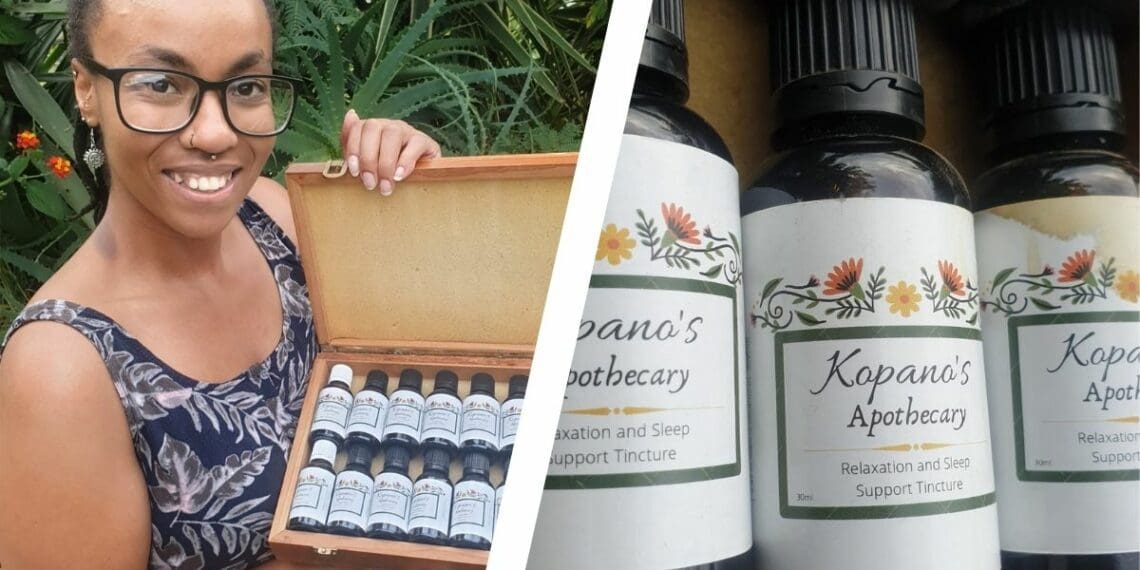
Kopano Makunyane started her journey into herbalism and skincare after experiencing a bad bout of eczema. Unable to afford the high cost of dermatological creams and medicines, she ended up researching natural ways to soothe her skin. The end products of her research were so effective, she turned it into a business.
“I did the thing that I always do, which was to research, research, research. And I happened upon a recipe for skin ailments like eczema. I got the herbs and I made the skin salve. [After] I put it on, it worked like a bomb.”
Makunyane had always had an interest in healing people, and aimed to become a doctor as a child. When she did not get the required marks during her school career, she decided to take psychology as a major instead. She explains how a class called critical psychology changed her perspective on healing and administering healing.
“We [talked] about how western medicine creates a division between the [sick] person and their healing. It puts the healing of that person in somebody else’s hands. In the old days, you would feel a cough coming on and then you’d go out to your herb garden, gather some herbs, crush it, and drink it into a tea. Then pish posh, you are healed.”
Makunyane developed eczema around the age of 25, and found that the medical care she needed was out of her reach financially. She didn’t have medical aid at the time and was unable to afford the cost of dermatologist appointments and specialised medications and ointments.
“I just went to some of my family members who did have eczema and asked them for their creams and asked them what they did. It helped a little bit, the creams did. It went away and then it came back the next year.”
When the eczema resurfaced, she decided to use the resources she had at her disposal. She headed to the internet and found online communities also dealing with the same issues.
“My mom kept pushing me to go to the doctor, but I said I don’t think that’s all the way necessary. I’m not dying, so I went online. I joined a herbalism group on Facebook and I asked them also, ‘what can I do for eczema?’, and they [explained their remedies]. And honestly, from that day on I was like, ‘I’m not turning back’.”
For Makunyane, the only way to treat skin and other health ailments now is with natural remedies she brews herself.
“If I’m really, really sick, then I’ll go see a doctor. But if it’s nothing dire, and I can make something to help heal myself, then I will. There’s a balance that can be met between allopathic medicine and herbalism, so that’s how I try to live. “
Kopano’s Apothocary
Makunyane started her business in 2020 during the Covid-19 pandemic. “I started when the lockdowns had been [mostly] lifted. So it wasn’t really out of desperation. I mean, at that juncture, I was unemployed and had been the whole of that 2020 year. But I needed a revenue stream that felt aligned to me.”
She says finding employment with another company was not what she wanted to do, as a full-time job required all of her time and all of her energy. Instead, she ventured into making skincare and other herbal products.

“Starting within herbalism felt like a natural lifting off point because I’d wanted to be a doctor my whole life, and because I was about helping people in every way. So it felt like a natural progression.”
Prior to starting her business, she had always only interacted with herbalists through a cultural lens, a lens where the practice did not necessarily include her.
“I’d never thought that me, a person who wasn’t called by the ancestors, would be a herbalist. The only way I’d ever really interacted with other herbalists is if they had a calling. I haven’t been called that way. But then I started it. I consulted a few people and they said ‘well, if you’re good at it, then just carry on’. So I did.”
Through Kopano’s Apothecary, Makunyane sells three products, namely Skin Healing Salve, the Relaxation and Sleep Support Tincture, and the Hormonal Support Tincture. She uses a variety of natural ingredients to make the products, including catnip, skullcap, valerian root, calendula, comfrey, and plantain. She says that the products she makes are all inspired by health issues she experienced personally.
Putting healing back into people’s hands
Makunyane says that, as a herbalist, she deals with many preconceived notions people have. She explains that, either people are hesitant to deal with her because she is not a traditional healer, or they think she is “some type of hippie”.
She also says that for her, it is important to pass on her knowledge to her customers. While she does not conduct formal training or knowledge sharing sessions, she says that she feels obliged to explain what her products contain and how they work.
“I feel it’s important to explain what everything in the tincture or in the salve does in a way [that] empowers the person who is taking the product. They don’t have to rely on me as their herbalists, or as their healer, and they can probably get the herbs themselves, and make it themselves. It’s not like I have special knowledge. I wasn’t touched by God in this miraculous way.”
Translucency around her remedies is important to Makunyane, as she feels like modern medicine lacks this very quality.
“[With] the western medicine paradigm, only a select few have this knowledge, and only they are the ones that can disseminate it. They’re the ones that can diagnose. It gives them a lot of power. My quest with herbalism is to give healing power back to people. That’s why I don’t mind if somebody buys this tincture once and doesn’t come back again. At least they know that they can do whatever it is that‘s in that bottle.”
ALSO READ: 500 Free State learners inspired at AgriCareers kick-off
Makunyane has some advice for aspiring skincare producers.
Believe in yourself
You are absolutely smart enough to do it. You are smart enough to make your own medicine. Nothing is out of your reach. If it is growing in your garden and if you have access to the internet or some kind of information [source], perhaps even [your] grandmothers or mother, if you have that, you can actually do it. There’s nothing that is out of your reach. You don’t have to go to a big herbalism school to make your own medicine.
Ask for help
Ask for help. Ask people who have started businesses for fundamental things, like how do you do market research. What is a good way to register my company? Are there bodies like that available? Get financial help. Learn how to do certain financial things like how to keep your books right. Don’t just rely on your own understanding. You don’t need to know everything and be everything.
Find a good supplier
Find a good supplier. I would have put more into finding a cheaper supplier right off the bat, had I known that this was going to be a business that I want to do. That would have been my first thing. I just used what was available to me.
Just do it
Just do it. Fear is a thief of joy, it is a thief of progression. It’s a thief of excitement. It is a thief of your own esteem. Fear needn’t be there when you are wanting to start a business. It will be [because] it’s terrifying, putting your heart out there for everybody to be able to criticise you. But just do it. Do whatever it is you want to because there is help out there. You just need to find it.
Get Stories of Change: Inspirational stories from the people that feed Mzansi.