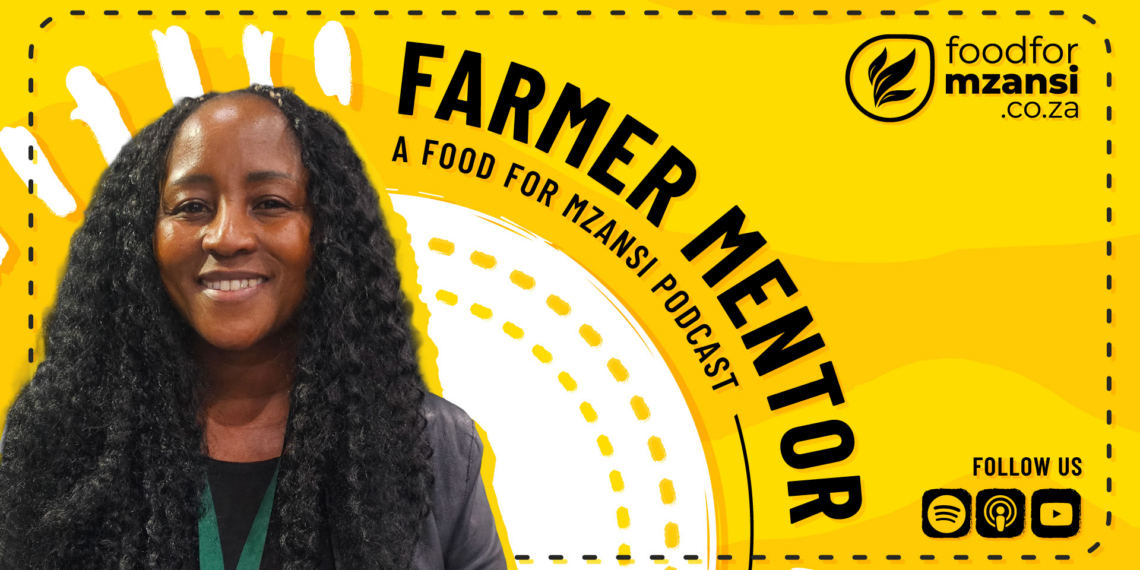
From a humble village garden to supplying major fresh produce markets in Johannesburg and Tshwane. In this Farmer Mentor episode, Tebogo Nyathela, founder of Farmers’ Hope, shares how compliance, water rights, and mentorship helped her grow a commercial farm.
What started as a small garden to provide fresh vegetables to distressed families in Tebogo Nyathela’s village has grown into a commercial farming and agro-processing business supplying major fresh produce markets.
Nyathela, founder and CEO of Farmers’ Hope in Kgomo Kgomo in North West, started farming in 2016 after noticing that vegetables she bought from the market to donate to families often wilted before reaching them.
“I thought, why don’t I start a small garden?” Nyathela says. She began with less than a hectare and soon realised that the quality of her own produce met market standards. After a local store showed interest in her vegetables, she decided to increase production and target larger markets.
Today, Farmers’ Hope produces a range of seasonal vegetables, including jalapeños, spinach, cabbage and beetroot. The farm supplies the Tshwane and Johannesburg fresh produce markets, as well as a Spar store in the Hammanskraal area.
For Nyathela, however, accessing bigger markets requires more than simply producing enough vegetables.
Related stories
- Market first: How Tshepiso built Blessed and Beautiful Farms
- No one-size-fits-all: Liane’s lessons on leaving the land better
- Eggsellent growth: How Lebo Mashigo built a poultry empire
- Rising talent: Gugu grows from two piglets to poultry, spinach
Compliance comes first
Her advice to farmers looking to supply formal markets is straightforward: get compliant.
“Farmers must comply. Make sure you have things such as SA Gap certification, adhere to regulations and have the necessary water rights,” she says, adding that Farmers’ Hope received assistance from the department of agriculture with food safety training and SA Gap certification.
She also stresses the importance of production capacity. Farmers approaching large markets need to be able to consistently meet demand while maintaining quality.
“When you go to the big markets, you need to have enough vegetables to supply. Make sure you plant enough each season and that your quality is the best,” Nyathela notes.
Water compliance is another important consideration. She advises farmers who use boreholes or other water sources to understand the applicable requirements and apply for the necessary water-use authorisation.
“It’s difficult to be assisted without water rights. Nowadays, it is a prerequisite for accessing certain forms of assistance. There is no shortcut,” she says.
Building a support network
Nyathela acknowledges that farming is difficult, particularly when producers are trying to establish themselves and grow their businesses.
Her advice is to avoid trying to navigate the industry alone.
“You need to get a mentor so that you can avoid some mistakes. You also need people you can talk to and a good relationship with your family for backup and support.”
For her, a strong support network has been essential during demanding periods on the farm.
One of Farmers’ Hope’s biggest business shifts came after the farm experienced post-harvest losses when supplying fresh produce markets.
Instead of allowing vegetables that did not meet fresh-market standards to go to waste, Nyathela started processing them. The farm now produces powdered spinach and beetroot, as well as pickled jalapeños.
Some of the vegetables used for processing are not rotten or unsafe, but may be slightly deformed or fail to meet the appearance requirements of the fresh market.
“Since we started agro-processing, we don’t have too much loss anymore. We process vegetables that may not be top quality for the fresh market, and we have reduced waste by about 95%.”
The strategy has allowed Farmers’ Hope to diversify its income while making better use of what the farm produces.
Looking beyond South Africa
Nyathela is now exploring international markets for the farm’s processed products. Through support from the department of trade, industry and competition, she plans to travel to Germany to investigate opportunities in the European Union market.
The focus is on dehydrated spinach, powdered beetroot and pickled jalapeños.
The preparation includes attending workshops, engaging with retailers and seeking meetings with importers to better understand market requirements and build relationships.
For Nyathela, the journey from a small garden to commercial farming has been built on starting with what was available, learning along the way and continuously looking for ways to add value.
READ NEXT: The ‘Golden Hour’: Managing a newborn calf’s first hours