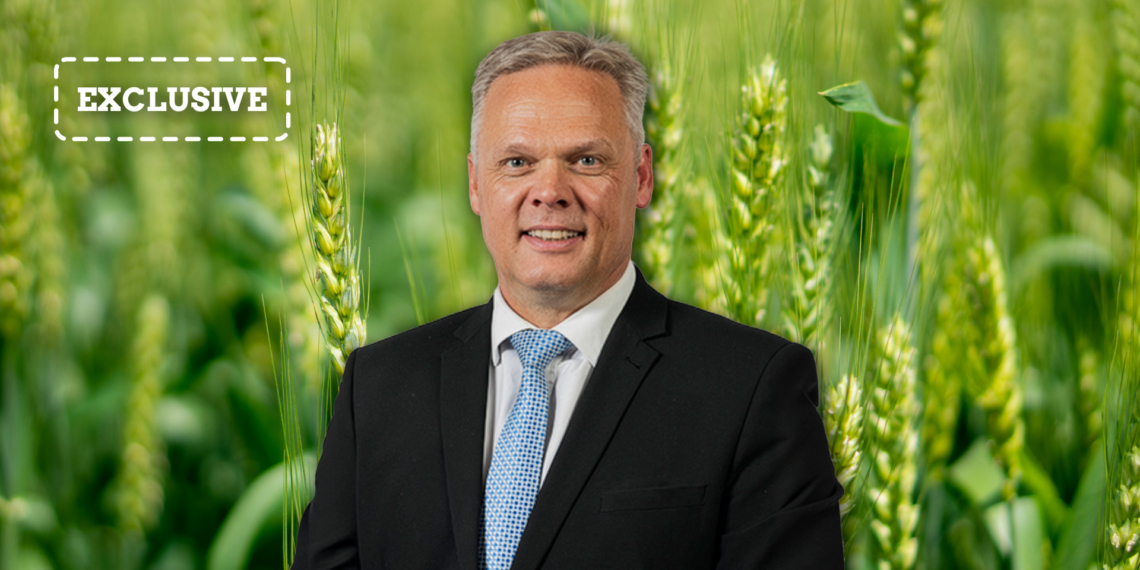
Two months into office, the minister of agriculture, Willie Aucamp, said his key vision is for the sector to grow, create sustainable jobs, and strengthen biosecurity.
In an exclusive interview with Food For Mzansi news editor Tiisetso Manoko, Aucamp discussed how critical it is to implement the Agriculture and Agro-processing Master Plan (AAMP) without fail, secure new trade, address ageing infrastructure, and work with sister departments and organised agriculture to tackle rural safety.
Tiisetso Manoko: What practical steps will your department take to speed up the implementation of the AAMP, especially at provincial and municipal level?
Willie Aucamp: The AAMP needs to be implemented on a faster scale; I think that is the first thing that we need to acknowledge. It is a live document; there might be changes as we progress with it. I know that there are people who have raised certain concerns, and I have said I am open to having all the role players sit around the table and see what needs to be changed and make sure that the changes are for the positive.
The rollout should be increased, and if everything that is there should be implemented, we would be further than where we are now. I think it is a good starting document for us, especially if you look at marketability and export strategies and biosecurity measures. So we have to start implementing it.
Amid foot-and-mouth disease (FMD), how is the department strengthening disease control?
It has been going well. If we look at the situation we are finding ourselves in, this is the biggest FMD outbreak ever experienced in the country. The amount of vaccines that were imported into the country up to the end of June was 13.5 million vaccines; for the months of July and August, in total there will be 10 million vaccines coming to South Africa for these two months.
It shows that the plans we have put in place are working. The uptake from the private sector is increasing the amount of vaccines we are getting in. A few months ago we had a problem where people could not get their hands on the vaccines. I am happy to say that is not the problem anymore; there are vaccines.
Related stories
- Minister Willie Aucamp: What farmers need now
- Willie Aucamp’s toughest battle isn’t on the farm
- Traceability key as SA opens up FMD vaccine markets
- KZN farmer loses 90% of crop amid severe water shortages
It is still the responsibility of government where there are new outbreaks; we will go there and vaccinate the areas where we know people do not have the facilities or financial ability.
The uptake we have seen is that people want to be proactive and they do not want to wait for the government to come to them or the FMD to hit their areas.
What concrete steps will you take to secure new trade agreements and remove existing barriers for South African agricultural exports?
I have had discussions with the Chinese ambassador. China is willing to buy meat from us if we can show them we have biosecurity in certain areas. Biosecurity firstly starts on the farm. Our farmers need to go back to ensure that they stick to the terms and conditions of making sure that the farms are biosecurity-compliant.
The reason I bring these issues up is that trade and biosecurity are interlinked. If we can clean our FMD outbreak areas for about four to six months, we have pushed back, we have vaccinated all our animals, and everything is in place to ensure no more outbreaks, then we can say to countries that want our meat and say these areas are safe; come and get the meat here.
However, this will be a collaborative effort from everybody. Companies in the Middle East are already taking our meat products; they do not have cattle, countries like Jordan, which is a desert. So the market is there; we just need to impose tough measures on FMD.

From left to right: Food For Mzansi news editor Tiisetso Manoko, agriculture minister Willie Aucamp, and Food For Mzansi head of product and user experience Gareth Davies. Photo: Food For Mzansi
How will your department work with other stakeholders to improve water, roads, rail and municipal services that are critical to the agriculture sector?
Firstly, we got to admit what the problem is: we are facing a huge infrastructure problem. If we look at roads, especially in our rural communities, the quality of roads, potholes, and side-breaks has been neglected badly over decades. So farmers have to drive on potholes to deliver their products to market; maybe the farmers have to go to the harbour, and that harbour is inefficient.
We have problems with our rail networks, and we need to address those.
I am very happy to say the encounters I had with my counterparts in cabinet have been really productive. I have spoken to the ministry of transport, water and sanitation, as well as public works, and I can say we are engaging issues that concern the agriculture sector, and there are plans in place to make sure the industry operates better.
Working with the police ministry, what specific steps will you take to tackle stock theft, farm attacks and other rural crime and make farmers and workers feel safer?
Farm safety, farm murders, farm attacks, stock theft are a reality. Before I was a minister, I served in the Portfolio Committee on Agriculture, and we received farm safety reports. And the first thing we said on that report is that we admit that farm murders and attacks are a reality. And I am now saying that the amount of violence that is going along with farm attacks is just out of proportion; one murder is one too many.
Each time a farmer gets attacked or murdered, we are also threatening food security and job opportunities in this country. I am firmly of the opinion that we must declare farm attacks as a priority crime so that the police can put more effort and more capabilities towards curbing that. Not only reactively but proactively as well.
For more on the interview, watch this video.
READ NEXT: Local innovation and exports drive growth in SA rooibos industry