Wednesday, October 21, 2026
SUBSCRIBE
22 GLOBAL MEDIA AWARDS
Food For Mzansi
  • News
  • Changemakers
  • Lifestyle
  • Farmer’s Inside Track
  • Food for Thought
No Result
View All Result
  • News
  • Changemakers
  • Lifestyle
  • Farmer’s Inside Track
  • Food for Thought
No Result
View All Result
Food For Mzansi
No Result
View All Result
in News

Broken promises? Limpopo farmers evicted from communal land

A dispute with a chief displaced 20 farmers in Limpopo. They were evicted to make way for a commercial farm, and are struggling to survive. Lawyers say the farmers have options to fight the eviction

by Bernard Chiguvare
15th June 2024
GroundUp

Farmer Ali Baloyi sits on what is left of his water pump near the Letaba River. He says he can no longer earn a living. Photo: Bernard Chiguvare

Share on FacebookShare on TwitterShare on WhatsApp

Small-scale vegetable farmers, who were evicted from the land they were using near Phalaborwa, Limpopo to make way for a commercial farm, are battling to make a living.

The 20 farmers, members of the Mopani Farmers’ Association, had been farming on communal land under the Majeje Tribal Authority since 2014. They farmed vegetables, green pepper, okra, butternut and chillies, selling their produce locally or sending it to Johannesburg. Some of them had employees. Some donated produce to schools in the area.

In July 2022, the farmers suddenly found that fencing poles had been erected on the land. They went to complain to chief Mlungisi Ntsanwisi, who said a fruit farmer was due to move onto the land. A few days later, the farmers say, excavators moved onto the land and destroyed their crops.

Conflicting stories

To get the views of Ntsanwisi, the farmers referred GroundUp to the chief’s special advisor, Boela Bruwer. Bruwer denied that he is the special advisor to the chief and said he had no say over Majeje community issues. (GroundUp is in possession of a letter emailed on 15 February 2024 to one of the farmers in which Bruwer described himself as an advisor to the Majeje Tribal Authority.)

But, he said, the farmers had been removed by members of the community “because they have no PTOs and they did not create work for the unemployed”. A PTO is a document giving permission to operate the land.

But GroundUp has seen a letter dated 14 April 2016 from the Majeje Traditional Authority to one of the farmers, Ali Baloyi, giving him “permission to perform agricultural activities” in the area. The letter is signed by Ntsanwisi and sent by “P.N. Mabobo”, who is described as “chief councillor”.

Contacted by GroundUp, Mabobo said that he did not have much information about the eviction of the farmers. He provided a contact number for the chief and advised GroundUp to call after 10 am. GroundUp made several calls but there was no response.

Some of the evicted farmers have rented land or started growing crops on other communal land near where they used to farm. Others, like Baloyi, are battling to feed their families.


Related stories
  • Land reform dispute: Award-winning wool farmers win court battle
  • Graft, guns and violence: Farmer relives land reform nightmare
  • ‘Land reform needs action, not just plans’

Baloyi showed Groundup the land from which he had been evicted. He managed to salvage his irrigation pipes but lost other equipment.

Sitting on his broken pump next to the Letaba River, Baloyi said: “I have no clue as to how I should eke out a living. Farming was my only means of putting food on the table. What is surprising is that the chief granted us permission but now he decided to evict us.”

GroundUp
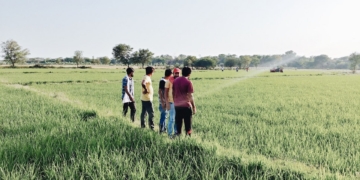
The land the 20 farmers used to grow vegetables is to be used for a commercial fruit farming project. Photo: Bernard Chiguvare

Mawewe Nkhwashu, a manager at Mopani Farmers Association, said evicting the farmers had deprived them of their living. “There are very limited chances of employment in rural areas. Farming is the only means the farmers could provide for the family,” he said.

Asked whether the association had approached the chief on behalf of the farmers, Nkhwashu said his association had tried many times, but to no avail.

‘Unlawful actions’

Lawyers for Human Rights attorney Louise du Plessis said; “LHR finds it despicable that poor people are thrown into worse poverty because of these kinds of unlawful actions by people who have more power than them. There are ways to deal with these situations in the interest of all involved.”

She said the farmers could still institute a damages claim, up to three years from the day they were evicted. “There is a possibility that they can still go to the Land Court to restore the rights they have,” she said.

Dr Fani Ncapayi from the Trust for Community Outreach and Education said the evictions “represent a new form of land dispossession” by traditional authorities. “The evictions reverse the land reform process,” he said.

Linda Page, chief director of communications in the Limpopo Department of Agriculture, Land Reform and Rural Development, said the department had tried to intervene “by mobilising relevant stakeholders like the Department of Cooperative Governance and Traditional Affairs”. But the chief was disputing the allocation of land to the affected farmers, she said.

Page said the department advised the farmers to approach the nearest legal resources centre at Tzaneen Magistrate Court for intervention.

”The chief has no soft heart for small-scale farmers,” said Baloyi. We were evicted when we were in the process of harvesting our crops.”

With no land to farm, he has resorted to buying tomatoes from other farmers to sell in the nearby villages.

This story was first published by GroundUp.

ALSO READ: Land reform in crisis as over 1000 CPAs fail to bear fruit

Sign up for Mzansi Today: Your daily take on the news and happenings from the agriculture value chain.
Bernard Chiguvare

Tags: Commercialising farmercommunal landInform meLand reformLimpopo
Reality check: What SA agri interns really experience on the farm
News

Reality check: What SA agri interns really experience on the farm

by Lisakanya Venna
19th October 2026

Transitioning from agricultural theory to practical farming is proving to be a bittersweet journey for South African interns. From intense,...

Read moreDetails
This week’s agri events: 19 – 23 October

This week’s agri events: 19 – 23 October

19th October 2026

Stop the rot: Four steps to slash post-harvest losses

18th October 2026
A standing ovation for agriculture’s incredible talent! The Agri’s Got Talent 2026 top three celebrate their achievements: winner Honey Katoo of Endulini Fruit in Patensie, alongside runner-up Clareece Vlotman of Wolfpack in Wolseley and finalist Lwandile Nantsi of Laastedrift in Ceres. Photo: Supplied/Food For Mzansi

Patensie claims Agri’s Got Talent crown for second year running

17th October 2026
The panellists at FNB Business’s “Farming together” discussion at the Royal Show explored how market access, mentorship, financial discipline and strong commercial relationships can help farmers build sustainable businesses. Featured from the left are Bertram July (FNB’s distribution sales lead), commercial farmer Shakes Shabalala; Sandy Gumede (co-founder of Zulu Girl Wines), and Janis Robson (FNB’s head of development and SME business development). Photo: Food For Mzansi

FNB puts relationships at the heart of commercial farming

17th October 2026

Potatoes and tomatoes plunge while avocado prices soar

Stronger rural policing needed to protect lives and livelihoods

Build your future in agriculture with Agri Skills Transfer

SA and Namibia reevaluate livestock trade after FMD outbreak

Reality check: What SA agri interns really experience on the farm

Join Food For Mzansi's WhatsApp channel for the latest updates!

JOIN NOW!
Next Post
Meet the host farmers for our 2024 provincial farmer days!

Meet the host farmers for our 2024 provincial farmer days!

THE NEW FACE OF SOUTH AFRICAN AGRICULTURE

With 21 global awards in the first six years of its existence, Food For Mzansi is much more than an agriculture publication. It is a movement, unashamedly saluting the unsung heroes of South African agriculture. We believe in the power of agriculture to promote nation building and social cohesion by telling stories that are often overlooked by broader society.

By-laws vs. livelihoods: Barriers facing WC smallholder farmers

CPAs urged to register for free governance support toolkits

Potatoes and tomatoes plunge while avocado prices soar

Becoming bankable: How to get your farm ready for finance

Fixing SA’s agricultural visa system to protect seasonal harvests

SA and Namibia reevaluate livestock trade after FMD outbreak

  • Awards & Global Impact
  • Our Story
  • Contact Us
  • Cookie Policy
  • Privacy Policy
  • Copyright

Contact us
Office: +27 21 879 1824
News: info@foodformzansi.co.za
Advertising: sales@foodformzansi.co.za

Contact us
Office: +27 21 879 1824
News: info@foodformzansi.co.za
Advertising: sales@foodformzansi.co.za

  • Awards & Global Impact
  • Our Story
  • Contact Us
  • Cookie Policy
  • Privacy Policy
  • Copyright

Chat Options

About this assistant

This feature generates automated answers summarised from Food For Mzansi articles. By using it, you are interacting with an AI system (provided by Google), not a human. AI can make mistakes. Please refer to the source articles for verification and citation purposes.

Our staff do not check or moderate Lerato’s answers in advance, but may review some later. Our journalists continue to write and edit all the articles Lerato uses as sources.

To estimate unique and returning web users, we store a random browser ID in this browser. WhatsApp users are counted by phone number. The same person using both channels may be counted twice.

I'm Lerato, your AI assistant!
No Result
View All Result
  • News
  • Changemakers
  • Lifestyle
  • Farmer’s Inside Track
  • Food for Thought

Copyright © 2026 Food for Mzansi