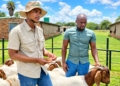
There’s nothing more exceptional than someone who has opened his heart and eyes to the world of people suffering and using his accolades to continue uplifting others. Behind the scenes, there’s a lot of history that formed and shaped Professor Naudé Malan, and difficulties too.
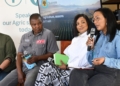
Malan touches at the seam of your soul with his dry sense of humour, his entertaining nature, and his humbleness that strikes the air when you are in a room with him. Recently, he was awarded the Mzansi Changemaker award at the Mzansi Young Farmers Indaba and as he approached the stage in awe, the man with such grace and talkative nature did not have much to say.
However, his heart speaks volumes through the work he does at Izindaba Zokudla Farmer’s School.
“We are all busy with a really bigger project and this and that project can only succeed with integrity,” he says.
The apple doesn’t fall far from the tree
Growing up in Johannesburg, Malan recalls having a great relationship with his siblings and parents. The apple did not fall far from the tree because both his parents were in academia, so it was natural for him to gravitate towards academia as a career.
“Both of my parents were academics and that kindled my love of knowledge. When I started studying, I studied philosophy and my basics are in philosophy, my thinking is conditioned in philosophy,” he explains.
But the love for books transferred onto the love for agriculture. “I am still a little bit of a farmer, but I am focusing on the only crop that never fails and that is compost. And the reason I produce compost is because I have a little nursery that I run. I am growing trees and extremely rare indigenous trees.”
He mentions that he lives in a small house which doesn’t have enough space for farming, although he owns a plot with vegetables. He jokingly adds that his last crop was Jerusalem artichoke and today he is still farting from it.
Making big decisions
When his son was born, Malan says, he realised that philosophy wasn’t going to pay all the bills. This left him with major decisions about his future in academia.
“I switched to development studies. I did a master’s degree in 1997. While busy, I got a job at the University of Venda focusing on the Tshikonelo agricultural project and I had enough time to spend 18 months doing fieldwork on and off.”
During this project, Malan saw the struggles and the position of small-scale farmers in South Africa. “Venda is extremely fertile but it is still pretty wild. The animals, like leopards and elephants, would come into the area and eat an entire year of harvest,” he says.
After that, Malan got a job at the University of Johannesburg in 1998. He completed his doctorate in 2009, focusing on the social security system, but after the doctorate he rekindled his love for agriculture.
His love for small-scale farmers
The idea of Izindaba Zokudla was birthed during his time spent in Venda.
“Understanding that these farmers are pushed into certain production regimes, and they don’t have the opportunity to discuss it among themselves and learn from each other, is problematic because the productivity and position of small-scale farmers leaves a lot to be desired,” he says.
Malan dreamt of small-scale farmers having a safe haven with no strings attached. In 2015, Izindaba Zokudla kicked off with funding that was left from previous projects.
“I could see it, and I realised this is really a good ticket and the farmers asked me to continue with that and I did. The whole idea was to circulate ideas, technology, systems and procedures, and enterprise modules.”
He further mentions that the agenda behind small-scale farming development is often not clear and the problem is that the system was not designed for small-scale farmers. South Africa’s commercial farmers, since 1994, have built this bulk export system which underlies SA’s food system. So the idea for small-scale farmers to sell locally has always been at the back of his mind.
“I have the choice to align myself with my own thinking and what I believe is the truth and the right way to do things. Also, I can be one of those in the background that pushes forward. I don’t think I am a great leader, but I want to stand with the great leaders and stand behind what they are doing. It was important for me to do this right,” he explains.
Continue despite challenges
Life isn’t always sweet, Malan acknowledges. “Life is difficult. I can’t say my life has been great. I had a lot of struggles, and I lost a lot of people because I spend a lot of time on Izindaba Zokudla. What drives me is the realisation of the ecological crises, it is not so much agriculture but more nature,” he says.
The Mzansi Changemaker award came at a time when Malan was just about to give up on Izindaba Zokudla, he says. “It was the most unexpected thing ever. Two months ago I went to my boss and said to him I am not going to do Izindaba Zokudla anymore, I can’t do it, I have too much work.”
He was encouraged to continue the work and reflecting back on those two months, he says, “I realised I just have to go flat out.”
READ NEXT: Women’s Day: Join us at our Soul To Soil brunch
Sign up for Farmer’s Inside Track: Join our exclusive platform for new entrants into farming and agri-business, with newsletters and podcast