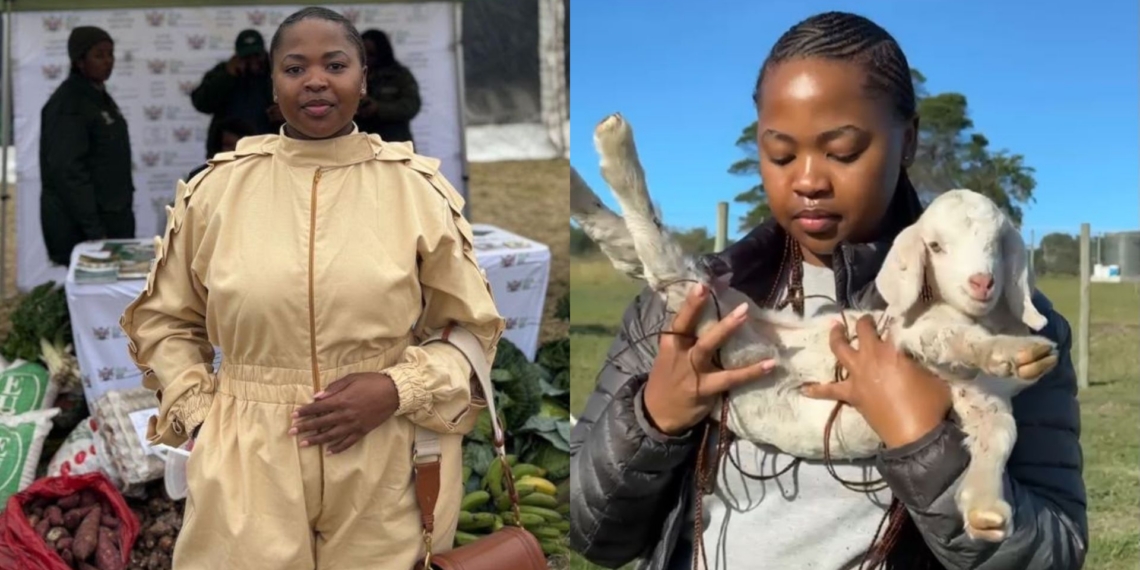
As a teenager, Lwambeso Asanda Sizani started her own mixed farming business, setting her apart from her peers. Seeing the importance of livestock in Xhosa culture sparked her interest in livestock farming. Today, she is the founder and director of Asanda Mixed Farming and an accounting student.
Sizani says growing up at KwaMdange in Peelton Village, near Qonce in the Eastern Cape, influenced her journey in livestock farming and in understanding the significance of livestock in rural areas.
Driven by tradition, powered by resilience
“My journey into agriculture started when I was still in high school, at around 16 years old. Growing up, I spent a lot of time in the rural areas with my grandmother, and I became interested in the role livestock plays not only economically, but also in our amaXhosa culture and rural way of life.
“One thing that always stood out to me was seeing the kraal at home standing empty. I felt that something that had historically represented livestock, food security, and wealth within our families was no longer serving that purpose. I wanted to change that,” she explains.
Sizani started her farming venture after undergoing the Xhosa tradition from a young girl to a woman. “I was the first girl in my family to ask to undergo intonjane, an amaXhosa rite of passage for young women.
“After the ceremony, I used money I had received as gifts, together with money I had saved while still at school, to purchase my first two pregnant Savannah does. That was really the beginning of my farming journey.
“Livestock was attractive to me because it was something I could realistically start with within the resources and land available to me.”
Related stories
- EC student farmer turns family farm into future opportunity
- EC teen farmer balances school and piggery business
- Young Lady Grey farmer diversifies from broilers to shisanyama
- Fresh out of farming school, Memani’s agribusiness takes flight
Reinvesting to build a diversified herd
From the two pregnant goats, her herd has grown over the years through reinvesting in her operation.
“With this season’s kids, I currently have approximately 70 Savannah goats. The farm has also diversified and now has 10 Large White pigs and approximately 50 indigenous chickens,” she says.
Although she has been in the farming industry for five years, her business enterprise, Asanda Mixed Farming (Pty) Ltd, was only formally registered at the beginning of 2025. She operates on communal land in Emagqazeni Village, Ncera, outside East London.

However, every farming business goes through challenges. For Sizani, rising feed costs have had an impact on operations, causing her to search for solutions.
“Feed is one of the expenses that can quickly put pressure on a livestock operation, particularly as the number of animals increases. When you are buying feed continually, increases in input prices directly affect your cost of production and ultimately how much money is left to reinvest in the farm.
“That pushed me to think beyond simply buying feed and to ask what I could produce for myself. I currently have approximately two hectares of maize, primarily intended to contribute towards feed production for the livestock.”
She sells rams and kapaters (wether goats) to breeders and the traditional market, respectively, while keeping ewes for breeding purposes at this stage of her business.
Navigating communal land and funding gaps
Having to operate on communal land has contributed to her struggles to expand. “I currently operate on communal land, which has allowed me to start and grow, but it also creates limitations when you want to expand into a larger commercial operation or make significant long-term infrastructure investments.
“Land access has also affected opportunities available to me. For example, I received a letter of intention from the Mohair Empowerment Trust relating to an opportunity to enter Angora goat and mohair production, but accessing suitable land is a prerequisite before that opportunity can be fully realised.”
Financial support will go a long way to help her commercialise, but Sizani does not receive any funding despite submitting several applications.

“I have not yet received formal government funding or farmer support programme inputs, although I have submitted applications for agricultural inputs and support.
“I have also submitted applications for more formal farmer support because infrastructure, breeding stock, feed-production capacity and other inputs would allow the enterprise to expand more efficiently,” she explains.
Despite all these challenges, Sizani is not allowing it to hold her back. Instead, she continues to build her operation while actively seeking the partnerships, knowledge and opportunities to take the business forward.
Turning tradition into a thriving agribusiness
Meanwhile, she is also studying accounting at Milpark Education, with the long-term goal of qualifying as a chartered accountant.
“I see accounting and agriculture as complementary rather than separate paths. I want to combine financial knowledge with practical agricultural experience to build commercially viable agricultural businesses and contribute to rural enterprise development.”
As a young female farmer, Sizani emphasises that she has many plans, dreams and a long-term vision to develop Asanda Mixed Farming into a commercially sustainable and diversified agricultural enterprise that contributes to the rural economy.
“I want to continue developing the Savannah goat operation and improving the quality and productivity of the herd. I also want to expand the piggery and poultry components of the business and increase our feed-production capacity so that more of what the livestock consumes can eventually be produced within the farming operation.
“My biggest dream is ultimately to demonstrate that a young person from a rural community can start with very little, build a serious agricultural enterprise, and use that enterprise to create opportunities beyond themselves,’’ she says.
READ NEXT: Stronger rural policing needed to protect lives and livelihoods