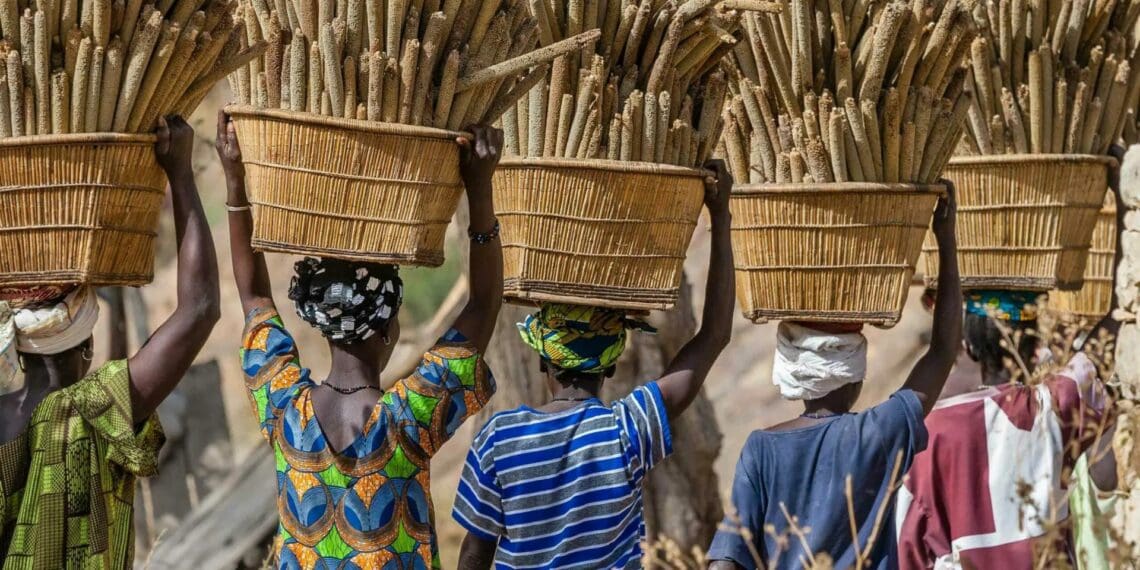
The men migrate to the city and leave the women behind to feed the family, say some of the Southern African Developing Community (SADC) rural farmers when they describe how they earn a livelihood. It is an echo of the patterns of the past, but for many, a changed climate has made the current scenario a very different challenge, with great uncertainty about what they face in the future.
Rural women farmers in the region, at the forefront of the climate crisis, are among the most affected by it. Not only do they live in one of the most climate-vulnerable regions on Earth, at the southern tip of the African continent, but they also have first-hand experience of how a changed climate affects the crops in their fields.
The African continent, including the SADC region, is warming at an alarming rate. While the world hopes to keep the increase of global average temperatures below 1.5°C as per the UN Paris Agreement signed in 2015, this is an average that includes oceans which are cooler than land masses. In this scenario, many parts of Africa would have increases of more than 3°C.
Life on the land is hard
For women in agriculture in the region, who have already endured five extreme climate events in the form of cyclones in Mozambique, the slow steps to reduce average global temperature increases are too little, too late.
Flaida Macheze (48) from Mozambique’s capital, Maputo, and a member of the National Peasants Union, told Daily Maverick that she and her colleagues suffer more than three climate crisis events each year.
“We’ve learnt to adapt [because] we must produce (food),” said Macheze. “We know that even if we go to COP, [if] we bring our declaration and demands forward [because we] need compensation, we won’t get those funds. So what we do is we build our own alternatives.”
COP27’s ’empty’ promises
Macheze was speaking soon after the conclusion of the global climate talks, the 27th Congress of the Parties (COP27), in Egypt late last year where world leaders had gathered to decide the best way forward in tackling the climate crisis. The meeting fell short again in making progress on limiting or doing away with fossil fuel use – the single-biggest contributor to the climate crisis.
COP27 saw countries finally concede – after nearly three decades – to setting up a loss and damage fund for developing countries that have faced the loss of livelihoods and huge damage to infrastructure from climate events. Macheze is sceptical especially since, five years down the line, developed nations have not begun to meet their climate financing goals of providing $ 100 billion per year to developing countries by 2025.
Farmers like Macheze say life on the land is hard. “It doesn’t rain when you expect rain, and we have dry seasons when we shouldn’t. You plant but don’t reap. And sometimes, you’re left without seeds. We know our government does not distribute seeds [when they have been lost due to climate events].”
To survive, rural farmers like Macheze have come to rely on seed banks and redistribution of indigenous seeds, alongside the support of women farmer organisations. She said that during one of the cyclones in Maputo, a huge plot of land was flooded, with sweet potato, cassava and maize submerged in water. The redistribution of seeds from other women was a saving grace, enabling her to start over.
The bigger picture
Africa contributes only about 4% of global emissions, yet it is the hardest hit by the effects of the climate crisis.
Statistics show that more than 60% of Africa’s population are smallholder farmers, with women contributing 60% to 80% of labour in food production for households and for sale. Despite this contribution, they remain on the sidelines of economic crisis protection, development and climate financing.
“Even though they say that men are providers, it’s not true; it’s not linear. The women produce to feed their families. So when they are not able to reap, these women can end up in prostitution, just [to provide] food for their families,” said Macheze. She said women who had to stand in long lines just to receive a litre of cooking oil in the aftermath of climate disasters, often ended up offering sexual favours to aid administrators to feed themselves and their families.
‘Marginalised and sidelined’
Although there has been a huge increase in the international focus on women’s rights, and their rights to livelihoods, this has not meant a lot to women in rural areas who now bear the brunt of the most urgent issue of our time. They are frequently shut out of access to funds, credit and the means to secure land and financial backing from institutions that can help to shield them from the climate crisis.
Yolanda Mulhuini, the executive director of Grupo para o Desenvolvimento da Mulher e Rapariga (Group for the Development of Women and Girls), and a member of the African Women’s Development and Communication Network said that rural women have long been marginalised and sidelined in key decision-making spaces.
The Mozambican social activist noted that representatives from rural areas are often left out of decision-making because it is assumed that they do not have the relevant knowledge to participate, even though they make a sizeable contribution to food production.
A United Nations Food and Agriculture Organisation study of land ownership among women in some of the SADC countries and East Africa found that women are rarely land owners, and when they do own land, it is smaller and less fertile than that owned by men.
Climate change impact increasing
Thandiwe Chidavarume, a board member of Women and Land in Harare, Zimbabwe, told Daily Maverick she advocates for women’s land rights and trains them in how to make effective use of the land.
“Unfortunately, the work that we are doing is impacted heavily by climate change. Every year in Zimbabwe, we have been experiencing droughts; or the late onset of rainfall,” said Chidavarume.
“For 27 years, we have watched the responsible ministers and heads of state meeting to discuss the problem of climate change; but we haven’t seen anything that is yielding results. We continue to see an increase in the impact of climate change.”
Women’s inclusion is crucial
Zimbabwean Memory Kachambwa, executive director of the African Women’s Development and Communication Network (Femnet), noted that even though African women spend about 60% of their time on agricultural activities, they continue to be underrepresented in agenda-setting spaces that affect their livelihoods. The inclusion of women in tackling the climate crisis was crucial, she said.
Some suggest that agroecology – farming with ecological principles of sustainable, organic farming – could minimise the effects of the climate crisis that threaten rural livelihoods.
While agroecology does reduce farmers’ input costs, the training needed to build on existing knowledge can be expensive and is often difficult for women farmers in remote areas to access. Confronted by the difficulties this presents, rural farmers say it seems they have been forgotten by those who claim to want to aid their development.
The women at the forefront of rural agriculture fear they are on their own and must find ways to provide support to each other in the face of diminishing resources. This gives them some hope for the survival of their livelihoods. But for them, three decades of talk shops on climate change have done little to shift the needle.
- This article was originally published by Daily Maverick s
ALSO READ: Climate change: How animals are adapting
Sign up for Mzansi Today: Your daily take on the news and happenings from the agriculture value chain.