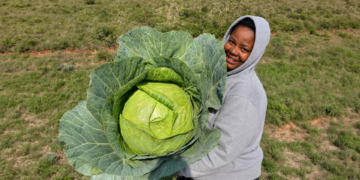
In a country where access to land has become a headache for many, a glimpse of hope and motivation can be drawn from young people who are taking advantage of land given to them, particularly from the ever-troubled communal property associations (CPAs).
Peter Setou, chief executive of the Vumelana Advisory Fund, said that in the fight against youth unemployment, which has reached over 45% in the country, agriculture has not only become a substitute career path but a need for those exposed to pockets of land to make a living.
“The story of land reform is taking a turn, with some pockets of successes unfolding where young people are leveraging restituted land as a strategy for employment creation and economic transformation,” he said.
Golden opportunity
Bheki Mlaudzi, a 32-year-old youth administrator and beneficiary of the Giba CPA in Mpumalanga, said land means employment and business opportunities for those who want to fight food insecurity and joblessness in the country.
Mlaudzi has worked on the Giba CPA’s restituted land for over a decade, tending to irrigation systems and participating in large-scale banana, ginger, and macadamia farming projects.
Mlaudzi shares that in 2020, the ginger venture thrived due to Covid-19 pandemic as there was a strong demand for it.
“It was a great experience to be exposed to such an opportunity for learning. While the experience was painful at the time, it also taught resilience and highlighted the importance of ensuring that the community is empowered,” he said.
Related stories
- Post-claim support: Why land reform isn’t just about land ownership
- Land reform in SA: Slow but steady strides forward
Another example of this success is 33-year-old poultry farmer, Perfect Khoza from the Coromandel Trust in Mpumalanga, who, after struggling to find employment and opportunities in construction, turned to the CPA’s restituted land.
Khoza used a portion of the community’s restituted land to build a small but promising broiler business, where she employs part-time workers whom she hopes to convert into permanent employees.
Land is everything
Khoza cited infrastructure challenges, including inadequate shelter and ventilation, alongside financial difficulties, rising feed costs, and climate change. Despite these challenges, it is all worth it.
“Owning land is one of the greatest investments we’ve ever had. Importantly, it can be passed down to future generations to create a lasting impact,” he said.
Setou added that over time, they have seen the CPP model consistently deliver tangible results and meaningful impact for beneficiaries of the land reform programme.
“These pockets of success highlight the model’s potential. The challenge now is to scale these successes to unlock similar outcomes with other beneficiaries of the land reform programme across the country.
“Whether through formal learnerships, technical training, or on-the-job exposure, young people involved in CPAs are gaining more than just experience; they are becoming an invaluable generation that will help take the country’s land reform programme forward,” he said.
Related stories
- Land reform fallout: CPAs plagued by strife, inexperience, infighting
- Land reform in crisis as over 1000 CPAs fail to bear fruit
Ongoing challenges hampering progress
However, Setou noted that despite these successes, challenges in the country’s land reform persist. In some areas, there are delays in accessing government grants critical for recapitalisation, and in others, there is a lack of post-settlement support.
“This lack of government support is a common issue among CPAs nationwide. However, strategic partnerships have helped mitigate some of the challenges. Our efforts to provide crucial assistance with governance training, capacity development training tools, mentorships and the facilitation of partnerships between CPAs and private investors have yielded results,” he said.
To unlock the full potential of land reform for the country’s young people and begin to address high rates of unemployment among the youth, Setou said, there is a need for greater support for land reform beneficiaries.
“Young people need exposure through mentorship to guide them through the complexities of supply chains, contracts, compliance, access to markets, capital and the essential skills that can enable them to turn small ideas into scalable businesses,” Setou concluded.
ALSO READ: FMD: Research shows water disinfection could protect livestock