It is forgivable to think that an oil shock mainly hurts at the petrol pump. After all, that is where households feel it first. But when my colleagues and I at the Bureau for Economic Research started digging through South Africa’s fuel data, a different story emerged – one that says as much about the country’s infrastructure failures as it does about global geopolitics.
As we began modelling the likely impact on the South African economy, it quickly became clear that diesel would inflict even more pain on the economy than petrol. (Our insights are based on ongoing analysis that has not yet been published.)
There are two reasons for this.
Firstly, diesel underpins the South African economy’s cost structure. It powers the systems that keep the economy functioning: freight transport, food distribution, mining operations, agricultural machinery, generators and large parts of the country’s logistics network. Higher diesel prices, therefore, raise the cost of transporting goods, distributing food, operating mines and running backup generators during electricity disruptions.
This means the dominant economic impact of the Gulf War on South Africa is not simply that households are paying more at the pump. The impact is also being felt through higher logistics, freight and operating costs as they feed through supply chains into broader inflation.
Secondly, the price of diesel has spiked markedly more than the price of petrol. Relative to the first quarter of 2026, diesel prices in the second quarter increased by almost 60%, compared with about 25% for petrol.
Our calculations suggest that higher fuel prices could add roughly R45 billion (US$2.7 billion) – just over 2% of quarterly GDP spend – in additional fuel costs to the South African economy in the second quarter of 2026 alone. Nearly 70% of that additional cost burden would come from diesel rather than petrol.
The main conclusion we draw from our insights is that South Africa needs to fix its fundamentals and shore up buffers so that it is better placed to withstand external shocks when they strike.
South Africa’s shift in fuel consumption
To understand why diesel matters so much today, it is important to recognise how fuel consumption has changed.
Over the past two decades, diesel consumption has steadily overtaken petrol consumption in the South African economy.
In 2005, petrol accounted for close to half of total fuel consumption, while diesel accounted for roughly a third (see figure below). Today, diesel accounts for almost half of all fuel consumed nationally, while petrol’s share has declined steadily.
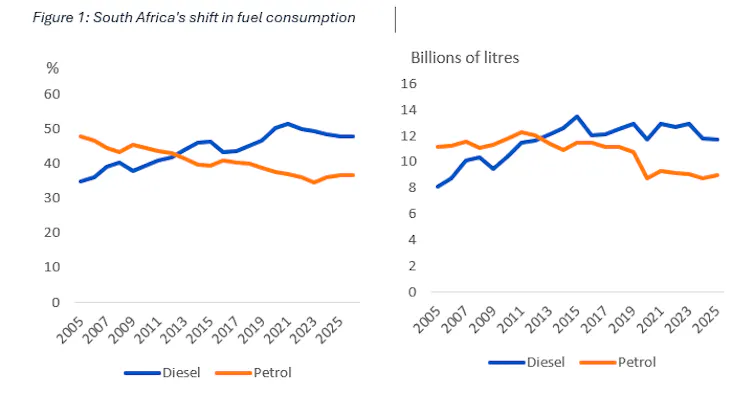
Part of the explanation is relatively benign. Petrol vehicles have become significantly more fuel-efficient over time, allowing households to travel further on less fuel. Weak household income growth, higher fuel prices and expensive vehicle financing have also constrained discretionary driving and slowed petrol demand growth.
Diesel, however, is different. Diesel is primarily an operational input into the economy rather than a form of discretionary consumption. As such, its increased use reflects deeper structural changes in the South African economy:
- More freight has shifted to roads and trucks as the state-owned transport monopoly Transnet’s rail capacity has deteriorated. These freight trucks run on diesel.
- Use of diesel accelerated sharply during the severe power-cut years between 2022 and 2024. This was particularly evident in businesses in the mining, manufacturing and agricultural sectors as well as hospitals, shopping centres and data centres. All have increasingly come to rely on diesel generators to keep operating.
Related stories
- Middle East tensions and fuel hikes threaten SA food prices
- Middle East war: Why food costs are set to soar
- Middle East war: Fuel, fertiliser hike could deal double blow to farmers
- Development finance key to growing future commercial farmers
During the worst periods of load-shedding in 2023, Eskom relied heavily on diesel-fired open-cycle gas turbines to help keep the lights on when the coal fleet failed. At times, Eskom’s diesel usage was estimated to account for 20%-30% of national diesel demand. Fortunately, that dependence has eased considerably as the electricity supply stabilised and diesel-fired open-cycle gas turbines usage declined.
Still, diesel has quietly become South Africa’s shadow infrastructure system – the fuel that has compensated for failures elsewhere in the economy, from electricity generation to freight transport.
This means South Africa’s vulnerability to oil shocks cannot be easily remedied just by getting consumers to ditch their fossil fuel-guzzling SUVs in favour of electric vehicles. Vulnerability is embedded in the diesel-intensive systems that move goods, power operations, and keep the economy running.
The impact
South Africa has always been vulnerable to oil shocks because it imports virtually all of its crude oil. But the nature of that vulnerability has changed. As domestic refining capacity has declined, as several domestic refineries closed between 2020 and 2023, fuel (rather than crude) imports have increased. This means South Africa has become exposed not only to higher oil prices but also to disruptions in global fuel supply chains themselves.
This creates the risk that external and domestic shocks will begin to reinforce one another. A global fuel disruption on its own is painful but manageable. But fuel stress becomes considerably more destabilising.
The impact is likely to be felt in a number of ways.
Firstly, in the country’s agricultural sector. South Africa is unlikely to face an immediate food supply crisis as domestic agricultural production conditions remain relatively favourable. Nor is there an immediate risk of food inflation as consumer food inflation began moderating earlier this year, supported by ample supplies of grains, fruits and vegetables.
Nevertheless, the sector will be affected. Fuel accounts for a substantial share of food distribution costs in South Africa’s highly road-dependent transport system. Wandile Sihlobo, chief economist of the Agriculture Business Chamber of South Africa, notes that roughly 80% of South African grain is transported by road. Higher diesel prices, therefore, feed directly into the cost of moving food across the country.
Farming is also highly diesel-intensive. In addition, fertiliser prices have spiked as a result of the closure of the Strait of Hormuz. These price hikes will squeeze margins across farming and food distribution long before they fully appear in supermarket prices.
Farmers may also lose important export markets. The Gulf states, together with Iraq and Iran, are important destinations for South African fruit and meat exports, much of which moves through shipping routes linked to the Strait of Hormuz.
The second major impact will be on the government’s finances.
In April 2026, the government introduced temporary fuel levy relief of R3 per litre (or $0.18/litre), before extending and expanding the support specifically to diesel. By May, diesel levy relief had effectively increased to R3.93 per litre ($0.24/litre), temporarily reducing the general fuel levy on diesel to zero.
The total relief provided between April and June is expected to cost the fiscus roughly R17.2 billion in forgone tax revenue. Since this exceeds the roughly R10 billion contingency reserve available in the current budget, the fiscal cost will need to be absorbed either through stronger-than-expected revenue or expenditure adjustments elsewhere.
The third area of impact is inflation. The cost of fuel shapes inflation expectations because it is highly visible and purchased frequently. Even temporary fuel spikes therefore risk de-anchoring inflation expectations. This is particularly important in the South African economy, where the Reserve Bank has spent several years cementing its credibility to aid the move to a lower inflation target. This depends on inflation expectations continuing to fall towards 3%.
This helps explain why policymakers are concerned not only about fuel prices themselves, but also about the possibility that higher fuel costs may become embedded in broader pricing behaviour and wage expectations.
The bigger lesson: resilience matters
South Africa did not consciously choose to become more diesel dependent. It happened gradually, one workaround at a time. It spent years building diesel into its coping mechanisms. When rail failed, the country used trucks. When electricity failed, it used generators and open-cycle gas turbines.
Those adaptations kept the economy moving, but they also quietly increased South Africa’s exposure to global fuel shocks.
The lesson from the current crisis is, therefore, not simply that oil prices are volatile. It is that resilience matters, just not the kind of home-grown resilience which depends on costly workarounds just to keep the lights on and the goods moving.
- This story was first published by The Conversation, and written by Lisette IJssel de Schepper, the chief economist at the Bureau for Economic Research, Stellenbosch University. The views and opinions expressed in this article are those of the author and do not necessarily reflect the views or positions of Food For Mzansi.
READ NEXT: SA growers turn up the heat in Europe with grapefruit campaign