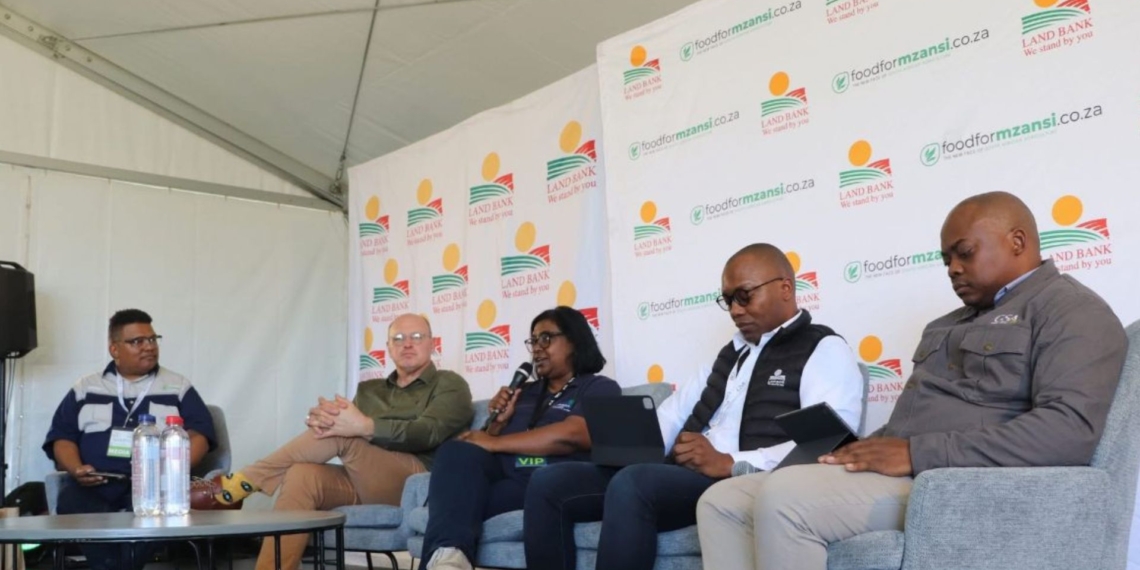
Agricultural leaders at Nampo Harvest Day 2026 say stronger development finance, partnerships, and long-term farmer support are essential to improve food security and grow South Africa’s agricultural sector.
Acting Land Bank CEO Jabu Mphambo said leading the institution during its recovery phase carries both pressure and opportunity.
“Leading the bank is an immense responsibility, but at the same time a great privilege,” he said.
Mphambo explained that the bank has continued implementing its turnaround strategy following the 2020 default. “My approach has been to combine urgency in execution while building confidence. Turnaround is not an event, it’s a process.”
He said Land Bank has improved significantly in recent years, although challenges remain. “We are in a far better position than we were in 2020, but there is still work to be done.”
According to Mphambo, Land Bank increased blended finance disbursements by 70% in the past financial year, reaching about R1 billion in loans and around R1.72 billion when grants were included.
He also addressed recent reports about the bank’s funding position, saying engagement with the National Treasury is already underway ahead of debt obligations due in 2028.
“Some of the headlines can be misleading, but the fact is that we have started engaging with our shareholder, National Treasury, in anticipation of unlocking funding to continue supporting the sector,” Mphambo said.
Related stories
- Innovation drives resilience at Nampo Harvest Day 2026
- Land Bank back on track, boosting support for farmers
- Blended finance: Closing the gap for Africa’s smallholder farmers
- Land Bank unlocks growth, tackles financing gaps at Nampo
Preparing farmers to become bankable
Leona Archary, CEO of the Agricultural Development Agency (Agda), said one of the sector’s biggest gaps is preparing farmers to become finance-ready.
“The big role we have been trying to play is to facilitate an ecosystem model that brings together various players in the sector,” she said.
Archary noted that farmers often struggle to access funding because they are not adequately prepared for financing requirements.
“We keep saying a bank cannot finance us, whether it’s Land Bank or a commercial bank, but the issue is the readiness of the farmer to become banked.”
She said Agda works with Land Bank to help farmers improve compliance, prepare documentation, and access pre- and post-settlement support. “How do we take them through that preparatory phase, get all the documentation in order, get compliance in order, and provide the support that enables the bank to come in and finance that farmer?”
Farmer support that goes beyond funding
Sibusiso Mabuza, CEO of Phahama Grain Phakama (PGP), said his experience working in development economics, banking, and entrepreneurship has shaped the way he approaches farmer development.
“I’ve been an entrepreneur, and I’ve also failed. I think all these lessons frame my way of thinking,” he said.
Mabuza said PGP focuses on supporting farmers from subsistence level through to commercialisation, with a strong emphasis on food security, mentorship, and long-term sustainability.
“Our focus is that we’re a development organisation supporting farmers from subsistence farming all the way to potential commercial farmers.”
He explained that the organisation works closely with smallholder farmers through mentorship, training, and financial support programmes aimed at strengthening rural economies and improving food security.
During the 2025/26 season, the organisation contributed about R90 million towards supporting more than 2 000 smallholder farmers. Mabuza said one of the biggest challenges remains the low participation of black farmers in grain production, which currently accounts for less than 10% of total grain production.
Development finance critical for food security
Although funding opportunities are available, Mabuza explained that many farmers remain hesitant to access finance, prompting PGP to expand its support model to include pre-investment assistance such as business plans, financial modelling, profitability assessments, mentorship, and restructuring support for struggling farmers.
Mabuza said the organisation takes a holistic and long-term approach to farmer development, focusing not only on funding but also on pre- and post-investment support and training. “We take a long-term view when supporting farmers.”
Johan Kotzé said South Africa cannot achieve long-term food security without a strong agricultural development model. “The best people to help with food security are farmers,” he said. Kotzé rejected the idea that small-scale farmers do not contribute meaningfully to the food system.
“One misnomer is that small-scale farming does not contribute to food security. That is rubbish. The food system goes from small to large producers.”
Kotzé said development finance institutions, such as Land Bank, play a role that commercial banks cannot fulfil alone. “You cannot mitigate the risks of people entering a very risky business without having a development bank.”
He also stressed the importance of gradually transitioning farmers into commercial agriculture. “You cannot bring new entrants into agriculture without a development concept where you mature people into the commercial space.”
READ NEXT: Farmers embrace smarter strategies for sustainable growth