The recent African Agri Investment Indaba (AAII) signalled a decisive shift in how Africa’s food security challenge is being approached. Rather than focusing on isolated innovations, discussions converged on a clear message: the future of African agriculture lies in integrating technologies into intelligent, connected systems that build resilience, profitability and long-term sustainability.
The AAII demonstrated how drones, circular economy models, smart storage and trade infrastructure can function as interlinked components of a single agricultural ecosystem. The emphasis moved away from what individual technologies can achieve in isolation, towards the compounded impact created when they operate together across the value chain.
Gerrit van Rensburg of SkyFarmers opened the discussion by illustrating how modern drone technology has evolved beyond crop spraying. He highlighted the role of drones in generating precise, actionable data that informs critical on-farm decisions, from input placement to timing of interventions.
Strengthening regenerative practices
Building on this data-driven approach, Gerald Nel of Grüner and FARA presented the Integrated Bio-Circular Networks Africa (IBNA) model. By using yield forecasts and harvest residue data, agricultural waste is redirected into bioenergy and organic fertiliser production rather than being discarded.
These outputs then feed back into farms and processing facilities, reducing input costs and improving energy security while closing nutrient loops.
Related stories
- Precision spraying: Drones lift farming to new heights
- Drone spraying cuts costs, boosts yields for KZN sugarcane co-op
- Agbiz outlines outlook for grain and fruit industries
- Seed technology: How innovation drives higher yields & success
Sabrina Basson of EmitiQ expanded the conversation to environmental outcomes, demonstrating how regenerative practices supported by precision data and circular systems enable farmers to participate in carbon markets.
Improved soil health and carbon sequestration become measurable and tradable assets, providing an additional income stream while reinforcing sustainable land management practices.
Protecting production through smart storage
High-tech production, however, delivers limited benefit if post-harvest losses remain unchecked. Marco Sutter of Bühler highlighted the scale of the challenge, noting that close to 30% of Africa’s grain is lost after harvest.
He emphasised the role of smart silo technology in monitoring spoilage and mycotoxins, ensuring that gains achieved in the field are protected through storage and reach the market in saleable condition.
Roble Sabrie of the Food and Agricultural Organisation (FAO) placed these advanced production systems within a broader economic context, stressing the importance of efficient trade infrastructure.
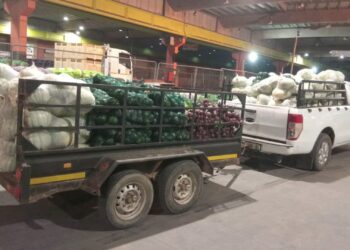
He pointed to strategic routes such as the Lobito Corridor, which connect productive agricultural regions to domestic and international markets.
“Corridors are the circulatory system, moving healthy produce from robust agricultural hearts to hungry markets. This systems-based approach represents a fundamental redesign of African agriculture, offering the potential for greater profitability, resilience and self-sufficiency at scale,” he said.
READ NEXT: Lerato’s legacy: Black sheep becomes broiler queen