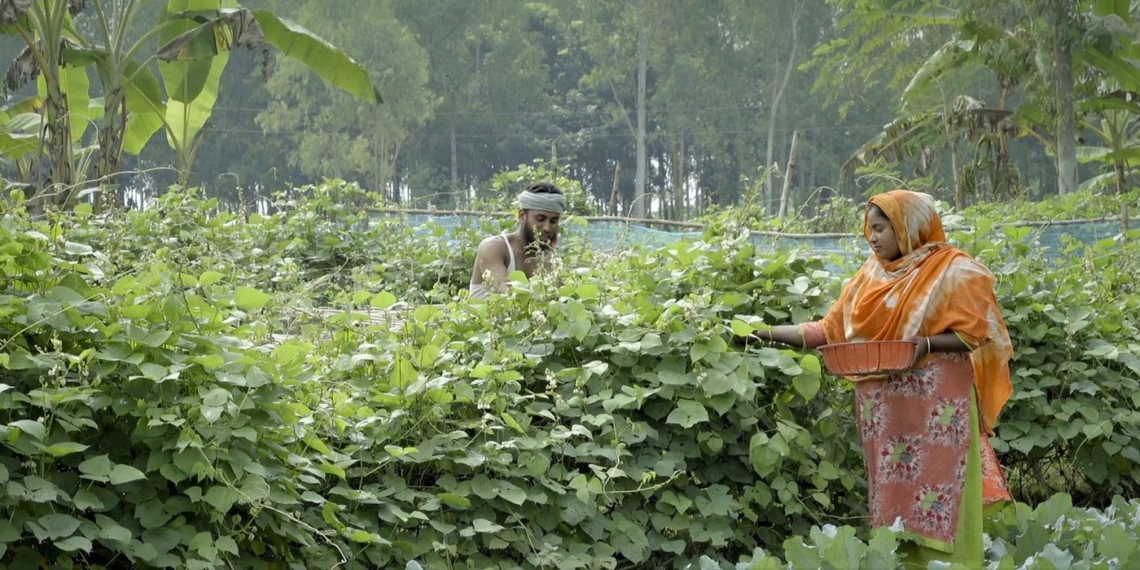
Today, 28-year-old Nasreen is a successful businesswoman. From her home in rural Bangladesh, she runs a thriving ecological farm – one that supports the local ecosystem and uses no chemical fertilisers or pesticides. Her chemical-free vegetables reach customers in urban areas, thanks to the e-platforms she’s active on.
And as a participant in the IFAD-supported PACE project, she is part of a bigger initiative rethinking and transforming gender roles throughout the country.
But Nasreen wasn’t always able to be so self-reliant.
Just three years ago, Nasreen’s family was like many others. Her husband was the only earner in the household, and his wages as a day labourer weren’t quite enough to live on.
They had a small household garden that Nasreen tended by herself. To try to make ends meet, she sold her surplus vegetables at the local market, but it never brought in much money. They were struggling to provide for their two daughters, and like too many other women in rural Bangladesh, Nasreen’s work went unpaid and unrecognised outside her family.
Access to the right resources
That began to change in 2019. Some acquaintances in her neighbourhood had gotten involved with the Palli Karma Sahayak Foundation (PKSF), a long-standing partner of the International Fund for Agricultural Development (IFAD) and a leading provider of micro-credit loans to women entrepreneurs.
Through this contact, Nasreen learned more about the PACE project, an initiative helping rural households across Bangladesh set up and maintain their own agricultural businesses.
The subproject in her area focused on “safe” vegetables – those that are especially well suited to the region’s growing conditions and beneficial to the local environment – ensuring that even the most vulnerable households have a way to participate and earn a reliable source of income.
For Nasreen, it seemed like the perfect opportunity to expand her home garden into a full-fledged business. Moreover, many other PACE participants in her area had taken up ecological farming – an agricultural practice designed to enhance and sustain the local ecosystem instead of disrupting it – and that appealed to her, too.
Of course, she needed a loan and some supplies to get started, so she turned to the PKSF. As an implementing partner of the PACE project, the PKSF’s financial services are coupled with support in the form of trainings and technical assistance to help entrepreneurs start up a business, increase their productivity and access new markets.
Nasreen got her start with a loan of $300 and a series of trainings on everything from the basics of ecological farming, to how to reach customers beyond her neighbourhood, to how to manage a loan. The loan enabled her to start producing on a commercial scale, and the trainings gave her the skills she needed to build her enterprise.
A wobbly start
It wasn’t easy at first. She had no experience in being a full-time farmer, and like many other ecological farmers, she struggled to keep up her pace of production with those using conventional methods such as genetically modified seeds or chemical fertilisers. But by the end of her first year, she’d already made $3 000.
Today, she produces an incredible variety of vegetables throughout the year – gourds of all kinds, onions, radish greens, hyacinth beans and string beans, cauliflower, tomatoes, potatoes, chillies – and sells them at both her local market and the district market. She’s also active on an e-commerce platform that allows her produce to reach customers as far away as the capital city of Dhaka.
The ecological farming techniques she practices are sustaining her family and community and restoring the local ecosystem.
Because she grows a diverse variety of crops and uses natural manure and fertiliser, she’s restoring soil fertility with every crop cycle. She uses only organic pest control methods, too, further allowing her to avoid the use of chemicals. And because she’s able to harvest year-round, there’s a constant supply of nutritious food for her family.
She still contends with challenges in her day-to-day running of the business. Conventional-style farmers will always be able to produce greater quantities than her at lower costs, meaning the struggle to keep up will never quite disappear. Many consumers aren’t aware of the benefits of ecological farming or aren’t interested in purchasing chemical-free vegetables, so it’s sometimes difficult for her to get a fair price.
The Covid-19 pandemic has affected her business, too: The lockdown prevented the opening of a collection and grading centre that would have helped her earn higher prices for her produce through its evaluation services, and therefore would likely have opened up new markets to her as well.
Doing well despite the challenges
Despite these difficulties, she and her family are doing well. With the profits she earns, she’s been able to send her elder daughter to a local government-run school (her other daughter is still too young to attend).
Her business is so profitable that her husband no longer works as a labourer and has begun helping Nasreen in the fields instead.
She’s now able to fully participate in making household decisions, too. In the future, she hopes to expand her farm and to continue investing in her children’s education, and to save enough to build a house. For now, though, she’s content in the knowledge that she’s already creating better opportunities for her family. Importantly, her hard work is being recognised – and she’s starting to notice her success inspiring others, too.
“As I am the one who is guaranteeing a sustainable livelihood for my family, I see people around me acknowledging me and valuing my opinions,” she says. “I love to see that my relatives and neighbours are also getting interested in taking the risk of starting businesses of their own.”
This article was originally published by the International Fund for Agriculture Development (IFAD).
ALSO READ: Regenerative farming turns soil into spunges
Sign up for Mzansi Today: Your daily take on the news and happenings from the agriculture value chain.