Fairtrade International has announced that it has suspended the certification of a South African producer following serious allegations of its farmworkers living in poor conditions.
This comes days after Drakenstein Municipality hosted the first-ever International Fair Trade Towns Conference in Africa from 20 to 22 September. During the conference in Paarl last week, dozens of farmworkers supported by Women on Farms members picketed outside, expressing their frustration over poor wages and living conditions for workers on farms.
Unfair working conditions
Fairtrade-certified farms are meant to uphold international standards for fair working conditions. Some of these are that workers’ pay must be at least the minimum wage, that the right to collective bargaining is upheld, and that there is adequate housing.
Farmers and producers who are certified can usually export their goods at a higher price. The premium paid on Fairtrade-certified products is to be kept in a separate account and used to improve the conditions of workers and farmers.
While Fairtrade has been tight-lipped on revealing the name of the suspended local producer, the body told GroundUp that this was not the first time this producer had been found to be non-compliant.
“In 2022, when allegations of serious non-compliance in labour and living conditions for workers at Fairtrade-certified vineyards in South Africa were made, Fairtrade acted immediately and treated them with the urgency and seriousness they deserved,” Fairtrade told GroundUp.
Related stories
- Pesticides: CropLife SA calls for responsible use
- Proper disposal of pesticide waste vital for farmers
The body then conducted “a rights-based assessment and report on egregious violations to the appropriate national protection agency for further assessment and follow-up based on relevant and applicable law”.
After the allegations surfaced, Flocert, Fairtrade’s independent certifier, conducted its own audits that led to the suspension of the local producer until July 2023. As of September 2024, this producer was suspended again, Fairtrade said.
Fairtrade also referenced a study done by Women on Farms last year which also highlighted serious violations by certified producers and farmers in the wine industry. “We continued to act accordingly even though the specific names of farms and the associated allegations were not shared with Fairtrade,” the body said.
In 2023, Women on Farms published The Labour and Living Conditions of Workers on Fairtrade Certified Wine Farms in the Cape Winelands District Municipality, South Africa. It found that 31% of surveyed workers earn below the National Minimum Wage of R27.58. And most of the participants did not consider their earnings to be a living wage.
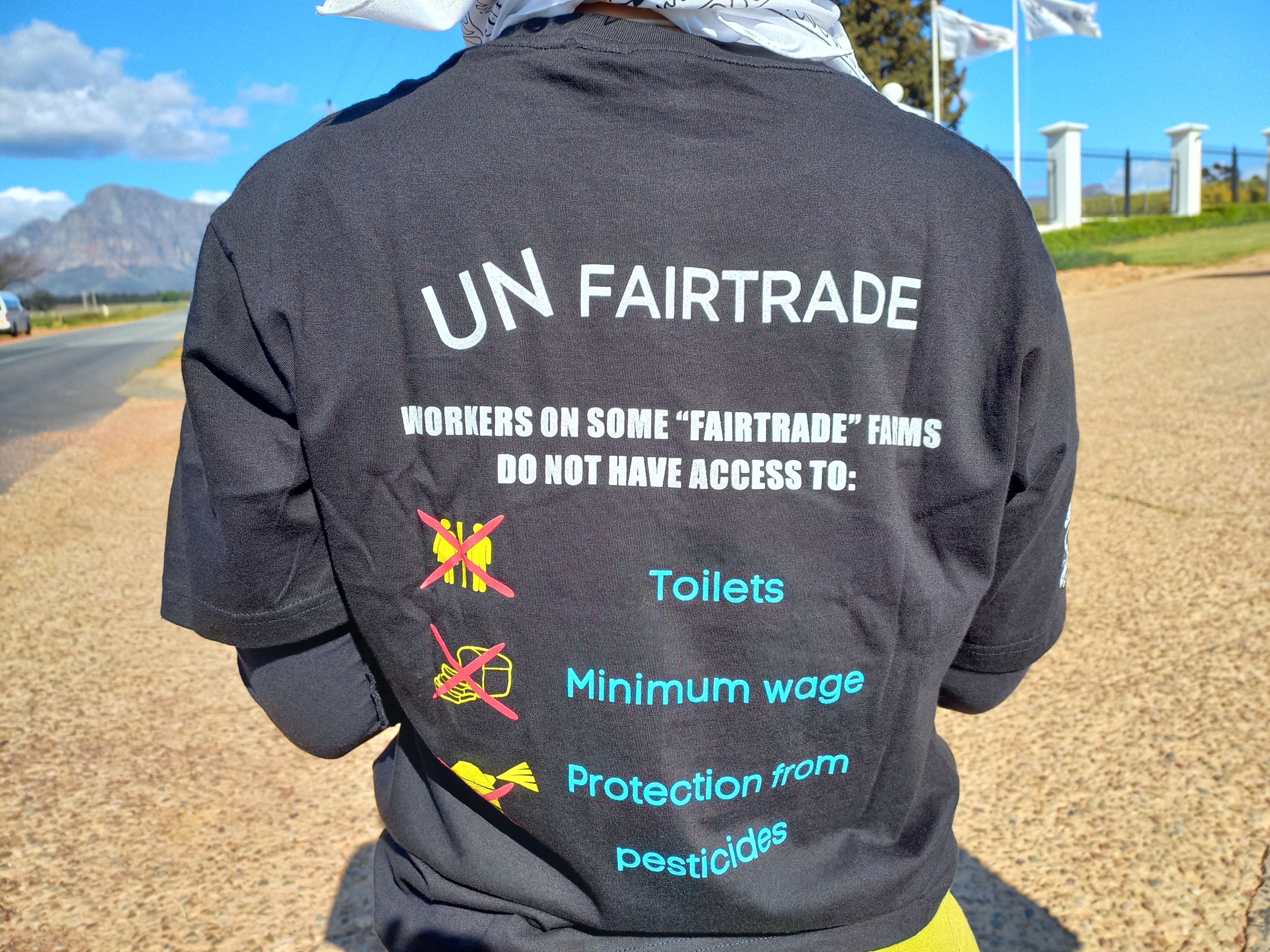
Women on Farms is calling for Fairtrade to impose harsher repercussions for certified farms and producers found to be non-compliant. Photos: Marecia Damons/GroundUp
Health risks
Compiled by researcher Celeste Fortuin, the study surveyed 50 women across 18 Fairtrade-certified farms and found that:
- 54% of women reported exposure to pesticides.
- 35% of women lacked toilet facilities at their work sites.
- 15% of women did not have access to safe drinking water.
These are “not reflected in the audits conducted by Flocert … because of inherent flaws in the auditing process and because of a culture of secrecy and intimidation on many Fairtrade-certified farms,” WFP stated.
The report also revealed that 73% of the women surveyed did not know how to report a Fairtrade violation, while 10% felt too intimidated to do so.
Denile Samuel, labour rights coordinator at Women on Farms, said: “Hopefully, we’ll be able to influence better policies and better policing of the Fairtrade standards. Hopefully, this will also be the start of getting Fairtrade-certified workers to speak out.”
In response to the issues raised by Women on Farms, Fairtrade said it had taken several measures over the past year-and-a-half to improve conditions for workers, including educating workers on available channels to report violations, and establishing the Precarious Work Committee to focus on issues faced by temporary and seasonal workers.
“Fairtrade Africa is exploring opportunities to lobby for better wages for workers. Two roundtable discussions were held with producers, workers, trade unions, and government,” the body said.
Fairtrade said that workers who deal with chemicals like pesticides are trained on how to safely handle chemicals and spraying equipment. They are given protective equipment and shown how to identify health issues.
“Fairtrade alone cannot solve all of the deeply entrenched challenges for women agricultural workers,” the organisation said. It urged all supply chain actors to work together to address challenges in South Africa’s wine sector.
This story was first published by GroundUp.
READ NEXT: Break down the silos in agriculture, urges Phosa at Agda AGM
Sign up for Mzansi Today: Your daily take on the news and happenings from the agriculture value chain