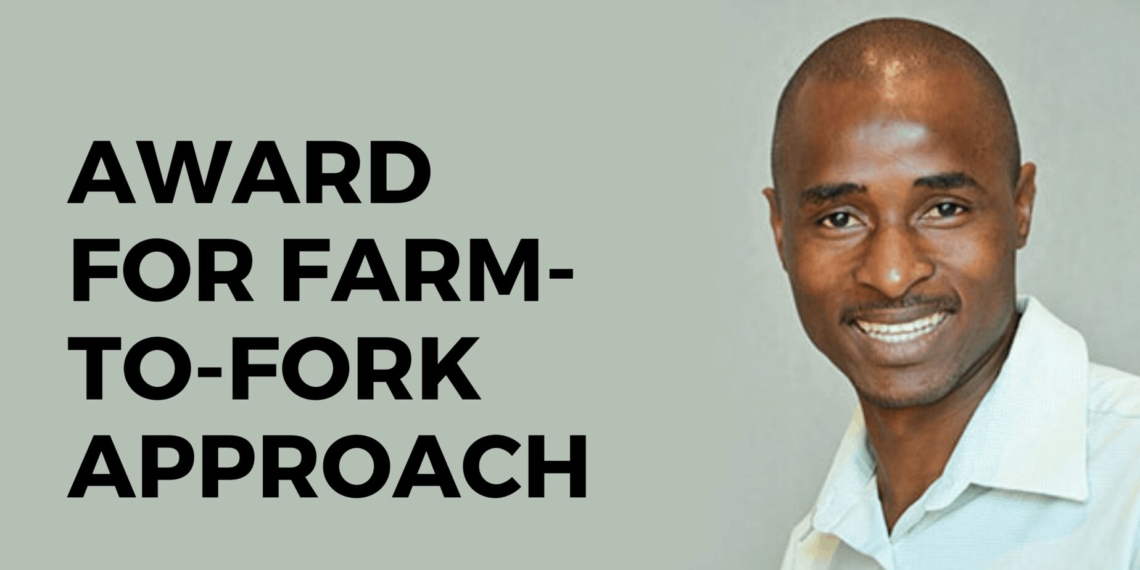
 A Western Cape meat scientist, Dr Cletos Mapiye of the department of animal sciences at Stellenbosch University, is one of three scientists from Africa honoured with a 2020 Young African Researchers Award for the authenticity and quality of their scientific research.
Mapiye was commended for his research work in the field of agriculture and food sciences. Awards were also made in the fields of health and pharmaceutical sciences, and water, energy and environmental sciences.
He is currently the interim SARChI Chair in Meat Science: Genomics to Nutriomics in the department of animal sciences, and a team member of the Sustainable Agriculture and Food Security research program at Stellenbosch University.
7-year history as Stellenbosch academic
Mapiye has been working as an academic at Stellenbosch University since 2013, where he teaches Meat Science to undergraduates, and Sustainable Animal Production to postgraduates. He has since supervised 7 PhD and 9 MSc graduates and published over 100 articles in international refereed journals.
Previously, he completed a postdoctoral fellowship at Agriculture & Agri-Food Canada (AAFC) at the Lacombe Research and Development Centre in Canada, and lectured at the University of Rwanda, and the Bindura University of Science Education in Zimbabwe. He started his career in 2003 as a research officer at the Grasslands Research Station of the Department of Research and Specialist Services in Zimbabwe.
Mapiye hails from Zimbabwe, where he grew up in the rural area of Mhondoro and learnt first-hand how to tend chickens, goats, and cattle from his father, who is a smallholder farmer. It is because of these roots, says Mapiye, that he finds such satisfaction in working with especially smallholder farmers, and seeing how his efforts help them to farm livestock better.

He completed a BSc Agriculture with Honours in Animal Science (2002) and an MSc in Animal Sciences (2004) from the University of Zimbabwe. It was here were his paths first crossed with Prof Kennedy Dzama, who is now a distinguished professor in Animal Science at SU. He piqued his interest in Animal Science, and would later become his PhD supervisor at the University of Fort Hare in the Eastern Cape from which he graduated in 2010.
His efforts towards research, development and capacity building to improve sustainability of food and agricultural systems, food security and poverty reduction in the developing world, was first recognised in 2017 through a Young Scientist Prize: Agriculture and Food Security from The World Academy of Sciences (TWAS) Regional Office for sub-Saharan Africa.
“My research programme focuses on finding new strategies to enhance sustainability of meat production and consumption,” he explains. “This covers different livestock production systems, ranging from commercial through to small-scale and complex subsistence systems.”
He is especially interested in how changes to the diets of livestock plays out in the fatty acid composition of their meat, and ultimately benefits the health of people who consume it. “It is all about improving the performance of animals and the quality of their meat through the use of different types of feed,” he explains his interest in animal nutrition and meat science.
A model by one of DR CLETOS Mapiye’s research groups serves as a decision-making tool for development agents and policymakers in Southern Africa.
He is currently supervising a project that is running on the Welgevallen Experimental farm of the SU Faculty of AgriSciences that is ascertaining the water requirements of indigenous South African sheep breeds such as Damara, Pedi, Namaqua and Black-headed sheep. Funding obtained from the Water Research Commission is making this research possible.
Experimenting with hemp seedcakes
Mapiye and his students are also experimenting with hemp seedcakes to see if such by-products have value as an alternative feed source and meat preservative. This project is part of an initiative by the SARChI in Meat Science, funded by the Department of Science and Technology and administered by the National Research Foundation.
In recent years he has also been involved in projects that looked into the value of using fruit-based diets (such as grape pomace and citrus pulp) as an alternative feed source for sheep and cattle, and whether they can extend the shelf life of meat. “The project was started in 2015, and was inspired by the droughts we were experiencing, in an effort to help especially farmers in the Western Cape secure alternative feed options,” he explains.
His research group recently developed a system dynamics model to evaluate the sustainability of a low-input ruminant meat production system. The model currently serves as a decision-making tool for development agents and policymakers in Southern Africa.
“My work on the use of plant by-products rich in phytochemicals as livestock feed supplements and natural preservatives of meat has been widely adopted in Southern Africa. For example, some local farmers, feedlots and feed companies have adopted plant by-products as cheaper feed supplements and meat preservatives.”