Wednesday, October 21, 2026
SUBSCRIBE
22 GLOBAL MEDIA AWARDS
Food For Mzansi
  • News
  • Changemakers
  • Lifestyle
  • Farmer’s Inside Track
  • Food for Thought
No Result
View All Result
  • News
  • Changemakers
  • Lifestyle
  • Farmer’s Inside Track
  • Food for Thought
No Result
View All Result
Food For Mzansi
No Result
View All Result
in Movers and Shakers

Fish farmer believes tilapia is the protein of the future

by Sinesipho Tom
29th October 2020
32-year-old Thomas Keet, director of Zini Fish Farm. Photo: Supplied

32-year-old Thomas Keet, director of Zini Fish Farm. Photo: Supplied

Share on FacebookShare on TwitterShare on WhatsApp

Waking up to feed and supervise a school of Mozambique tilapia that could fill up 26 rugby fields is what 32-year-old Thomas Keet, director of Zini Fish Farm, does every day.

The Cape Town born fish farmer’s mission is to ensure that our local supermarkets are supplied with an affordable source of protein. He believes that aquaculture, and specifically the tilapia, has a crucial part to play in our food security going forward.

Keet not only ensures that there is sufficient feed for the fish. He also manages a team of three while he simultaneously monitors the water quality and liaises with Eskom to ensure that there is going to be power to keep their earthen fishponds running for that day.

“Managing Eskom has become a job in itself these days,” he chuckles.

READ MORE: SA’s tilapia fish farmers swimming upstream against cheap imports

“We consume quite a bit of power, pumping water and aerating ponds, cooling and heating things. So, when the power goes out – which it does a lot in this country – I have got a big backup generator to keep things going,” he explains.

Tilapia is a traditionally freshwater fish found in shallow streams, dams, rivers and lakes. Tilapia has been an important source of food and income for small-scale farmers across Africa for centuries.. Photo: Supplied

Although Zini Fish farm specialises in the Mozambique tilapia or blue kurper they also farm with rare fish like dusky kob, spotted grunter, Natal stumpnose, malabar rockcod and mud crab. The 44.75-hectare fish farm is in Mtunzini, up the north coast of KwaZulu-Natal, about an hour and 20 minutes north of Durban and about 30km south of Richards Bay.

Keet says his journey to aquaculture was undesigned. As a lover of science and the outdoors he was not enticed by the BCom finance degree he completed at Stellenbosch University in 2008. Although he completed some holiday work as a commerce intern following his graduation, he wanted to pursue a career in science.

“I have always been science orientated and of course aquaculture was the course they offered in the animal science department at Stellenbosch. So I did a BSc in animal sciences specialising in aquaculture.”

He then completed a Masters in Fisheries Sciences at Rhodes University’s Ichthyology department in Makana, formerly known as Grahamstown. “That’s how I sort of landed up here in Mtunzini,” he says, “I came up here to do my research for my master’s thesis.”

Zini Fish Farms is 44.75 hectares big and comprises of 26 hectares of ponds. The primary product is saltwater tilapia popularly known as Mozambique tilapia or blue kurper in South Africa. Photo: Supplied

When he arrived on the farm as a researcher in 2012 the farm was called Mtunzini Fish Farm and it was under different management. In 2016 the company was taken over by the Zini Fish Farm management and that’s when he was appointed as one of the directors.

“This farm is quite old. It was a prawn farm initially and it was built in the late 80’s and the early 90’s. That operation came to a halt in the early 2000’s and it laid fallow for a few years. Then a new person took over and they started developing it as a fish farm,” he says.

As a director he specialises as a hatchery technician where he monitors the hatching larvae. “The first couple of days the little fish are quite delicate, and they are quite tricky to rear. It requires quite a lot of equipment and expertise to grow enough fish on the farm and to get it right on a big enough scale.”

Keet says since the tilapia industry is undermarketed and there is not a lot of support in the industry, he has to wear many hats throughout the day to put the tilapia industry on the map.

Keet specialises as a hatchery technician where he monitors the hatching of larvae. He says the first couple of days the little fish are quite delicate, and they are quite tricky to rear. Photo: Supplied

“I have to be quite adaptable and be able to do many different things because it is not a well-defined, well-serviced facet of the agricultural industry yet. But in the same vein it is also what I enjoy the most about it because you are able to do all kind of different things as opposed to having a very specific job.

“I get a bit scared of having to do a monotonous job where I have to do the same thing every single day,” he says.

Zini Fish Farm is South Africa’s largest pond-based aquaculture farm and its warm climate and access to sea and estuary water is well-suited to grow the Mozambique tilapia.

“The Mozambique tilapia performs better in our farming environment, even though most people grow some tilapia fish like the Nile tilapia in fresh water,” he says.

Keet explains the Mozambique tilapia evolved in saltwater. Rearing these fish in a saltwater environment results in lower stress and cortisol levels.

“Another benefit is that fresh water is quite a scarce commodity not only in South Africa but in the world. We are not limited by needing fresh water. We just use estuary water which is in abundance here in South Africa.”

Thomas Keet says fresh water is quite a scarce commodity not only in South Africa but in the world. At Zini they are not limited by needing fresh water as they use salt water to rear their tilapia. Photo: Supplied

The farm supplies most of their fish to supermarkets in Durban and in rural local areas in northern KZN, Empangeni, Richards Bay and Esikhawini.

“There are a lot of people living in the rural areas of northern KZN and people don’t realise the size of the informal market, because there is very little information available on it. That is why I am focusing on selling in that informal rural market,” he says.

Aquaculture a key to food production

Keet says since the tilapia industry is undermarketed and there is not a lot of support in the industry, he has to wear many hats throughout the day to put the tilapia industry on the map. Photo: Supplied

The Rondebosch High School matriculant believes that aquaculture is a crucial part of our food production system going forward. However, it is underdeveloped specifically in South Africa. He believes that it is imperative that we start focusing on developing an industry that produces more than abalone, trout, oysters, and the small amount of tilapia farming we have.

“I want be involved in some projects that aspire to achieve a meaningful aquaculture industry in South Africa. I don’t need to be the one leading. But I would like to be involved trying to achieve that goal,” he says.

ALSO READ: Global recognition for ‘Gutted’, the story of Kalk Bay fishers
Sinesipho Tom

Sinesipho Tom is an audience engagement journalist at Food for Mzansi. Before joining the team, she worked in financial and business news at Media24. She has an appetite for news reporting and has written articles for Business Insider, Fin24 and Parent 24. If you could describe Sinesipho in a sentence you would say that she is a small-town girl with big, big dreams.

Tags: Cape TownDurbanEskomKwa-Zulu NatalRhodes UniversityRichards BayStellenbosch UniversityThomas KeetZini Fish Farm
This week’s agri events: 19 – 23 October
News

This week’s agri events: 19 – 23 October

by Tiisetso Manoko
19th October 2026

There is a lot happening in the final months of 2026! Get all the information on the Villiersdorp Show, livestock...

Read moreDetails

Stop the rot: Four steps to slash post-harvest losses

18th October 2026
A standing ovation for agriculture’s incredible talent! The Agri’s Got Talent 2026 top three celebrate their achievements: winner Honey Katoo of Endulini Fruit in Patensie, alongside runner-up Clareece Vlotman of Wolfpack in Wolseley and finalist Lwandile Nantsi of Laastedrift in Ceres. Photo: Supplied/Food For Mzansi

Patensie claims Agri’s Got Talent crown for second year running

17th October 2026
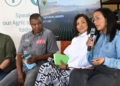
The panellists at FNB Business’s “Farming together” discussion at the Royal Show explored how market access, mentorship, financial discipline and strong commercial relationships can help farmers build sustainable businesses. Featured from the left are Bertram July (FNB’s distribution sales lead), commercial farmer Shakes Shabalala; Sandy Gumede (co-founder of Zulu Girl Wines), and Janis Robson (FNB’s head of development and SME business development). Photo: Food For Mzansi

FNB puts relationships at the heart of commercial farming

17th October 2026
Agri Skills Transfer students gain hands-on experience at the institution’s Cullinan Farm Training Centre, where agricultural theory meets the realities of commercial production. Photo: Supplied/Food For Mzansi

Build your future in agriculture with Agri Skills Transfer

17th October 2026

How animal welfare and human rights shape food security

Laastedrift Agri leads with BigBucks Gala success

Build your future in agriculture with Agri Skills Transfer

CPAs urged to register for free governance support toolkits

Farmers urged to tap into recycled human waste as fertiliser

Join Food For Mzansi's WhatsApp channel for the latest updates!

JOIN NOW!
Next Post

RECIPE: Spooky cake truffles

THE NEW FACE OF SOUTH AFRICAN AGRICULTURE

With 21 global awards in the first six years of its existence, Food For Mzansi is much more than an agriculture publication. It is a movement, unashamedly saluting the unsung heroes of South African agriculture. We believe in the power of agriculture to promote nation building and social cohesion by telling stories that are often overlooked by broader society.

CPAs urged to register for free governance support toolkits

Potatoes and tomatoes plunge while avocado prices soar

Becoming bankable: How to get your farm ready for finance

Fixing SA’s agricultural visa system to protect seasonal harvests

SA and Namibia reevaluate livestock trade after FMD outbreak

Agda conference to tackle finance, market access and agri growth

  • Awards & Global Impact
  • Our Story
  • Contact Us
  • Cookie Policy
  • Privacy Policy
  • Copyright

Contact us
Office: +27 21 879 1824
News: info@foodformzansi.co.za
Advertising: sales@foodformzansi.co.za

Contact us
Office: +27 21 879 1824
News: info@foodformzansi.co.za
Advertising: sales@foodformzansi.co.za

  • Awards & Global Impact
  • Our Story
  • Contact Us
  • Cookie Policy
  • Privacy Policy
  • Copyright

Chat Options

About this assistant

This feature generates automated answers summarised from Food For Mzansi articles. By using it, you are interacting with an AI system (provided by Google), not a human. AI can make mistakes. Please refer to the source articles for verification and citation purposes.

Our staff do not check or moderate Lerato’s answers in advance, but may review some later. Our journalists continue to write and edit all the articles Lerato uses as sources.

To estimate unique and returning web users, we store a random browser ID in this browser. WhatsApp users are counted by phone number. The same person using both channels may be counted twice.

I'm Lerato, your AI assistant!
No Result
View All Result
  • News
  • Changemakers
  • Lifestyle
  • Farmer’s Inside Track
  • Food for Thought

Copyright © 2026 Food for Mzansi