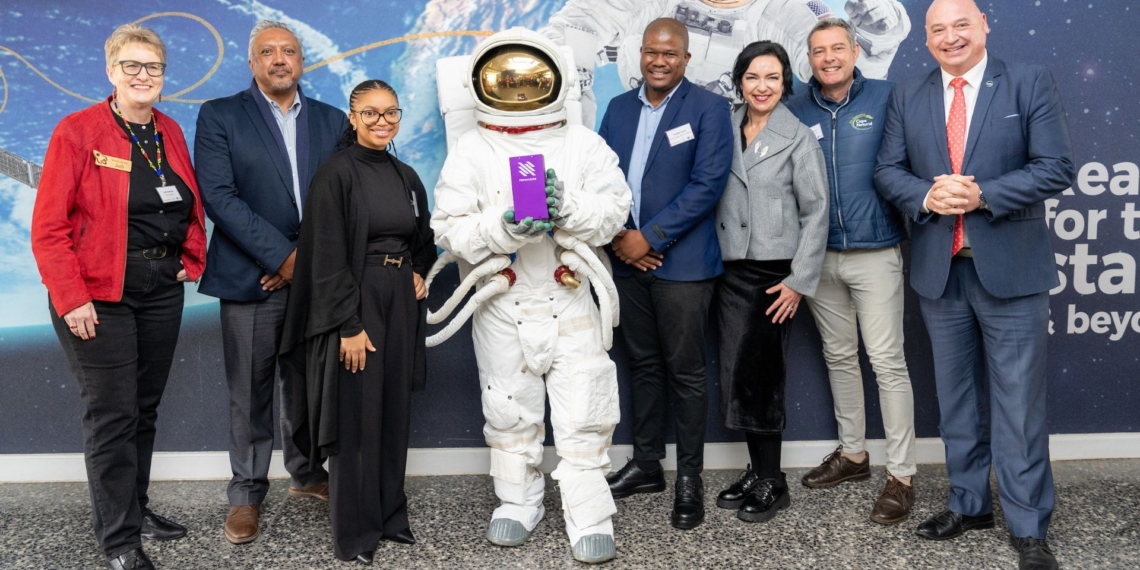
South Africa’s indigenous rooibos is heading to the International Space Station this October in a pioneering space project. According to the South African Rooibos Council (SARC), the initiative will expose local seeds to microgravity and space radiation to explore off-Earth living systems.
Upon their return, learners from Parklands College and seven Cederberg schools in the Western Cape will plant them alongside control seeds to analyse germination, growth, and yield.
The groundbreaking experiment ultimately aims to solve crucial agricultural cultivation challenges on Earth while driving youth interest in cutting-edge space science.
Igniting STEM curiosity through space research
According to SARC director Dawie de Villiers, the council is expanding its traditional focus on local health research to explore how microgravity and cosmic radiation impact the crop.
He explained that these learners will act as active project collaborators, tracking the seeds’ growth and resilience side-by-side with Earth-bound control crops. The project aims to solve ongoing commercial cultivation and yield challenges for local farmers, while driving youth interest in science, technology, engineering, and mathematics (STEM).
“We hope that a fuse is lit among our young learners to dive deeper into science, technology, engineering, and mathematics,” De Villiers said.

Speaking at the launch, Dr Kelebogile Gasealahwe, a South African Radio Astronomy Observatory (SARAO) postdoctoral fellow at the University of Cape Town (UCT), urged learners to draw inspiration from the crop’s journey.
“To be rooted in the depth of the land and soar high into the sky, all the way into space, is a message I would like you all to keep close to your hearts,” Gasealahwe said.
Reflecting on her own journey from Kimberley to becoming an astronomer, Gasealahwe emphasised that South Africa’s world-class facilities, such as the MeerKAT radio telescope, prove the country is a global leader in science.
She encouraged the students to pursue careers in STEM and use the rooibos experiment to expand their personal ambitions.
“The seeds are going to space, but the seeds of inspiration we hope to grow in each of you today will help expand your imagination,” Gasealahwe added, urging learners to remain unique and true to their identities while launching their own dreams.
Related stories
- Zero-tariff breakthrough sparks new era for SA’s rooibos industry
- Rooibos industry targets global growth while protecting local roots
- Rooibos industry holds its ground amid climate uncertainty
- New study unlocks rooibos power for fish farming
Bridging classrooms and the cosmos
The South African National Space Agency (Sansa) has thrown its scientific weight behind the project to boost local skills development and innovation.
Thandile Vuntu, head of Sansa’s science engagement unit in Hermanus, said the initiative creates essential opportunities for young people entering STEM fields.
“Space science is becoming more integrated into areas that affect daily life, from communications to environmental monitoring,” Vuntu said.
“Initiatives such as this highlight the importance of collaboration between industry, government, academia and the science sector in building a strong pipeline of future scientists, engineers and researchers.”

Delivering this scientific curriculum directly to the classrooms is MaxIQ Space, which has structured an extended STEM education programme introducing learners to space science, plant biology, and sustainable agriculture.
Judi Sandrock of MaxIQ Space said the initiative aims to strengthen access to authentic scientific learning experiences.
“The value of this project lies in giving learners exposure to real research processes linked to space science,” Sandrock said. “It provides a structured opportunity to develop scientific thinking, data analysis skills and an understanding of how experimentation works in practice.”
To broaden national participation, learners across South Africa are also being invited to design the official Rooibos in Space mission patch during July and August, extending the project’s reach beyond the core participating schools.
How opportunities can change lives
The Western Cape education department deputy director-general for curriculum and assessment management, Bertram Loriston, urged young people to seize every opportunity.
Reflecting on his own journey, Loriston recalled working at CERN in Geneva, where scientific experiments and data management broadened his horizons. Despite the challenges of that scientific path, he ultimately chose teaching to inspire curiosity in young people, and praised teachers for exposing learners to opportunities that open doors beyond the classroom.

His message to the students was simple and emphatic: “When opportunity knocks, you must be dancing. Seize it.”
Putting that advice into practice is Chloe Coetzee, a grade 10 learner from Clanwilliam Secondary School, who said the initiative has already taught her how curiosity can unlock major career and academic opportunities.
For Coetzee, sending a local South African plant into space is a proud milestone that will help earn the country’s scientific research global recognition.


READ NEXT: The Karoo’s quiet lesson on trust and truth