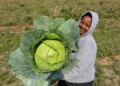
When Venessa Simelane took over her family’s backyard vegetable patch in Mpumalanga, she wasn’t looking to start a business. She was simply keeping a piece of her mother’s legacy alive.
Supported by a life-changing infrastructure investment from her neighbour, CM Mills, she has transformed from a backyard grower into a commercial force producing up to 1 500 broilers per cycle.
Simelane grew up in Chrissiesmeer, Mpumalanga, a beautiful region known as the Place of the Rising Sun. Being raised around a family of small-scale farmers meant that her connection to agriculture was formed at an early age, sparking a curiosity that grew alongside her.
Even as she focused on her academics, first completing her primary education at Laerskool Chrissie and later matriculating from Netherland Park Secondary School in 2017, that deep-rooted love for the land never left her.
Following her matriculation, Simelane found herself navigating a period of unemployment, not knowing that the quiet daily routines at home were actually preparing her for her future career.
Related stories
- Flying solo: FS farmer beats hurdles to scale poultry enterprise
- Simangele turns school lease into retail-supplying agribusiness
- Limpopo youth grows grain business from social grant savings
- Self-taught EC farmer builds 6-hectare agribusiness from scratch
Keeping a mother’s legacy alive
The true foundation of her business journey began in 2019, when her mother, Babsie Simelane, passed away.
Her mother had always kept a dedicated backyard vegetable garden, planting spinach, carrots, potatoes, lettuce, and tomatoes for the family’s consumption. Following her loss, Simelane took full responsibility for keeping her mother’s garden alive.
It quickly became a vital financial lifesaver during her time without work. Most of what she ate came directly from the backyard, which helped save precious household money.
Over time, this daily responsibility transformed into a commercial opportunity through a simple, firm boundary. Whenever neighbours stopped by to ask for tomatoes or other vegetables from the garden for free, Simelane told them that she was selling the produce instead.

“Deciding to grow vegetables not only for home use but also to sell was one of the best decisions I have ever made.
“Every meal requires at least one or two vegetables, which means there is always a demand for fresh produce. Growing vegetables has allowed me to support my household, generate income, and contribute to providing healthy food to my community,” Simelane says.
The spark for poultry production
While she continued to run her home vegetable garden, a new opportunity arose shortly after the Covid-19 pandemic.
In 2021, her growing passion for agriculture led her to join a development programme that allowed her to attend the Buhle Farmers’ Academy, where she received specialised training in broiler production.
The development programme provided her with crucial initial momentum by supporting her with her first 100 day-old chicks and enough feed for a full production cycle. “It was during this training that I discovered my true calling and decided to pursue poultry farming as a career,” she recalls.
Operating from the same backyard where her garden grew, Simelane successfully raised the birds for six weeks and sold them directly to her local community.

She continued running this combined backyard poultry and vegetable setup, slowly building her customer base, until 2024, when she took the major step of formalising her venture by registering the business as Avesanda Poultry Farm.
The turning point and the power of a neighbour
By 2025, the backyard operation had officially outgrown its space.
Simelane took a calculated business risk and secured a lease on a 4.4-hectare farm to expand both her poultry and crop production. However, the new land lacked the necessary commercial infrastructure, which threatened to halt her progress.
This bottleneck was cleared through an extraordinary relationship with her new neighbour, CM Mills, located directly opposite her farm.
Recognising her work ethic and determination, the neighbouring business stepped in with a massive capital investment to accelerate the growth of Avesanda Poultry Farm.
Instead of offering a standard loan, the neighbour completely renovated the infrastructure on the property. They installed perimeter fencing, fitted specialised curtains in the poultry houses, supplied drinkers and feeders, provided professional slaughtering equipment, and ensured the farm had proper access to water and electricity.
To ensure she could use the new facilities immediately, the neighbour also funded her initial production cycles. They purchased her first batch of 200 day-old chicks along with feed for the entire cycle, and later funded a second batch of 400 day-old chicks with a full cycle of feed.
“This support gave me the opportunity to expand my production, strengthen my operations, and build the foundation for the growth that Avesanda Poultry Farm is experiencing today,” Simelane says.
“I remain deeply grateful for their belief in my vision and their commitment to supporting emerging farmers.”
Scaling up to commercial status
With the infrastructure challenges solved by her neighbour’s intervention, Simelane’s daily management has driven massive operational growth.
Today, Avesanda Poultry Farm has scaled up from its 100-chick backyard origins to producing between 1 200 and 1 500 broilers per production cycle. More importantly, she has secured a consistent commercial market to supply 1 200 slaughtered chickens every single week.

The 4.4-hectare property has also allowed her to expand the vegetable business she took over from her mother. On top of her original crops, Simelane now grows green peppers, chillies, and butternut for the market.
The growing enterprise supports the local economy by employing two permanent staff members, including Simelane herself, and two part-time workers.
“One of my proudest achievements is the growth of my business… This reflects my determination, hard work, and commitment to building a sustainable agricultural business,” Simelane says.
Mitigating risks on the road to integration
However, operating at this scale comes with significant risks that Simelane must manage tightly to keep the business sustainable. Her biggest hurdle is rising feed costs, which account for 65% to 75% of poultry production expenses.
To protect her profit margins, she purchases feed in bulk, works with neighbouring farmers to negotiate better prices, and vets suppliers to ensure consistent quality.
Biosecurity is another daily priority due to the threat of highly pathogenic avian influenza. Simelane maintains strict farm hygiene by using disinfectant footbaths and sanitising all vehicles and equipment entering the farm.
This careful attention to detail is paying off, as every milestone reached brings her closer to fulfilling her ultimate family goal.
“My family is motivated by what I’m currently doing, and they are happy and proud. I know and believe that in the family, I’ll be the first commercial farmer.”
For aspiring agricultural entrepreneurs, Simelane stresses that business discipline must always come first.
She advises young producers to treat farming as a business rather than just a passion, to start small with what they have, and to gain practical experience on an established farm before venturing out on their own.
“Starting a farming business is rewarding, but it requires commitment, discipline, and sound business management,” she concludes.
READ NEXT: Flying solo: FS farmer beats hurdles to scale poultry enterprise