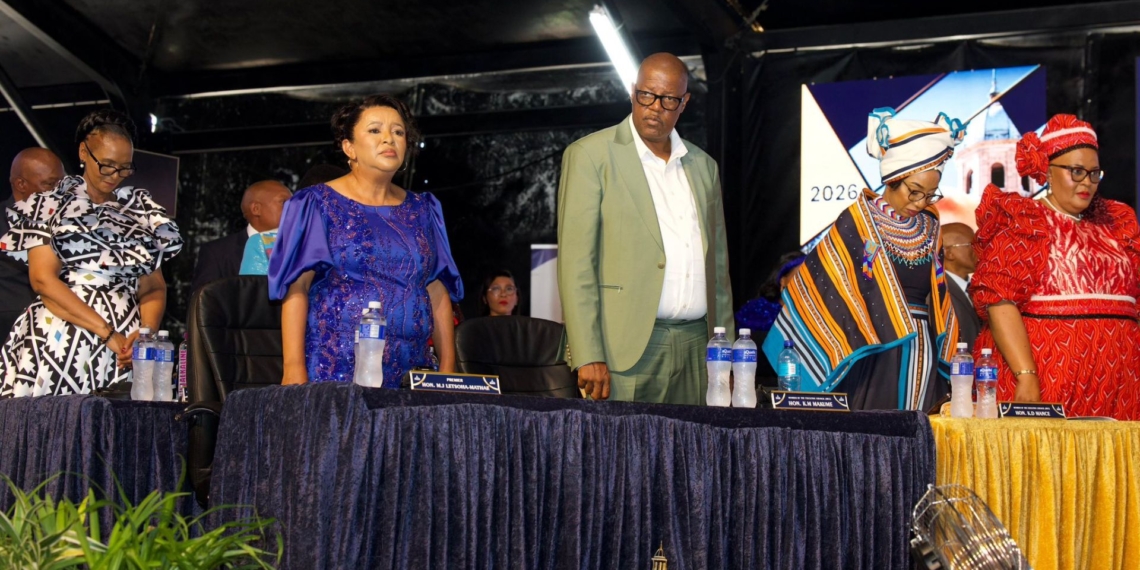
Free State premier MaQueen Letsoha-Mathae said the foot-and-mouth disease (FMD) outbreak in the province presents extraordinary challenges to livestock farmers.
In her State of the Province Address, Mathae said her administration will support the integrated national FMD control, eradication, risk-based vaccination, and comprehensive surveillance, movement control strategy.
“This 10-year strategy will serve as roadmap for South Africa to obtain FMD-free status from the World Organisation of Animal Health. We welcome the successful production of locally manufactured vaccines by the Agricultural Research Council after almost two decades.
“As vaccine availability improves over the next few weeks, the Free State government shall work with all stakeholders, including the provincial house of traditional leaders, to continue the fight against FMD.”
MaQueen Letsoha-Mathae
The premier said they are revitalising, growing and diversifying the agricultural sector, affirming the role of women and youth farmers.
“Financial support for women beneficiaries has increased to 34% and, even more significant, financial support to youth farmers increased from less than 5% to 31% of our Comprehensive Agricultural Support Programme conditional grant funding envelope,” she noted.
Related stories
- Relief at last: 1 million FMD vaccines touch down in Mzansi
- Strong biosecurity, vaccination urged as FMD threatens exports
- Free State farmers pay the price for broken roads, broken promises
- Communal grazing worsens FMD outbreak in Free State
Growing food security in FS communities
“Our support will meet the 50% and 40% respective thresholds in the 2026/2027 financial year. Food security is a matter of national priority. Growing and producing food is about ending poverty, creating economic opportunities, strengthening communities and ensuring our national resilience.
“We are rejuvenating our food security initiatives, from backyard to community food gardens, including establishing and supporting vegetable gardens at schools and early childhood development (ECDs) centres whilst linking food security projects to informal and formal markets,” she said.
Mathae said the effects of climate change are felt in the agriculture sector and almost every other aspect of daily life. “In this regard, we are pleased to announce that the transfer of the environmental affairs function to the department of agriculture has been finalised with the proclamation amending Schedule 2 of the Public Service Act, 1994, on 10 July 2025.
“Moving forward, we will integrate environmental sustainability with rural development and food security. Both agriculture and environmental affairs must be part of the key economic drivers in the Free State,” she said.
Curbing illicit trade is key in Gauteng
Meanwhile, Gauteng premier Panyaza Lesufi said the province faces the most severe and prolonged FMD outbreak in recent history, which began in April 2025 following the illegal movement of infected cattle into the province.
“By January 2026, 195 confirmed cases affecting 261 000 cattle had been recorded, with the likelihood of under-reporting. In response, the provincial government has implemented a coordinated intergovernmental strategy, including strict livestock movement controls, quarantine 27 and vaccination measures, intensified roadblocks to curb illegal transport, and a unified communication campaign.
“To date, 286 000 cattle have been vaccinated, with additional doses secured, while farmers are urged to strengthen biosecurity and cooperate fully with veterinary authorities to contain and end the outbreak,” he said.
Regarding the tobacco industry, Lesufi said the government must deal with the illicit trade that continues to cripple the economy.
“Recently, British American Tobacco (BAT) announced its intention to completely close its manufacturing plant in Heidelberg, placing livelihoods at risk. The company attributes its decision largely to the persistent growth of the illicit cigarette trade in the country, which has significantly eroded its market share and revenues.
“Together with the police, we are intensifying the protection of our manufacturing and retail sectors. Already, we have confiscated counterfeit goods valued at R250.2 million last year,” he said.
READ NEXT: Rooibos industry holds its ground amid climate uncertainty