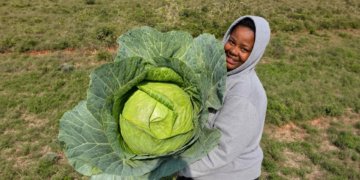
What began as a helping hand in the family business has blossomed into a thriving agribusiness led by a tech-savvy visionary rooted in Limpopo. In this episode of the Farmer Mentor series, fruit farmer Khuliso Madima shares how she runs her “Garden of Eden” with purpose.
In the fertile heart of Thohoyandou, Limpopo, where her ancestors once toiled, fruit farmer Khuliso Madima is growing litchies and mangoes on 124 hectares, reaching consumers across South Africa.
“This place is the Garden of Eden,” she says with a smile, her voice full of affection. “I get to have the best fruits, the juiciest fruits that are top quality.”
Once a corporate project manager at MTN, Madima’s path to farming was unexpected but perhaps inevitable.
Rembander Agribusiness, a long family legacy established in 2004, was passed from her father to her mother. And when Covid-19 brought the world to a standstill, it became Madima’s turn to step in.
“It was just a matter of me helping out in the family business, and then there I was. I was in, and I fell in love.”
However, Madima is not just in; she’s innovating. With a background in business information systems and experience in managing large-scale ICT projects, she is seamlessly merging her tech expertise with her work in agriculture.
Timing harvests for peak demand
The farm grows 52 hectares of Mauritius Lychee trees and 46 hectares of Mango trees cultivars being Kent, Sensation, Peach and Tommy Atkins.
“To plan our production cycles for litchis and mangoes, we carefully consider both the seasonality of each cultivar and the market demand for these fruits. For litchis, our Mauritius cultivars typically start their season from mid-November to mid-December. The harvest for litchis usually spans about three full weeks, ensuring that we meet the high demand customers have for this fruit during this period,” Madima explains.
As for mangoes, the harvest is organised according to the specific cultivars and their respective seasons. In October, Madiama focuses on harvesting the Sensation mangoes, which are primarily used to produce atchaar.
“Between November and December, we harvest Tommy Atkins and Peach mangoes, as these varieties are in high demand during this period. Finally, Kent mangoes are harvested between February and March,” she says.
By aligning the harvest schedules with the peak seasons of each cultivar, they are able to meet market demand while ensuring the fruits are harvested at their optimal quality. This strategy also helps Madima maintain a steady supply of mangoes throughout the year, catering to different customer preferences at various times.
Turning connections into contracts
Her innovative and strategic approach is not limited to the farm gate but extends into the marketplace, where she’s forging strong relationships and expanding her reach.
Madima has built relationships with several of South Africa’s major fresh produce markets – from City Deep in Johannesburg and Pretoria to Tzaneen and Polokwane.
Trucks arrive from KwaZulu-Natal, drawn by her farm’s reputation for quality and her direct pricing. Her fruits even feed into the export supply chain, reflecting the high standards she maintains.
Madima credits her ability to navigate markets and build networks to her willingness to show up and learn.
“Attending Subtrop events, they always have these gatherings… and then you get to know who is doing what. You approach them and market what you are doing. Also, the extension officers – they give advice. Where to go, who to contact. That has really helped.”
Related stories
No stranger to overcoming obstacles
Her former corporate life wasn’t far removed from transformation and development. At MTN, she led projects bringing technology to schools, particularly for children with disabilities. “We would go out to schools and transform them with IT, getting them assistive devices,” she recalls. “It was a very big thing.”
That same drive to improve lives through systems and support now fuels her mission on the farm. However, her transition has not been without challenges, especially in an industry as seasonal and capital-intensive as fruit farming.
“When you have so much fruit and now you have to buy material to package the fruits and you find that you don’t have the finances… What happens now?” she asks.
“Then you resort to selling at the farm gate. The price will be lower, but it gets you to have finances, then to go and buy material. Then you start sending out to bigger markets which pay better.”
One of her toughest lessons came when she ambitiously ventured into organic farming. The idea was noble and true to her values, but the execution was financially draining.
“There’s a lot of cash injection, but for that money to come back, for the return on investment, it takes a long time,” she admits.
“I went big. So now there’s just a small portion, half a hectare, that I’m practising to go back to it… because ideally that’s what I would want.”
Fruit farmer looks to exports
Today, her farm is more than just mangoes and litchis. She’s added 25 hectares of cash crops – this year, sugar beans, red onion, Piquant’e peppers and soon, pepperdews – in partnership with another company. Her cash crops are rotated seasonally and its planted according to market demands, she explains.
This diversification is key to sustainability in an industry where earnings are seasonal but expenses are year-round.
“You have to plan how the money will sustain the farm for the whole year. Most of it is operational funds. It’s everyday, everyday money coming out.”
To keep all of this running smoothly, she leans heavily on her project management background. “You look at what is working for that time and what are the emergencies. At the end of the season, you look at what will be dealt with, what will be a priority, what will bring money – what will sustain us.”
Her vision is expansive. She dreams of a fully-fledged, multi-enterprise farm from aquaponics, vegetables, and bees among the litchi blossoms.
“The opportunities are there. I don’t want to only focus on one thing.”
“When my dad was still here, we grew avocados. He ran it so successfully that he was exporting to Spain and Germany. We stopped exporting by the time he passed on because we had to renew the export [licence].”
However, armed with renewed ambition and an export licence to match, she’s poised to bring her Garden of Eden to the world.
READ NEXT: Macadamia mission: Vumisa swaps engineering for farming roots
Sign up for Mzansi Today: Your daily take on the news and happenings from the agriculture value chain.