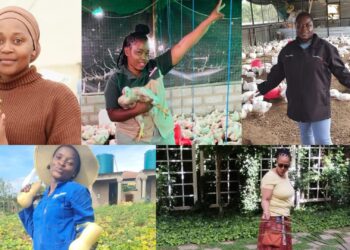
Lesego Mohube’s rise in commercial vegetable production wasn’t just about hard work; it was about collaboration and financial literacy. In this episode of Farmer Mentor, she shares how she transitioned from student life to mastering the Johannesburg Market.
What began as a search for direction for Lesego Mohube quickly became a clear path, taking her straight from student life at the Potchefstroom College of Agriculture into commercial vegetable production.
Today, Mohube is not only supplying one of South Africa’s largest fresh-produce markets but has also been recognised as the 2025 Student Sustainability Award winner at the South African Agricultural Awards, proving that bold decisions can fast-track a young farmer to success.
Before her third-year practicals, Mohube spent time working for Eastern Cape potato farmer Thulani Magida, an experience that sharpened her discipline.
“He showed me that you can have passion, but you will also need to work hard, and you start realising this is not a joke,” she shares.
Related stories
- Mzansi celebrates its brightest young farming talent
- Young Limpopo scientist unlocks peperboom’s healing power
- Closed doors: Young farmers still left out of agri power circles
- Early-bird tickets live for the 2026 Mzansi Young Farmers Indaba
Rising to the farming challenge
By the time she arrived in Johannesburg for her final-year placement, she was prepared for the challenge.
Within two months, she was managing her own tomato tunnel and soon after, ten additional tunnels for neighbouring farmers. She rotated crops, advised on chemical use and supported producers pursuing organic practices.
Her first tomato harvest went directly to the Johannesburg Market. Her next crop, green peppers grown with her partner, Bokang Monareng, sold out completely under the RSA Group.
“I didn’t think we would produce such beautiful, good-quality green peppers. When you take it to the market, it’s your produce competing against 56 other farmers. So being sold out was amazing.”
Supplying a major fresh-produce market requires strategy, something Mohube learned early.
Lessons to clinch your market
Mohube credits the RSA Group for strong communication between agents and producers, a factor she sees as essential.
According to her, three non-negotiables shape a farmer’s ability to secure and maintain a market in the fresh produce industry:
1. Build a relationship with your agent
“Your agent must know your brand. They must know your packaging. When you have that relationship, there is a sense of urgency. Remember, they also benefit; they take 7.5% or 10%,” she says.
2. Your packaging speaks before you do
“People look at packaging first, then size. Have a sticker with your business name, location and telephone number. It shows professionalism,” she shares.
3. Study the market before you plant
Mohube never plants without at least a month of careful analysis and planning. She also emphasises that financial literacy is essential for running a successful farming operation.
“I do production planning, budgeting, and estimated yields, and I look at the market app. I compare last year’s prices with the expected harvest period. You must understand the crop before you put it in the ground,” Mohube explains.
She cautions that planting merely because it aligns with the traditional season can erode profits. While most growers put tomatoes in the ground in January, those who wait until late February often earn higher returns in June and July when market supply is lower.
Advice for young farmers
Her business, Broederstroom Farms, is now preparing for expansion. Her 2026 vision includes entry into onion production.
She cautions that planting just because it’s the usual season can reduce profits. Most farmers plant tomatoes in January, but those who wait until late February often earn more in June and July when fewer tomatoes are available.
Despite the hurdles that come with farming, Mohube remains deeply committed to agriculture and wants other young people to see the sector differently.
Mohube encourages young farmers to move away from the isolation often associated with Gen Z, stressing that the sector depends on collaboration. She notes that farmers regularly rely on one another, especially in unexpected situations like labour shortages, and that asking for help should never be seen as a weakness.
“Don’t be an island. Communicate. Ask for assistance. Through people we actually learn,” she says.
Above all, she wants a future where farmers, especially young farmers, know their worth and grow with strategy, confidence and resilience.
“Do it because you have passion for it and you’re able to work hard for it. The sun will kill you. Your two-litre bottle will be done before 10am but if you love it, you’ll stay.”
READ NEXT: SA farmers reflect on 2025: From floods to favourable profits