South Africa’s agri sector is world-class, but some argue that young, black farmers are still locked out of power. As Youth Month draws to a close, agricultural economist Malapane Thamaga takes a closer look at the role of youth in agriculture.
The South African agricultural sector is one of the most organised sectors on the continent. Accordingly, it serves as a benchmark for most developing economies due to its competitiveness. This is attributed to decades of investment in developing commercial farmers in South Africa and the agrarian reform adopted in the late 1990s.
Consequently, decision-making on policy direction tends to be efficient, as does information flow from the farmer to the apex bodies and vice versa.
However, the dichotomous nature of the sector, characterised by highly commercialised white farmers and struggling new-era black farmers, makes such decision-making biased in favour of the former.
For instance, while commercial farmers are concerned about the diversification of international markets, the struggling emerging farmers are more concerned with access to production loans, obtaining quality seed to produce quality crops, the prospects and viability of going off-grid and its financial implications, access to land or the transfer of (Proactive Land Acquisition Strategy) PLAS farms to the beneficiaries of land reform, etc.
To add salt to the wound, advocacy and lobbying from these groups of farmers is lacking, if not entirely absent. This is mainly attributed to a lack of capacity due to limited financial resources and a lack of interest from young people within this category of farmers.
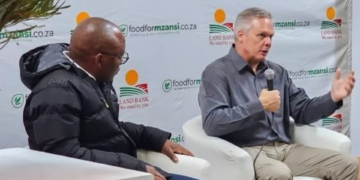
Through a number of conferences, including the Mzansi Young Farmers Indaba, where young farmers are afforded an opportunity to participate, it becomes clear that this cohort of farmers is clear about the path the agricultural sector should take.
Furthermore, it becomes evident that they have the skills and know-how to produce competitively if afforded the opportunity. However, the apparent lack of participation in decision-making structures keeps them at the periphery of the agricultural sector.
Young voices missing from the conversation
In 2022, the then minister of agriculture, land reform and rural development (DALRRD), along with her agricultural social partners, signed the Agriculture and Agro-processing Master Plan (AAMP), which serves as the framework for the planning and implementation of the economic reconstruction and recovery strategy.
The AAMP outlines two delivery models: the value chain round tables (VCRTs) and the production schemes.
VCRTs are platforms where stakeholders in specific agricultural value chains – such as fruits, wool, or grains – collaborate to address shared challenges and opportunities.
The production schemes are public-private transformation initiatives aimed at expanding production and market access for new-era farmers by unlocking underutilised resources and providing coordinated, practical support.
Since the signing of the AAMP, several commodity-specific VCRTs have been introduced along with commodity-specific production schemes.
Interrogating the working groups of these delivery models of the AAMP, it is evident that the young farmers who are generally vocal and provide leadership during conferences are nowhere to be found. Chances are that they are unaware of the existence of the AAMP or how to make their voices heard.
Several efforts have been made to amplify the voice of young people by establishing the Youth in Agriculture and Rural Development (Yard), a youth structure created as far back as 2007 to, among other goals, promote and improve the active participation of youth in the agricultural sector.
However, Yard has been used as a breeding ground for political gain, having been infiltrated by party politics, and now focuses less on agriculture.
There are, however, positive developments through the appointment of ministerial representatives in the agricultural industry trusts and levy administration structures, whereby a trend has emerged of qualified young farmers, academics and agricultural specialists being afforded the opportunity to serve.
This is attributed to the advice provided by the National Agricultural Marketing Council (NAMC) and the ministry of agriculture as the deciding body on these appointments.
Related stories
- 30 under 30: A toast to young changemakers in wine
- Tech & trade: Youth urged to redefine farming in Africa
Untapped resources
Another pocket of untapped opportunity lies in academia, where there is a wealth of young and vibrant minds that can be integrated into the agricultural sector by serving in a number of industry bodies.
Here, lessons can be learnt from the University of Pretoria, University of the Free State, and Stellenbosch University, as well as the Elsenburg Agricultural Training Institute and Grootfontein Agricultural Development Institute, where the integration between the agricultural industries and institutions of higher learning has yielded positive results.
Indeed, the new generation of academics programme has produced positive outcomes in attracting young patriotic South Africans into academia.
Lastly, it is important to note that serving in a leadership position is not cheap, nor does it yield instant benefits to those involved. However, it has been proven over time that when opportunities arise, those in leadership tend to benefit more due to their proximity to information.
The starting point will be for young farmers, agricultural professionals, and young academics to identify organisations that speak to their needs or areas they are passionate about, volunteer their services, and work their way into leadership.
The sooner there is integration of young academics serving in institutions such as the University of Venda, University of Fort Hare, Tshwane University of Technology, and Tompi Seleka Agricultural College with the agricultural industry, the better.
- Malapane Thamaga is an agricultural economist with the National Agricultural Marketing Council (NAMC). He writes in his personal capacity. The views and opinions expressed in this article are those of the author and do not necessarily reflect the views or positions of Food For Mzansi.
READ NEXT: Land reform needs real budgets, not just promises
Sign up for Mzansi Today: Your daily take on the news and happenings from the agriculture value chain.