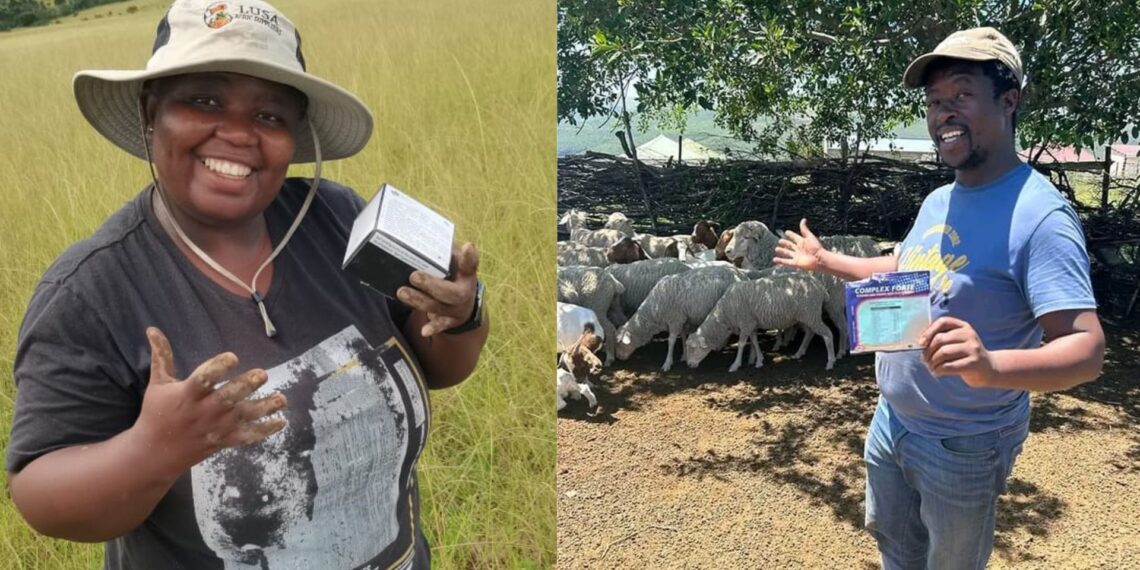
A community grows stronger when people care enough to act. That’s what happened when Lubabalo Bunu from Centane and Phelisa Ndayi from Dutywa in the Eastern Cape saw livestock suffering from ticks and decided to help local farmers find practical solutions.
The idea started with Bunu, who felt something needed to be done. Working together, they created Lusa Agric Supplies in 2021. Today, the business supports farmers through animal health products, training and agricultural consultation.
Ndayi is an agronomist, while Bunu has worked for some of the country’s leading banks.
An agribusiness is born
When they first noticed the worrying state of local livestock, Ndayi was a sales representative for Pannar Seeds in the Eastern Cape.
During farm visits across the province, Bunu often joined her. On one of these trips to kuGatyane, they saw cattle roaming freely along the road, heavily infested with ticks.
“We saw such beautiful cows, yet covered in ticks,” she says. “That is when we realised how urgently rural farmers needed accessible and reliable animal healthcare.”
Bunu studied accounting at Walter Sisulu University, while Ndayi completed her crop and soil sciences degree at the University of Fort Hare, followed by an honours and master’s degree from the University of KwaZulu-Natal.
After he was retrenched during the Covid pandemic, Bunu survived through small ventures, including a car wash, until he found stable ground again.
He grew up in a livestock-dependent community, which gave him natural experience in animal care.

The pair later opened a shop in Transido, Butterworth, selling animal health products, seed, agrochemicals and feed. When some products did not sell, they realised farmers needed direct support.
This led them to start home and farm visits, offering vaccines and bringing animal health services straight to rural households. Along the way, they received mentorship from Sivuyile Nqeto of Kyron Agric, with support from Zoetis and the department of agriculture.
Related stories
- Gogo’s herbal wisdom grows into Khula Hair Organics brand
- Dandelion: From backyard weed to profitable medicinal plant
- Keep track of livestock health with thermometers
- Umsenge tree: Nature’s pharmacy for health and livestock
Empowering farmers
Bunu tells Food For Mzansi that when livestock do not receive proper medical care, including vaccines, three major problems arise: disease outbreaks that could have been prevented; poor performance, including slow growth, low production, and weak fertility; and financial losses from treatment costs, deaths, and low-value animals.
“Another critical part of animal health is proper nutrition, which many communal and smallholder farmers often overlook.”
Lubabalo Bunu
Even with vaccines, animals that are poorly nourished have weak immunity, grow slowly, fail to conceive, and remain vulnerable to disease.
“Good health care and good nutrition must go hand in hand. Prevention is always cheaper and far more effective than treating sick animals later,” he says.
Caring for livestock & crops
Bunu explains that for a beginner, an animal health calendar is usually simple, seasonal, and consistent. It typically includes yearly or seasonal vaccinations before high-risk periods, deworming every three months or as advised by a veterinarian, regular dipping or spraying for ticks and external parasites, and a nutrition plan with supplements during winter or drought periods.
Currently, Lusa Agric Supplies focuses on animal vaccinations, block resting, and deworming.
“We sell livestock for farmers and to farmers, serving the entire province with a strong focus on the Transkei and Mnquma regions,” Bunu adds.
The business also has a crop care division, offering soil sampling, laboratory testing, and interpretation of results. They supply seeds, fertilisers, and agrochemicals. “Our team provides accurate technical advice to ensure healthy crops and good yields,” Bunu explains.
In addition, they offer consulting and business planning services, helping farmers and agribusinesses with enterprise planning, professional business plans, and guidance for funding or operational management.
Eye on the community
Bunu explains that with proper funding, they hope to establish a central hub where farmers can access all essential livestock services under one roof.
“We want to grow our livestock trading division into a recognised platform that helps farmers buy and sell quality livestock safely, fairly, and profitably across the province.”
Supporting farmers to improve yields and farm sustainably is one of their key future goals.
They are also exploring an online platform for selling different products tailored to various types of livestock. Currently, the business has two employees, but they plan to expand the team, creating more jobs and opportunities for the local community.
READ NEXT: Herbal heritage: Eastern Cape agripreneur boosts livestock health